Why the Cross?

Because of the Fall.
Christianity spoke again and said: “I have always maintained that men were naturally backsliders; that human virtue tended of its own nature to rust or to rot; I have always said that human beings as such go wrong, especially happy human beings, especially proud and prosperous human beings. This eternal revolution, this suspicion sustained through centuries, you (being a vague modern) call the doctrine of progress. If you were a philosopher you would call it, as I do, the doctrine of original sin. You may call it the cosmic advance as much as you like; I call it what it is—the Fall.” Chesterton Orthodoxy, 1909
Why did there have to be a Cross? Why did there have to be a Resurrection?
We are rebels, that is our problem.
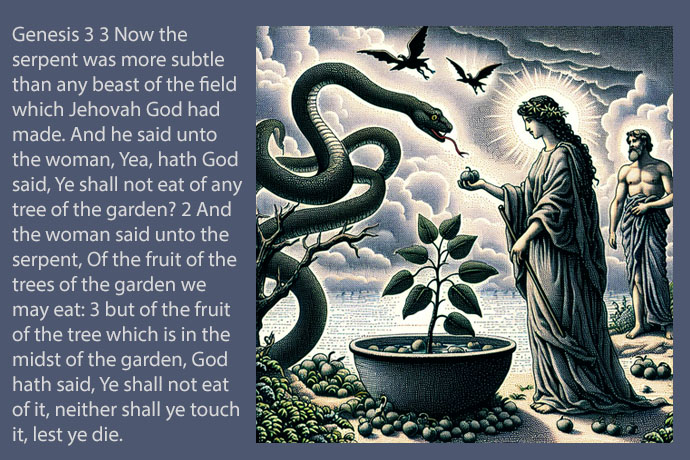
Genesis 3 3 Now the serpent was more subtle than any beast of the field which Jehovah God had made. And he said unto the woman, Yea, hath God said, Ye shall not eat of any tree of the garden? 2 And the woman said unto the serpent, Of the fruit of the trees of the garden we may eat: 3 but of the fruit of the tree which is in the midst of the garden, God hath said, Ye shall not eat of it, neither shall ye touch it, lest ye die. 4 And the serpent said unto the woman, Ye shall not surely die: 5 for God doth know that in the day ye eat thereof, then your eyes shall be opened, and ye shall be as God, knowing good and evil. 6 And when the woman saw that the tree was good for food, and that it was a delight to the eyes, and that the tree was to be desired to make one wise, she took of the fruit thereof, and did eat; and she gave also unto her husband with her, and he did eat. 7 And the eyes of them both were opened, and they knew that they were naked; and they sewed fig-leaves together, and made themselves aprons. 8 And they heard the voice of Jehovah God walking in the garden in the cool of the day: and the man and his wife hid themselves from the presence of Jehovah God amongst the trees of the garden.
We are rebels, that is the problem.
There is no chapter in all of Holy Scripture that is more broadly despised in the culture at large than this one. A talking snake and an angel with a sword flashing to keep people out of the garden. All those little line-diagram cartoons with a naked Adam and a naked Eve. Leaves and hair conveniently deployed to hide anything too personal, with a little snake twisting around in the background and an apple somewhere.
It’s all a bit of a joke, isn’t it. But, unless we come to grips with this chapter in the Bible, we’re not going to make much sense of the rest of the whole Bible. We’re not going to come to any agreement as to what the solution is if we can’t agree as to what the problem is.
Why a cross, and why a resurrection?
This chapter sets out the problem. If what human beings need above all else is better health, then may God give us doctors. If what human beings need above all else is more economic justice, then may God give us economists. If what human beings need above all else is better government, then God give us better politicians.
But, if what we need above all else is the forgiveness of our sin, if what we need above all else is reconciliation with the God who made us, then we need a Savior. None of the Bible makes sense without this chapter. That’s certainly what Paul thought. He can set up his understanding of who Jesus Christ is in terms of a kind of running contrast between Adam and Christ.
In Romans 5:18 So then, as through one trespass there is condemnation for everyone, so also through one righteous act there is justification leading to life for everyone. 19 For just as through one man’s disobedience the many were made sinners, so also through the one man’s obedience the many will be made righteous.
It’s very difficult to see how much will be left of what the New Testament says of Christ if we do not have a historic Adam and a historic fall.
The Mormon church teaches that the fall of Adam and Eve resulted in temporal death and mortality. But Mormons do not see the Fall as an unfortunate event. Rather, it was desirable and highly necessary. As it turns out, without the Fall no children would ever have been born
(2 Nephi 2:22–25).
But here arises a theological problem of great import, as Christianity is quick to point out: What of God’s commandment that Adam and Eve were not to partake of the forbidden fruit? Did not their disobedience constitute a sin in the eyes of the Lord? Mormons are not agreed on how to solve this dilemma. Some maintain that Adam had in fact sinned, but God used it for good (Brigham Young), while others argue that the Fall did not constitute a real sin (Joseph Smith Jr.). In either case, while mortality and physical death was brought on by the Fall, the virtue of its necessity prevents the Mormon church from maintaining that humankind inherited a fallen and sinful nature.
Why do we need a cross, a resurrection?
God had made all things and then said, “And it was good.” Then he made something, and he said, “And it was good.” Then he made something else and said, “It was good.” And when he finished making everything, he said, “And it was all very good,” because it was a way of saying God, and God alone, has the right to declare what is good. He made it. He knows what is good.
Now Adam and Eve are in a position where they’re listening to the voice of the Serpent saying, “Hah. God knows if you eat of this, then you become like God yourself, knowing good and evil.” The expression means determining good and evil. You make your own good. You define your good and evil yourself, You become like God.
All that’s saying is exactly what we do without putting it in quite so many words. It’s the very nature of idolatry. What Christians in every generation need to see is the horrific nature of such rebellion. God made us, and we owe him, He knows what is best. We are made in his image, but we are just creatures. The ugliness, the poisonous nature of sin, we scarcely see because we are in the same position as fish in water.
The first and greatest sin is not to love God with heart and soul and mind and strength. The first and greatest sin is not blasphemy, it’s not Sabbath breaking, it’s not war. The first and greatest sin is the de-Godding of God, the dethroning of God. That’s what Genesis 3 is about. It’s not whether or not you eat this fruit or that fruit. It’s not just the breaking of a rule, although it is the breaking of a rule, it’s something much deeper.
The Fall
Sin, in the first instance, from a Christian perspective, is not merely a list of dos and don’ts, not simply doing things we shouldn’t do and not doing things we ought to do, except in a very profound sense.
Sin, in the first instance, is displacing God from the center.
It is difficult to get across the notion of sin in a contemporary context. Sin has become a snicker word. When anybody mentions sin, people snicker. There’s no odium or heinousness attached to it, it’s just a snicker word. People don’t think of themselves as sinners.
From a Christian perspective, if in the beginning there was God and he made human beings in his image, his own image bearers, who were rightly related to him, so that when they woke up in the morning their thoughts drifted to him. Their desire was to please him. What they wanted more than anything was to praise him and honor him and please him.
Their every heart’s desire was to bring him pleasure and glory, and their inclination was toward him, because each thought that was the center of the universe, God himself; therefore, they were also rightly related to each other. But with the fall, each image bearer thought of himself or herself in the center of the universe.
Not physically, not geographically, but in terms of outlook and worldview, that’s the way it works. So when you wake up in the middle of the night and think, you don’t immediately gravitate to, “How can I glorify God this day?” but you look at the whole world in terms of how it relates to you. That is the heart of all sin. It’s profound self-centeredness.
system is at the center of the universe,” and there are other systems with other heroes, then you have all kinds of potential for struggle and race hatred and riots and war and mayhem.
If I am at the center of the universe, then what’s important in a family is that the family pleases me. If the family doesn’t please me, it can go jump in the creek. There you have the beginnings of breakdown and abuse and all these social, family ills that beset a society where everyone is bent on pleasing himself or herself. You take what’s not yours because the culture owes it to you somehow, and on and on and on.
Now from a biblical point of view, therefore, the heart of all that is odious to God, the heart of all that is heinous, the heart of all that is profoundly evil is decentering God. It is worshiping the created thing more than the Creator who is blessed forever, Paul says. In other words, that’s the big lie. The biggest lie of all is for that created thing to be not some other idol, some other lesser god, not the sun god or the god Moloch or one of the Baals, but me, my speech, the speech of my group, which doesn’t even have to be true speech, so long as it’s true for me.
Thus God, even if he/she/it does exist, has to be dethroned. In the very nature of the case, we have defined all language and reality that way. So, if there was a terrible hubris, pride self confidence, a terrible arrogance to modernism, and there is, it is characterized by the hubris of thinking that from our own finiteness, we could build up a system of knowledge that would find out all truth and eventually move to the point where it could dethrone God and replace him.
Now we have gotten to the place, where we deny there is any truth other than that which we make and define ourselves. It is the ultimate self-ism. Thus, from God’s point of view, although postmodernists look at Christians and think they’re extremely arrogant for saying other people are wrong, while they’re busy telling us we’re wrong for thinking so, yet from God’s point of view, this really is the extreme hubris.
God, if he/she/it exists, must then also serve me, because I’m at the center of the universe.
This God, then, can be accepted or rejected on the basis of whether or not I find him/her/it plausible. We start speaking of “The God I can believe in” or “The God I can’t believe in,” or we domesticate God, taking off the rough edges we find a bit uncomfortable.
Within that framework, the social pathologies begin to work out as well. If I am at the center of the universe and you think you’re the center of the universe, eventually we’re going to clash. If you have enough people in this little group over here thinking, “I’m at the center of the universe,” or “Somebody in our group or our race or our nation or our economic bracket or our