Where are we? How did we get here?

It is important to realize what a difference a people’s world view makes in their strength as they are exposed to the pressure of life.
There is a flow to history and culture. This flow is rooted in the thoughts of people. People are unique in the inner life of the mind, what they are in their thought world determines how they act. This is true of their value systems and it is true of their creativity. It is true of their corporate actions, such as political decisions, and it is true of their personal lives. The results of their thought world flow through their fingers or from their tongues into the external world.
It is true of Michelangelo’s chisel, and of a dictator’s sword.
People have presuppositions, and they will live more consistently on the basis of these presuppositions than even they themselves may realize. By presuppositions we mean the basic way an individual looks at life, his basic world view, the grid through which he sees the world.
Presuppositions rest upon that which a person considers to be the truth of what exists. People’s presuppositions lay a grid for all they bring forth into the external world. Their presuppositions also provide the basis for their values and therefore the basis for their decisions.
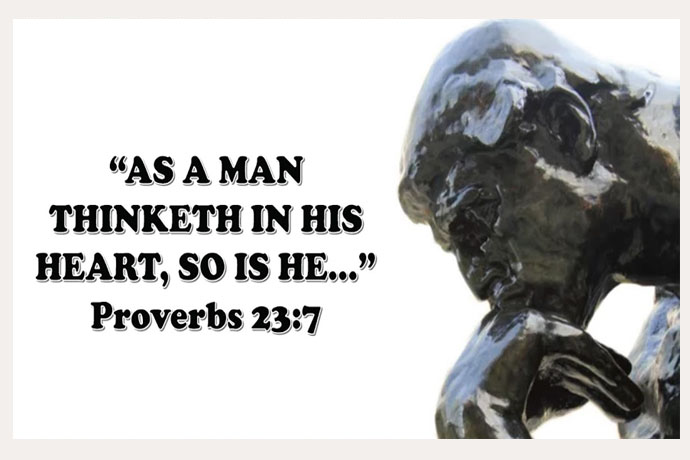
“As a man thinketh in his heart, so is he,” Proverbs 23:7 is really most profound.
An individual is not just the product of the forces around him. He has a mind, an inner world. Then, having thought, a person can bring forth actions into the external world and thus influence it.
Most people catch their presuppositions from their family and surrounding society the way a child catches measles. But people with more understanding realize that their presuppositions should be chosen after a careful consideration of what world view is true.
To understand where we are in today’s world, in our intellectual ideas and in our cultural and political lives, we must look three lines in history, the philosophic, the scientific, and the religious.
The philosophic seeks intellectual answers to the basic questions of life.
The scientific has two parts: first, the makeup of the physical universe and then the practical application of what it discovers in technology. The direction in which science will move is set by the philosophic world view of the scientists.
People’s religious views also determine the direction of their individual lives and of their society.
As we try to learn lessons about the primary dilemmas which we now face, by looking at the past and considering its flow, we could begin with the Greeks, or even before the Greeks. we will begin with the Romans (and with the Greek influence behind them), because Roman civilization is the direct ancestor of the modern Western world. Wherever Western civilization has gone, it has been marked by the Romans.
In many ways Rome was great, but it had no real answers to the basic problems that all humanity faces. The Greeks tried first to build their society upon the city-state, All values had meaning in reference to the polis. But the polis failed since it proved to be an insufficient base upon which to build a society.
The Greeks and later the Romans also tried to build society upon their gods. But these gods were not big enough because they were finite, limited.
The gods were amplified humanity, not divinity. Like the Greeks, the Romans had no infinite god. This being so, they had no sufficient reference point intellectually; they did not have anything big enough or permanent enough to which to relate either their thinking or their living.
Consequently, their value system was not strong enough to bear the strains of life, either individual or political.
It is important to realize what a difference a people’s world view makes in their strength as they are exposed to the pressure of life.
That is why the Christians who were able to resist religious mixtures, syncretism, and the effects of the weaknesses of Roman culture speaks of the strength of the Christian world view.
This strength rested on God’s being an infinite-personal God and his speaking in the Old Testament, in the life and teaching of Jesus Christ.
The Christians not only had knowledge about the universe and mankind that people cannot find out by themselves, but they had absolute, universal values by which to live and by which to judge the society and the political state in which they lived. And they had grounds for the basic dignity and value of the individual as unique in being made in the image of God.
A culture or an individual with a weak base can stand only when the pressure on it is not too great. Culture and the freedoms of people are fragile. Without a sufficient base, when such pressures come, only time is needed, and often not a great deal of time, before there is a collapse.
The Roman Empire was great in size and military strength. Not much could hold back the Roman legions, neither difficult terrain nor enemy armies.
Rome was cruel, and its cruelty can perhaps be best pictured by the events which took place in the arena in Rome itself. This was especially so after their growing rejection by the Jewish synagogues lost for them the immunity granted to the Jews since Julius Caesar’s time.
Why were the Christians killed in Rome?
No totalitarian authority nor authoritarian state can tolerate those who have an absolute by which to judge that state and its actions. The Christians had that absolute in God’s revelation. Because the Christians had an absolute, universal standard by which to judge not only personal morals but the state, they were counted as enemies of totalitarian Rome and were thrown to the beasts.
Rome did not fall because of external forces such as the invasion by the barbarians. Rome had no sufficient inward base; the barbarians only completed the breakdown, and Rome gradually became a ruin.
Rome in America
The Humanist Manifestos not only say that humanism is a religion, but the Supreme Court has declared it to be a religion. The 1961 case of Torcaso v. Watkins specifically defines secular humanism as a religion equivalent to theistic and other nontheistic religions.
The ruling of the Supreme Court in the Torcaso v. Watkins case in 1961 is instructive in another way. It shows that within the span of twenty-eight years the Supreme Court turned radically from a Christian memory to the humanistic consensus.
In 1933 in the United States v. Maclntoch case about conscientious objection, Justice Hughes stated in his dissent:The essence of religion is belief in a relation to God involving duties superior to those arising from any human relation.… One cannot speak of religious liberty, with proper appreciation of its essential and historical significance, without assuming the existence of a belief in supreme allegiance to the will of God.
The case Torcaso v. Watkins in 1961 takes the final step. Here, theistic religions, nontheistic religions, and pure materialistic humanism as a religion are all equated. And the change was complete in twenty-eight years from 1933 to 1961
The Abortion of the Human Race
Cultures can be judged in many ways, but eventually every nation in every age must be judged by this test: how did it treat people?
Each generation, each wave of humanity, evaluates its predecessors on this basis. The final measure of mankind’s humanity is how humanely people treat one another.
Those who regard individuals as expendable raw material, to be molded, exploited, and then discarded, do battle on many fronts with those who see each person as unique and special, worthwhile, and irreplaceable.
Yad Vashem is the monument in Jerusalem to the six million Jews and others who were killed in the Nazi Holocaust. It is one of the many memorials that are scattered over the world in tribute to those who have perished in upheavals of rampant evil, evil that swirls in on people when they no longer have a basis for regarding one another as wonderful creatures worthy of special care.
There are choices to be made in every age, and who we are depends on the choices we make.
What will our choices be?
What boundaries will we uphold to make it possible for people to say with certainty that moral atrocities are truly evil?
The way in which we ultimately decide them will determine the future for all of us.
As Mother Teresa has said, “If a mother can kill her own children, then what can be next?” Indeed, what can be next for all of us?
If we can take one life because it does not measure up to our standards of perfection, what is to stop us from taking any life, simply for our own convenience? Abortion and infanticide are only the beginning steps on a slippery slope that will lead to death for all but the planned and perfect members of our society.
The Thinkable and the Unthinkable.
There is a “thinkable” and an “unthinkable” in every era. One era is quite certain intellectually and emotionally about what is acceptable. Yet another era decides that these “certainties” are unacceptable and puts another set of values into practice. On a humanistic base, people drift along from generation to generation, and the morally unthinkable becomes the thinkable as the years move on. A “humanistic base” is the fundamental idea that men and women can begin from themselves and derive the standards by which to judge all matters.
There are for such people no fixed standards of behavior, no standards that cannot be eroded or replaced by what seems necessary, expedient, or even fashionable, no absolutes.
Perhaps the most striking and unusual feature of our moment of history is the speed with which eras change.
The young people of the seventies do not understand their older brothers and sisters of the sixties. What was unthinkable in the sixties is unthinkable no longer.
The unthinkables of the eighties and nineties certainly include things which most people today find completely fine. Most people today cant even remember why things supported today were unthinkable in the seventies. They will slide into each new thinkable without a jolt.
What we regard as thinkable and unthinkable about how we treat human life has changed drastically in the West. For centuries Western culture has regarded human life and the quality of the life of the individual as special. It has been common to speak of “the sanctity of human life.”
For instance, the Hippocratic Oath, which goes back more than 2,000 years, has traditionally been taken by the graduates of American medical schools at the time of their commencement. The Declaration of Geneva (adopted in September 1948 by the General Assembly of the World Medical Organization and modeled closely on the Hippocratic Oath) became used as the graduation oath by more and more medical schools.
It includes: “I will maintain the utmost respect for human life from the time of conception.”
The University of Pittsburgh changed from the Hippocratic Oath to the Declaration of Geneva in 1971, the students deleted “from the time of conception” from the clause beginning: “
This view did not come from nowhere. Biblical doctrine was preached not as a truth but as the truth. This teaching formed not only the religious base of society but the cultural, legal, and governmental bases as well.
As a total world-view it answered the major questions people have always asked. It dealt not only with the questions Who is God? What is He like? It also gave answers to the questions of Who are we as people? How ought we to live together? What meaning does human life have?
In this way, Judeo-Christianity formed a general cultural consensus. That is, it provided the basic moral and social values by which things were judged.
In a short time we have moved from a generally high view of life to a very low one.
Why has our society changed?
The answer is clear: the consensus of our society no longer rests on a Judeo-Christian base, but rather on a humanistic one. Humanism makes man “the measure of all things.” It puts man rather than God at the center of all things.
Today the view that man is a product of chance in an impersonal universe dominates both sides of the Iron Curtain. This has resulted in a secularized society and in a liberal theology in much of the church; that is, the Bible is set aside and humanism in some form (man starting from himself) is put in the Bible’s place.
Much of the church no longer holds that the Bible is God’s Word in all it teaches. It simply blends with the current thought-forms rather than being the “salt” that judges and preserves the life of its culture.
In our time, humanism has replaced Christianity as the consensus of the West. Having rejected God, humanistic scientists, philosophers and professors began to teach that only what can be mathematically measured is real and that all reality is like a machine. Man is only one part of the larger cosmic machine. Man is more complicated than the machines people make, but is still a machine, nevertheless.
Manipulation and the New Elite
As we consider the coming of an elite, an authoritarian state, to fill the vacuum left by the loss of Christian principles, we must not think naively of the models of Stalin and Hitler. We must think rather of a manipulative authoritarian government. Modern governments have forms of manipulation at their disposal which the world has never known before.
The ideas of sociological determinism, primarily involving conditioning (behaviorism), were widely discussed after B. F. Skinner (1971). His thesis was that all that people are can be explained by the way their environment has conditioned them. Since society plays a specially important role in that environment, society can and should use positive stimuli to bring about the society it wants.
Skinner’s utopia was a totally conditioned society. Skinner himself acknowledged that what is being abolished is man. He says, “To man we readily say good riddance.”
Skinner “Survival is the only value according to which a culture is eventually to be judged, and any practice that furthers survival has survival value by definition.”
The pressure toward the development of manipulative techniques comes through strongly in current biological research and development. We see this clearly in the outlook of Francis Crick (1916–), who received the 1962 Nobel Prize in Physiology and Medicine—along with James D. Watson and Maurice Wilkins—for breaking the DNA code.
Man no longer sees himself as qualitatively different from nonman. The Christian consensus gave a basis for people being unique, as made in the image of God, but this has largely been thrown away.
In the light of this discussion about social manipulation, three questions arise. First, who will control the controllers? Second, what will happen now that people have no boundary condition indicating what they should do in contrast to what they can do? Third, if mankind is only what modern people say it is, why does man’s biological continuation have value?
What of tomorrow?
In the United States, for example, a manipulating authoritarian government could come from the administrative side or from the legislative side. A public official in the United States serving at the highest level has wisely said, “Legislative dictatorship is no better than executive tyranny.” And one would have to add that with the concept of variable law and with the courts making law, it could come from the judicial side as well. The Supreme Court has the final voice in regard to both administrative and legislative actions, and with the concept of variable law the judicial side could become more and more the center of power. This could well be called “the imperial judiciary.” Cut away from its true foundation,
The central message of biblical Christianity is the possibility of men and women approaching God through the work of Christ. But the message also has secondary results, among them the unusual and wide freedoms which biblical Christianity gave to countries where it supplied the consensus. When these freedoms are separated from the Christian base, however, they become a force of destruction leading to chaos. When this happens, as it has today, then, to quote Eric Hoffer (1902–), “When freedom destroys order, the yearning for order will destroy freedom.”
At that point the words left or right will make no difference. They are only two roads to the same end. There is no difference between an authoritarian government from the right or the left: the results are the same. An elite, an authoritarianism as such, will gradually force form on society so that it will not go on to chaos. And most people will accept it—from the desire for personal peace and affluence, from apathy, and from the yearning for order to assure the functioning of some political system, business, and the affairs of daily life. That is just what Rome did with Caesar Augustus.
This special note is primarily for Christians. First, let us remember what is the hallmark of the present generation of humanistic thinking. It is the acceptance of the dichotomy, the separation of optimism about meaning and values from the area of reason. Once this separation is accepted, what an individual puts in the area of non-reason is incidental. The mark of the present form of humanistic thinking is this existential methodology.
As Christians, we must not slip into our own form of existential methodology. We do this if we try to keep hold of the value system, the meaning system, and the “religious matters” given in the Bible, while playing down what the Bible affirms about the cosmos, history, and specific commands in morals. We are following our own form of existential methodology if we put what the Bible says about the cosmos, history, and absolute commands in morals in the realm of the culturally oriented. If we do this, the generation which follows will certainly be undercut as far as historic Christianity is concerned. But also, if we ourselves bear the central mark of our generation, we cannot at this moment in history be the voice we should be to our poor and fractured generation; we cannot be the restorative salt which Christians are supposed to be to their generation and their culture if in regard to the Scriptures we, too, are marked by the existential methodology. If we are so marked, we then have no real absolute by which to help, or by which to judge, the culture, state, and society.
Second, as Christians we are not only to know the right world view, the world view that tells us the truth of what is, but consciously to act upon that world view so as to influence society in all its parts and facets across the whole spectrum of life, as much as we can to the extent of our individual and collective ability.
Third, as we look back to the time of slavery and the time after the Industrial Revolution, we are thankful for Christians such as Elizabeth Fry, Lord Shaftesbury, William Wilberforce, and John Wesley who spoke out and acted publicly against slavery and against the noncompassionate use of accumulated wealth.
We must wonder if Christians of the future will be thankful that in our day we spoke out and acted against abuses in the areas of race and the noncompassionate use of wealth, yet simultaneously and equally balanced this in speaking out and acting also against the special sickness and threat of our age—the rise of authoritarian government? That is, will we resist authoritarian government in all its forms regardless of the label it carries and regardless of its origin? The danger in regard to the rise of authoritarian government is that Christians will be still as long as their own religious activities, evangelism, and life-styles are not disturbed.
Many of the thoughts and ideas in this study came from the late Francis Schaeffer sixty years ago.