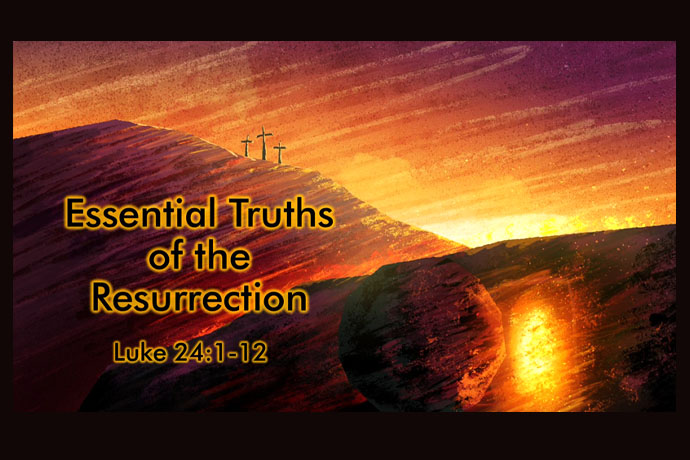
The Resurrection

Luke 24:1 But on the first day of the week, at early dawn, they came unto the tomb, bringing the spices which they had prepared. 2 And they found the stone rolled away from the tomb. 3 And they entered in, and found not the body of the Lord Jesus. 4 And it came to pass, while they were perplexed thereabout, behold, two men stood by them in dazzling apparel: 5 and as they were affrighted and bowed down their faces to the earth, they said unto them, Why seek ye the living among the dead? 6 He is not here, but is risen: remember how he spake unto you when he was yet in Galilee, 7 saying that the Son of man must be delivered up into the hands of sinful men, and be crucified, and the third day rise again. 8 And they remembered his words, 9 and returned from the tomb, and told all these things to the eleven, and to all the rest.
The Resurrection Is a staggering Historical Event
In many mainline churches, which are very liberal, the explanation of the resurrection is given like this: after Jesus died, his disciples “experienced” his presence. They felt very powerfully that he was somehow still with them.
As the disciples died followers began to find ways of expressing these higher truths, these spiritual experiences, through stories that symbolically represented them in concrete form.
All of the stories surrounding the resurrection are seen as such symbolic representations of higher spiritual truths. Some put it this way, the road to Emmaus never happened. Emmaus always happens.
There is an inevitable historical element in Christian claims that sooner or later has to be faced.
Several years ago in the Easter season, the then Anglican bishop of Perth in western Australia was asked on the public media in that country, “What would happen if suddenly the tomb of Jesus was found and beyond reasonable cavil, it really was the tomb of Jesus and the body was still there? What would happen to your faith? Would it be destroyed?” “Of course not,” the dear bishop replied. “Jesus has risen in my heart.”
That’s a kind of mystical approach to religion. It’s outside the public arena. It’s outside of history now. It’s private experience of something, and that is a long way removed from what the New Testament has to say. Paul, writing 25 years after Christ, is a lot more blunt. There he says, “If you really conclude Christ has not risen, then Christian faith is futile and empty,” which raises some very interesting things about the nature of faith,
In this liberal view, these events are legends. None of them actually happened, yet they always happen, because they tell us about and are symbolic representations of higher spiritual truths.
For instance, they reveal the higher truth that “spring always comes after winter,” that there’s always hope, and that we must hold on to hope.
Luke 24, even at the simplest, first-impression level, that explanation just doesn’t seem to fit the text.
But what exactly is this higher truth?
The truth of this text is that Jesus is saying: “I’m not a symbol. I’m really here. I am not just an impression in your mind. I’m not just a kind of spiritual presence. I’m here, flesh and bones.
You don’t write legends like this. Jesus requesting something to eat is almost trivial. It’s almost silly. So why is it there? It is there because it happened, because this is what the eyewitnesses actually saw.
The whole chapter has the marks of eyewitness accounts.
Why there are so many names in this narrative? To remind us there were eyewitness.
Jews were possibly the least likely people on the face of the earth to be open to the idea that a human being could be God. They had a paradigm, a worldview. They couldn’t say the name of God out loud.
Yet we know that almost immediately after the resurrection, Jesus’s disciples were worshiping a man. How did that happen? Only one thing could have done that: they saw him. They were confronted with the fact of the resurrection.
If Jesus was raised from the dead, then God did vindicate him. Then God is pleased with him.
Paul looked at Jesus. Then he looked at the temple and the sacrificial system, and said: “Okay, let’s think about the whole thing. Did the blood of bulls and goats and little lambs really, over the years, completely atone for sins? That wouldn’t make much sense, would it? What if it was pointing to something? What if all that was pointing to Jesus? And if it was all pointing to Jesus, what does that mean about the temple and sacrificial system?”
Once Paul understood the resurrection, he understood the cross. And once he understood the resurrection and the cross together, the whole Bible opened up to him. He had been expecting, as it were, a strong Messiah
It’s not just that the resurrection paired with the cross helps us understand the whole of Scripture. It helps us understand that all of Scripture is about Jesus. Jesus says so.
The Resurrection is The Message for the World
Luke 24, that the minute people find out about the resurrection, they communicate it to others. Nobody sits on this message. Immediately after the women meet the angels, The Emmaus disciples, and Jesus himself says, You are witnesses of these things. The resurrection paired with the cross is the powerful message.
One of the more interesting historical questions is how Christianity, within two or three centuries, was able to completely supplant the classical culture of the Greco-Roman world.
How is it possible that within a relatively short time, the populace turned away from paganism, away from classical culture, and embraced Christianity. How did it happen?
The resurrection was unique. The resurrection was a kind of message no one in the Greco-Roman world had ever heard, and it gave deep hope for the future—that the future is here, that it’s personal, that it’s certain, and that it’s wonderful. It still does all that today.
Regardless of who you were, Jew or Gentile, if you talked to an eyewitness of the resurrection, saw his changed life, and believed the credibility of his account, finally you knew that you were not just dust in the wind. Finally you knew that you were not just a stone that would eventually sink to the bottom. Finally you knew there is a future. The resurrection proved it.
Jesus Christ shows up in resurrected form and says: Your future is personal, and that is the only thing that can satisfy the human heart.
Martin Luther said suffering is intolerable if you are unsure of your salvation, unsure that, in spite of all of your flaws, God is with you.
There is no religion, no faith, no philosophy, and no person who has ever offered the world this kind of future, a future that is there, personal, certain, and unimaginably wonderful. There’s no more powerful message possible, and it is a message based on the historical fact of the resurrection.
Jesus Is the True King
C. S. Lewis wrote a little article some years ago called “Equality.” In it, he says he is absolutely in favor of democracy, because we are all sinners. And because we are all sinners, we need checks and balances. However, he says, democracy is medicine, not food. Ultimate reality is not democracy. We were made to be ruled, and if you don’t acknowledge Jesus as King, you will serve somebody else. You will bow the knee to someone or something. You may not admit that is what you are doing, but human nature will be served. If it doesn’t get food, it’ll gobble poison. You need a king. You will serve somebody.
Paul was more offended by Christianity than you. He was killing Christians because of how deeply he was offended. But when he realized Jesus had been raised from the dead, it didn’t matter what offended him anymore.
It didn’t matter because Christianity was true. And we have to keep that in mind. The resurrection is a historical event—a paradigm-shattering historical event.
The Resurrection Is the Key to Understanding Scripture
What happens on the road to Emmaus (vv. 13–35)? he explained to them what was said in all the Scriptures concerning himself” (vv. 25–27). The resurrection, when paired with the cross, makes sense of the cross and opens all of Scripture.
Acts 9 what might have been going on in Paul’s mind when he met the risen Christ.
on the Damascus Road Saul meets the resurrected, glorified Jesus. a great deal of his theology, worked out and displayed in his letters, stems from that brute fact.
From that vantage point, everything looked different. If Jesus was under the curse of God when he died, yet was vindicated by God himself, he must have died for others. Somehow his death absorbed the righteous curse of God that was due others and canceled it out. In that light, the entire history of the Hebrew Scriptures looked different.
Paul said, a human “Passover Lamb? If the tabernacle and temple rituals are read as pointing to the final solution, what does that say about the present status of the covenant enacted at Sinai?
That Jesus is alive and vindicated, everything changes.
Then he saw Jesus raised from the dead.
If Jesus was raised from the dead, then God did vindicate him. Then God is pleased with him.
Paul looked at Jesus. Then he looked at the temple and the sacrificial system, and said: “Okay, let’s think about the whole thing. Did the blood of bulls and goats and little lambs really, over the years, completely atone for sins? That wouldn’t make much sense, would it? What if it was pointing to something? What if all that was pointing to Jesus? And if it was all pointing to Jesus, what does that mean about the temple and sacrificial system?”
Once Paul understood the resurrection, he understood the cross. And once he understood the resurrection and the cross together, the whole Bible opened up to him. He had been expecting, as it were, a strong Messiah
It’s not just that the resurrection paired with the cross helps us understand the whole of Scripture. It helps us understand that all of Scripture is about Jesus. Jesus says so.
The Resurrection is The Message for the World
Luke 24, that the minute people find out about the resurrection, they communicate it to others. Nobody sits on this message. Immediately after the women meet the angels, The Emmaus disciples, and Jesus himself says, You are witnesses of these things. The resurrection paired with the cross is the powerful message.
One of the more interesting historical questions is how Christianity, within two or three centuries, was able to completely supplant the classical culture of the Greco-Roman world.
How is it possible that within a relatively short time, the populace turned away from paganism, away from classical culture, and embraced Christianity. How did it happen?
The resurrection was unique. The resurrection was a kind of message no one in the Greco-Roman world had ever heard, and it gave deep hope for the future—that the future is here, that it’s personal, that it’s certain, and that it’s wonderful. It still does all that today.
Regardless of who you were, Jew or Gentile, if you talked to an eyewitness of the resurrection, saw his changed life, and believed the credibility of his account, finally you knew that you were not just dust in the wind. Finally you knew that you were not just a stone that would eventually sink to the bottom. Finally you knew there is a future. The resurrection proved it.
Jesus Christ shows up in resurrected form and says: Your future is personal, and that is the only thing that can satisfy the human heart.
Martin Luther said suffering is intolerable if you are unsure of your salvation, unsure that, in spite of all of your flaws, God is with you.
There is no religion, no faith, no philosophy, and no person who has ever offered the world this kind of future, a future that is there, personal, certain, and unimaginably wonderful. There’s no more powerful message possible, and it is a message based on the historical fact of the resurrection.
Jesus Is the True King
C.S. Lewis wrote a little article some years ago called “Equality.” In it, he says he is absolutely in favor of democracy, because we are all sinners. And because we are all sinners, we need checks and balances. However, he says, democracy is medicine, not food. Ultimate reality is not democracy. We were made to be ruled, and if you don’t acknowledge Jesus as King, you will serve somebody else. You will bow the knee to someone or something. You may not admit that is what you are doing, but human nature will be served. If it doesn’t get food, it’ll gobble poison. You need a king. You will serve somebody.