The New Jerusalem

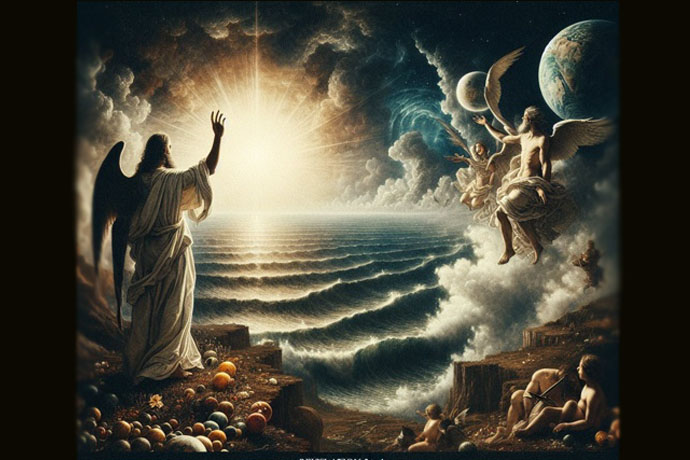
21 And I saw a new heaven and a new earth: for the first heaven and the first earth are passed away; and the sea is no more. 2 And I saw the holy city, new Jerusalem, coming down out of heaven from God, made ready as a bride adorned for her husband. 3 And I heard a great voice out of the throne saying, Behold, the tabernacle of God is with men, and he shall dwell with them, and they shall be his peoples, and God himself shall be with them, and be their God:
9 And there came one of the seven angels who had the seven bowls, who were laden with the seven last plagues; and he spake with me, saying, Come hither, I will show thee the bride, the wife of the Lamb. 10 And he carried me away in the Spirit to a mountain great and high, and showed me the holy city Jerusalem, coming down out of heaven from God,
The New Jerusalem
“I saw the Holy City, the new Jerusalem, coming down out of heaven from God, prepared as a bride, there’s a double switch here. This does not mean there’s a new heaven and a new earth and then Jerusalem is some small part of it. The whole thing is cast as the new heaven and the new earth.
The new creation and Jerusalem are none other than God’s tabernacle. This tabernacle is the true temple of God’s special presence portrayed throughout chapter 21. It was this divine presence that was formerly limited to Israel’s temple and has began to expand through the church, and which will fill the whole earth and heaven, becoming coequal with it. Then the eschatological goal of the temple of the Garden of Eden dominating the entire creation will be finally fulfilled. Hence, eschatology not only recapitulates the protology of Eden but escalates it.
The Old Testament tabernacle and temples were symbolically designed to point to the cosmic eschatological reality that God’s tabernacling presence, formerly limited to the holy of holies, was to be extended throughout the whole earth. Against this background, the Revelation 21 vision is best understood as picturing the final end-time temple that will fill the entire cosmos.
It is possible that the Garden of Eden was the first archetypal temple, and that it was the model for all subsequent temples. Such an understanding of Eden will enhance the notion that the Old Testament tabernacle and temples were symbolic microcosms of the whole creation. As microcosmic symbolic structures they were designed to point to a worldwide eschatological temple that perfectly reflects God’s glory. It is this universally expanded eschatological temple that is pictured in Revelation’s last vision.
At the same time, the idea of the new city-temple is related not only to the old temple, but (as is indicated by the presence of the precious stones) can be traced back to the Garden. There are indeed hints that the Garden of Eden was the archetypal temple in which the first man worshiped God:
Eden was where Adam walked and talked with God, as did the priests in the temple.
In Gen. 2:15 God places Adam in the Garden to “cultivate” it and “keep” it. These two verbs (Hebrew ʿabad and šamar) and their cognate nouns are also used of priests keeping the service of the tabernacle (Num. 3:7–8; 8:25–26; 18:5–6; 1 Chron. 23:32; Ezek. 44:14). Adam then can be seen as the archetypal priest who serves in and guards God’s first temple.
When Adam failed in his duty and was expelled from the Garden, two cherubim took over his priestly role: they “guarded” the way to the tree of life (Gen. 3:24). The same cherubim reappear guarding the ark of the covenant in the Holy of Holies.
The tree of life was probably the model for the lampstand placed directly outside the Holy of Holies.
That the Garden was the first temple is also suggested by the wood and stone carvings that gave the temple a garden-like appearance (1 Kgs. 6:18, 29, 32, 35; 7:18–20).
The entrance to Eden was from the east, which was also the direction from which one entered the tabernacle and the later temples of Israel.
Not only was Adam to guard the temple, he was to subdue and fill the earth (Gen. 1:28). It is plausible to suggest he was to extend the boundaries of the Garden until it extended throughout the whole earth. What he failed to do, Revelation presents Christ as having finally done. The Edenic imagery beginning in 22:1 reflects an intention to show that the building of the temple, which began in Genesis 2, will be completed in Christ and His people and will encompass the whole new creation.
Num. 3:7–8; 8:25–26; 18:5–6; 1 Chron. 23:32; Ezek. 44:14;204 cf. also Isa. 56:6).205 Targ. Neofiti Gen. 3:15 underscores this cultic notion by saying that Adam was placed in the garden “to do service according to the Law and to keep its commandments” (language strikingly similar to the passages just cited from Numbers), and on v. 19 the targum notes that in naming the animals Adam used “the language of the sanctuary.” Midr. Rab. Gen. 16.5 interprets Adam’s role in Gen. 2:15 as one of offering the kind of “sacrifices” later required by the Mosaic Law. Regardless of the precise translation of the two words in Gen. 2:15, these observations suggest that the writer of Genesis 2 was portraying Adam against the later portrait of Israel’s priests as the archetypal priest who served in and guarded God’s first temple.
When Adam failed to guard the temple by sinning and admitting an unclean serpent to defile the sanctuary, he lost his priestly role, and the two cherubim took over the responsibility of “guarding” the garden temple: God “stationed the cherubim … to guard the way to the tree of life” (Gen. 3:24).
It is likely, their role became memorialized in Israel’s later temple when God commanded Moses to make two statues of cherubim and stationed them on either side of the ark of the covenant in the holy of holies.
The tree of life itself was probably the model for the lampstand placed directly outside the holy of holies: it looked like a small, flowering tree with seven protruding branches from a central trunk, three on one side and three on the other, and one branch going straight up from the trunk in the middle, see Exod. 25:31–32; Josephus, Ant. 3.145.
“That the Garden of Eden was the first temple is also suggested by the wood carvings that gave Israel’s later temple a garden-like atmosphere: 1 Kings speaks of “cedar … carved in the shape of gourds and open flowers” (6:18); “on the walls of the temple round about” and on the wood doors of the inner sanctuary were “carvings of cherubim, palm trees, and open flowers” (6:29, 32, 35); beneath the heads of the two pillars placed at the entrance of the holy place were “carved pomegranates” (7:18–20). (6) The entrance to Eden was from the east (Gen. 3:24), which was also the direction from which one entered the tabernacle and later temples of Israel.
Not only was Adam to “guard” this sanctuary but he was to subdue the earth, according to Gen. 1:28: “And God blessed them.… ‘Be fruitful and multiply, and fill the earth, and subdue it; and rule over the fish of the sea and over the birds of the sky, and over every living thing that creeps on the surface.’ ” As Adam was to begin to rule over and subdue the earth, it is plausible to suggest that he was to extend the geographical boundaries of the garden until Eden extended throughout and covered the whole earth.206 This meant the presence of God, which was initially limited to Eden, was to be extended throughout the whole earth. What Adam failed to do, Revelation pictures Christ as finally having done. The Edenic imagery beginning in Rev. 22:1 reflects an intention to show that the building of the temple, which began in Genesis 2, will be completed in Christ and his people and will encompass the whole new creation.” G. K. Beale,
It is very possible that the first tabernacle and temple existed long before Israel became a nation. It is apparent that the first sanctuary is discernible from the very beginning of human history. Adam’s purpose in that first garden-temple was to expand its boundaries until it circumscribed the earth, so that the earth would be completely filled with God’s glorious presence. Adam’s failure led, in time, to the re-establishment of the tabernacle and temple in Israel.
Both were patterned after the model of Eden and were constructed to symbolize the entire cosmos in order to signify that Israel’s purpose as a corporate Adam was to extend its borders by faithfully obeying God and spreading his glorious presence throughout the earth.
Jesus’ identification of himself with the temple stairway of Genesis 28 is thus another way of claiming that he, not the Jerusalem temple, is the primary link between heaven and earth. Therefore, Jacob’s small sanctuary in Genesis 28 did not point merely to the temporary Jerusalem temple but ultimately to the permanent temple built by Christ. One need not go to the Jerusalem temple to be near God’s revelatory presence but only need trust in Jesus to experience that presence.
This is why Jesus says that the time was dawning when true worship would not occur at the Jerusalem temple, nor any other holy site, but would be directed toward the Father (and, by implication, through the Messiah) in the sphere of the coming eschatological Spirit of Jesus (John 4:21–26). A link with heaven would be created by the Spirit wherever there was trust in Christ, and those so trusting would come within the sphere of the true temple consisting of Christ and his Spirit.