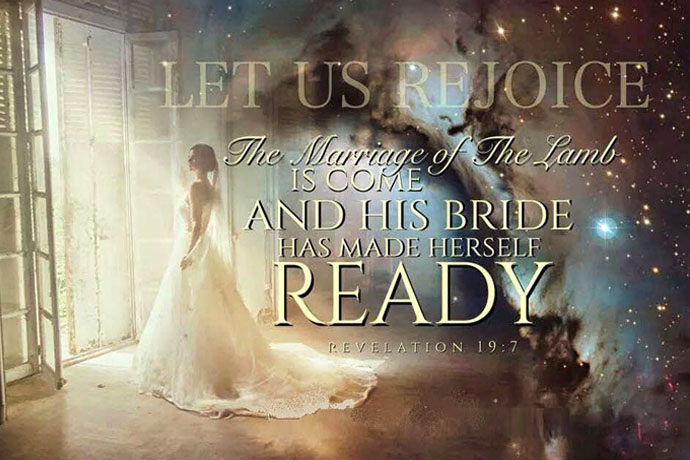
The Marriage Supper

Revelation 19:7 Let us rejoice and be exceeding glad, and let us give the glory unto him: for the marriage of the Lamb is come, and his wife hath made herself ready. 8 And it was given unto her that she should array herself in fine linen, bright and pure: for the fine linen is the righteous acts of the saints. 9 And he saith unto me, Write, Blessed are they that are bidden to the marriage supper of the Lamb. And he saith unto me, These are true words of God. 10 And I fell down before his feet to worship him. And he saith unto me, See thou do it not: I am a fellow-servant with thee and with thy brethren that hold the testimony of Jesus: worship God: for the testimony of Jesus is the spirit of prophecy.
A marriage was the single greatest celebration and social event of the biblical world. Wedding preparations and celebrations in ancient times were even more elaborate and involved than of today.
First was the betrothal, or engagement. This was an arrangement by both sets of parents contracting the marriage of their children. It was legally binding and could only be broken by a divorce . Matt. 1:18–19. A betrothal contract was often signed long before the children reached the marriageable age of thirteen or fourteen. Since a marriage represented the union of two families, it was natural for the parents to be involved. And there were years of preparation for the time of marriage, as the boy prepared for his bride.
The second stage of a wedding was the presentation, a time of festivities just before the actual ceremony. Those festivities could last up to a week or more, depending on the economic and social status of the bride and groom.
The third and most significant stage of a wedding was the actual ceremony, during which the vows were exchanged. At the end of the presentation festivities, the groom and his attendants would go to the bride’s house and take her and her bridesmaids to the ceremony. After the ceremony would come a final meal, followed by the consummation of the marriage.
Scripture uses the familiar imagery of a wedding to picture the Lord’s relationship with His church. The church’s betrothal contract was signed in eternity past when the Father promised the Son a redeemed people and wrote their names in the Book of Life. The apostle Paul described the church’s presentation in Ephesians 5:25–27: “Husbands, love your wives, just as Christ also loved the church and gave Himself up for her, so that He might sanctify her, having cleansed her by the washing of water with the word, that He might present to Himself the church in all her glory, having no spot or wrinkle or any such thing; but that she would be holy and blameless.”
The innumerable crowd of v 6 lift their voices to glorify God once again. They raise up such a doxology “because the marriage of the Lamb has come and his bride has made herself ready.” The marriage could not take place without the removal of the Babylonian archenemy and the coming of God’s kingdom in complete form, as narrated in 18:1–19:6.
The existence of Babylon was a necessary factor in the bride’s preparation for the marriage. Why is this necessary?
Babylon’s oppression and temptation was the fire ultimately used by God to refine the saints’ faith to prepare them to enter the heavenly city (for a similar notion see on 2:10–11; cf. also 6:11; Rom. 8:28ff.; 1 Pet. 4:12, 19; Phil. 1:28–30).
Rev 2;10 Fear not the things which thou art about to suffer: behold, the devil is about to cast some of you into prison, that ye may be tried; and ye shall have tribulation ten days. Be thou faithful unto death, and I will give thee the crown of life. 11 He that hath an ear, let him hear what the Spirit saith to the churches. He that overcometh shall not be hurt of the second death.
Rev 6;11 And there was given them to each one a white robe; and it was said unto them, that they should rest yet for a little time, until their fellow-servants also and their brethren, who should be killed even as they were, should have fulfilled their course.
The bride’s preparation is explained in v 8: she clothes herself with “bright, pure, fine linen,” which symbolizes “the righteous deeds of the saints” (note the explanatory γάρ [“for”] in the closing clause of v 8). Since δικαίωμα (“righteous deed”) and the δικαιόω word-group have such a variety of meanings, the word here must be defined by its immediate context and its usage elsewhere in the Apocalypse. These “righteous deeds” may best be explained in part from v 10, “holding to the testimony of Jesus. Testimony occurs seven other times in the Apocalypse, usually in the expression “testimony of Jesus” and always with the contextual idea of bearing witness to Jesus in both word and deed. For saints to hold to the testimony also means negatively that they will not give their loyalty to Babylon but separate themselves from it (18:4).
Therefore, a possible meaning here is that before the marriage can take place the saints must complete their preparation of performing “righteous deeds” by persevering in their faith despite the world’s persecution. This is close to the conclusion reached about earlier passages that affirm that believers will receive white robes.
According to this understanding, a classic theological tension appears to exist between the idea of the bride “preparing herself” (v 7) and that of the bride being “given” her garments (v 8), that is, “it was given to her that she should clothe herself” (for the tension elsewhere see Lev. 20:7–8; Phil. 2:12–13).
Lev 20:7 Consecrate yourselves and be holy, for I am the LORD your God. 8 Keep my statutes and do them; I am the LORD who sets you apart. Lev 20:7–8.
Phil 2:12 Therefore, my dear friends, just as you have always obeyed,y so now, not only in my presence but even more in my absence, work out your own salvation with fear and trembling. 13 For it is God who is working in you both to will and to work according to his good purpose. Php 2:12–13.
Some try to solve the difficulty by diluting the lexical meaning of ἐδόθη, given, granted and translating it as “permit, allow. Mounce solves the antinomy by saying that “this does not deny the Pauline doctrine of justification based on the righteous obedience of Christ (Rom. 5:18–19), but suggests that a transformed life is the proper response [by the justified] to the call of the heavenly bridegroom.”
If Mounce’s line of thought is on the right track, then it would be better to view vv 7–8 as indicating that a transformed life of good works (though certainly not perfection) is not only “the proper response” to justification but a necessary external response or “badge” required before entrance to the wedding of the Lamb is granted.
Theologically, this would mean that justification is the causal necessary condition for entrance into the eternal kingdom, but good works are a noncausal necessary condition. In this regard,
Without exception receiving white clothes elsewhere in the Apocalypse precisely conveys the idea of purity resulting from a test of persevering.
Therefore, the white clothes here should be equated not with the “righteous deeds” of perseverance, but with the reward or result of such deeds. In this light the final clause of v 8 could be interpretatively paraphrased as “the fine linen is the reward for (or result of) the righteous deeds of the saints.”
Another viable translation would be “the linen is the deeds putting right [acquitting, vindicating] the saints, righteous deeds performed by the saints. Another viable rendering would be “just judgments on behalf of the saints.
The white robes, might represent two inextricably related realities:
(1) human faithfulness and good works (as a necessary evidence of right standing with God)
(2) vindication or acquittal accomplished by God’s judgments against the enemy on behalf of his people, righteous acts of the saints, may be best left ambiguous:
(3) Rev. 19:7b says the bride “prepared herself” and 19:8 says that her ability to clothe herself “was given to her” by God as an unconditional, sovereign provision. This appears to be paralleled in 3:4–5, where the active sense of making garments white (v 4, “they have not soiled their garments, and they will walk with me in white”) is followed by the passive sense (v 5, “they will be clothed in white garments”).
The context supports a meaning of vindication or acquittal, resulting from divine judgments on behalf of the saints.
Rev. 19:8b also envisions “righteous acts by the saints” must not be lost sight of., in 19:7 the bride is said explicitly to have “prepared herself” for the wedding.
Rev. 19:8 has a unique parallel in Targum. Zech. 3:1–5. Clean garments and a “pure miter” are given to the high priest in Zech. 3:5–6 LXX to signify that his iniquities have been taken away.
The LXX of Exodus 25–37 repeatedly describes the clothing of the high priest as being partly made of “linen,” so that the “linen” in Rev. 19:8 probably includes a priestly nuance, especially in the light of Zech. 3:5–6 and of Rev. 15:6, where angelic priestly figures also wear “pure bright linen”.
Therefore, the phrases in Rev. 19:7b–8, “his bride prepared herself” and “it was given to her that she should clothe herself with fine linen, bright [and] pure,” continue the meaning of the marriage metaphor in 19:7a.
The metaphorical significance is, rather, that God’s people are finally entering into the intimate relationship with him that he has initiated. “heaven from God prepared as a bride”; so also 9:7, 15; 12:6; 16:12; cf. 8:6, where angels “prepared themselves to sound”).
The bride’s garments are interpreted as “righteous deeds” in order to describe an aspect of the intimate relationship between God and the people. As noted above, the phrase includes reference to persevering faith in Jesus despite persecution, which is required for entry into the consummate, intimate relation with Christ.
The church’s righteous faith and deeds during its earthly bondage were given a guilty verdict by the world but now its members’ lives of faithful witness are vindicated by God through judgment and deliverance at the time of their final union with him. Therefore, the white linen represents not only the saints’ pure and righteous condition before God but also their vindicated standing before God and the world.
The saints are clothed with pure linen as a symbol of God’s righteous vindication of them because, though they were persecuted, they were righteous on earth. The full meaning of the pure garments is that God’s righteous vindication involves judging the enemy, which shows that the saints’ faith and works have been in the right all along. This dual sense of “pure linen” in 19:8 suits admirably the rhetorical purpose of the entire Apocalypse, which includes exhortations to believers to stop soiling their garments (3:4–5) and not to be “found naked”
This underscores the aspect of human accountability, which is highlighted by 19:7b: “his bride has prepared herself.” Yet, the readers can be encouraged to obey the exhortation by the knowledge that God has provided grace for them to clothe themselves now by the power of the Spirit (“it was given to her” in 19:8a and see on 1:4, 12 for the relation of 1:4; 4:5; and 5:6 to 1:20) and also by recalling that they will receive “pure garments” from God at the end of their pilgrimage individually and corporately
Revelation 19:9 The angel commands John to write.
That which John is to write affirms by way of conclusion from vv 7–8 that those who participate in the vindication and in intimate communion with God are “blessed.” “Those called to the Lamb’s wedding supper” is a metaphorical interpretative restatement of the marriage pictures in vv 7–8. God’s sovereign initiative in bringing about the marriage relationship is emphasized
The “supper” intensifies the idea of intimate communion expressed in the marriage metaphors, since suppers were the occasion of close table fellowship. The picture of Christ dining with his people has the same idea in 3:20. The state of blessedness is the reward of enjoying such communion with God.
Verse 9 presents a different perspective on the wedding metaphor from vv 7–8. There the bride, the corporate church, was viewed as about to wed the Lamb, but now individual Christians are portrayed as guests at the marriage banquet. Both pictures portray the intimate communion of Christ with believers, but the first focuses on the corporate church and the second on individual members of the church. The same alteration of focus on the community as a whole and the members of the community has been seen in ch. 12
Revelation 19:10 John falls down in order to worship the angel in response to the angel’s confirmatory interpretation of vv 1–8 in v 9.
The explanatory (“for”) at the end of v 10 introduces an interpretative expansion of the preceding phrase, “those holding the testimony of Jesus” to make clear how both angels and Christians can be called “fellow servants.” Jesus.335 John is not to worship the angel because God’s true servants witness to Jesus, which brings honor to him; they do not witness or bring honorific attention to themselves or angels or any other created thing
The testimony is defined as “the spirit of prophecy,” which is supported by the parallel in 22:8–9. This may mean that it is a prophetic testimony inspired by the Spirit,
Therefore, angels in heaven and believers on earth are fellow servants in that they both have prophetic roles. Prophets here are not an exclusive office but the same group mentioned as prophets elsewhere in the book, where the prophetic role of the entire church is in mind (so 11:3, 6, 10; cf. 16:6).340 John is part of this general group, but he is also part of a narrower class of NT prophets and apostles who continue the OT prophetic office (e.g., see on 1:10; 4:1–2; 10:11; 17:1–3; cf. 22:9).341
“The Spirit of prophecy” indicates fulfillment of the promised “Spirit of prophecy,” which was to be a witness to the presence of the messianic era and therefore a witness here to Jesus as the only true object of worship (in contrast to angelic mediators of revelation [19:10a], idols, and the like). This Spirit was to be a possession of all those living in the latter-day community of faith (so Joel 2:28–32; Ezek. 39:29).343