The Incarnation

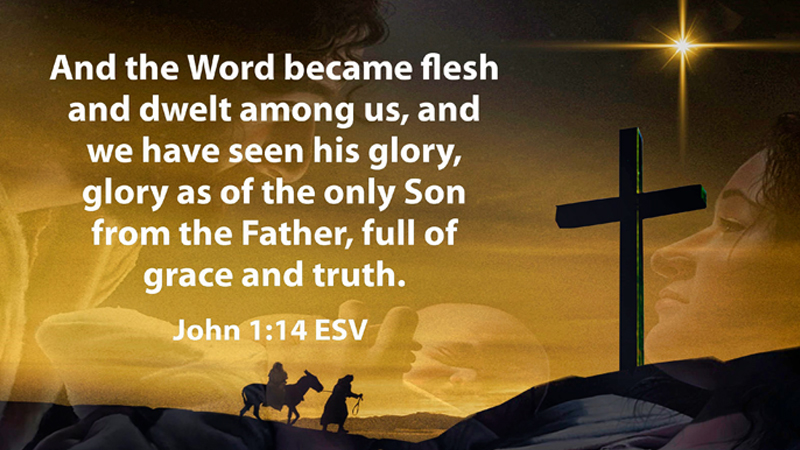
John 1;1 In the beginning was the Word, and the Word was with God, and the Word was God. 2 The same was in the beginning with God. 3 All things were made through him; and without him was not anything made that hath been made. 4 In him was life; and the life was the light of men. 5 And the light shineth in the darkness; and the darkness apprehended it not. 6 There came a man, sent from God, whose name was John. 7 The same came for witness, that he might bear witness of the light, that all might believe through him. 8 He was not the light, but came that he might bear witness of the light. 9 There was the true light, even the light which lighteth every man, coming into the world. 10 He was in the world, and the world was made through him, and the world knew him not. 11 He came unto his own, and they that were his own received him not. 12 But as many as received him, to them gave he the right to become children of God, even to them that believe on his name: 13 who were born, not of blood, nor of the will of the flesh, nor of the will of man, but of God. 14 And the Word became flesh, and dwelt among us (and we beheld his glory, glory as of the only begotten from the Father), full of grace and truth. 15 John beareth witness of him, and crieth, saying, This was he of whom I said, He that cometh after me is become before me: for he was before me. 16 For of his fulness we all received, and grace for grace. 17 For the law was given through Moses; grace and truth came through Jesus Christ. 18 No man hath seen God at any time; the only begotten Son, who is in the bosom of the Father, he hath declared him.
The portrayal of God in the beginning
The word to sum up the God of Genesis 1 is ‘transcendent’. This God has no rivals. He stands on the other side of the ontological ledger to creatures. He is beyond creatures. Creation is spoken into being by God. God’s repeated speech acts are causative.
Garden of Eden
By the end of Genesis 1–3 we see that the creation purpose to provide a dwelling place for God with humanity is challenged by both human and angelic sin. But there is light in this darkness: in the midst of judgment the text of the protoevangelium( the first preaching of the gospel) comes into view. Latin term meaning “first gospel.” It refers to the promise of Genesis 3:15 that the “seed of the woman” would conquer the “seed of the serpent.” This concept is applied to Jesus as Messiah.
God will remove the challenge but at a cost. He addresses the serpent as follows:
So the LORD God said to the snake, ‘Because you have done this, “Cursed are you above all livestock and all wild animals! You will crawl on your belly and you will eat dust
all the days of your life. And I will put enmity between you and the woman, and between your offspring and hers; he will crush your head, and you will strike his heel.” (Gen. 3:14–15,)
The blessing language of the creation account in Genesis 1 is now counterbalanced by the words of cursing in the Fall narrative of Genesis 3. The reference to the serpent’s eating dust is full of significance: ‘ “Eat dust.” The serpent will experience abject humiliation. Metaphorically eating dust is what happens to one’s enemies. The ‘enmity’ in view suggests a long period of conflict rather than a short one (Num. 35:21–22; Ezek. 25:15; 35:5).
This is in fact a promise that God will act for the benefit of mankind by defeating the serpent, the Dark Power that used the serpent as its mouthpiece, in combat and defeat him, so bringing benefits to mankind. That is, he is a champion. We are further entitled to say that he will be a human (an offspring of the woman), but one with power extraordinary enough to win.… The rest of Genesis will unfold the idea of this offspring and lay the foundation for the developed messianic teaching of the prophets.
Genesis 3 does not make clear in any deep way just how the serpent’s fate will be sealed. What is clear is that a male descendant of the woman will be involved. Triumph will come through suffering and that suffering will involve both the male offspring and the serpent: (Gen. 3:15)
The serpent will lose definitively, a crushed head, while the seed of the woman will sustain a struck heel. A subsequent book in the Torah underlines the nature of the challenge posed by the divine to human life in the new normal or abnormal (the post-Fall world). Leviticus reads strangely to modern Western ears: priests, sacrifices, blood and ritual. However, once the issue comes into view, namely of how a holy God can be present in the midst of an unholy people, then the logic of Leviticus becomes much less opaque. Ultimately atonement is needed, and at a cost.
This preparation from Genesis mentioned in John one is for the dwelling of God with humankind in a sacred space that is a palace-temple. The six-day process is best seen in architectural terms. God is building a habitation for himself. The divine generosity is shown in the way God creates a creature as his image with whom he can dwell. This is sheer grace in that there is no hint in the Genesis text that there was divine necessity to so create. Creation is an expression of divine freedom and generosity.
However, discord entered the scene with devastating consequences for the habitation of God with humankind. Even so, the divine project is not abandoned. There is not only judgment but also the promise (the protoevangelium) of the world set right.
The Great Mystery
The word “mystery” is often used carelessly and, consequently, has been misused. It is not like a Sherlock Holmes mystery. Simply collect all of the clues and you can solve the mystery. It is used in the sense in relation to Christ, it has to do with that aspect of Christ that can never be discovered. The apostle John attempts to lift us into the mystery of God and into the circles of deity far beyond the pursuit of man. Realms so high, lofty and noble that it is impossible to us to follow to its conclusion. All we can hope to do is gaze heavenward in wonder and long after the mystery of God.
The phrase that stirs up the sense of mystery is, “And the Word was made flesh” (John 1:14). In six simple words, the apostle states the most profound mystery of human thought, how deity could cross the gulf separating what is God from what is not God. Although man in all of his scientific advancement has made the world very complex, John the apostle breaks down the entire universe into two things: God and not God. To explain this mystery in as simple words as possible, the universe is made up of that which is God and that which is not God, and all that which is not God was made by God, but God was made by none. The mystery is compounded by the fact that between that which is God and that which is not God is a great and impassable gulf.
The most profound mystery of human flaw is how the creator could join Himself to the creature. How the “Word,” meaning Christ, could be made “flesh,” meaning the creature, is one of the most amazing mysteries to contemplate. Some may not think it is so amazing, but those who have meditated on this will be amazed at the unbridgeable gulf between God and not God.
A gulf is fixed, a vast gulf of infinitude, and how God managed to bridge that gulf and join Himself to His creatures and limit the limitless is beyond our comprehension. In the language we hear more properly, how can the infinite ever become the finite, and how can that which has no limit deliberately impose upon Himself limitations?
It is the arrogance of man that believes that he is, or at least acts as though he is, the only order of being. The Bible clearly teaches that humanity is only one order of God’s creation. There are angels and cherubim and seraphim and creatures and watchers and holy ones and all of these strange principalities and powers that walk so darkly and brightly through the passages of the Bible. In light of this, why would God favor one above the other? In the book of Hebrews, we read, “For verily he took not on him the nature of angels; but he took on him the seed of Abraham” (Heb. 2:16).
If we were doing it, knowing humanity as we do, we might have been tempted to select the order of angels or seraphim, supposing that it would not be quite as much a step down as it would be with man. Abraham certainly was not equal to an angel. The mystery of it all is, He came down to the lowest order and took upon Himself the nature and seed of Abraham.
Even Paul, one of the greatest intellects of all time, threw up his hands and said, “ “Beyond all question, the mystery of godliness is great: He [God] appeared in a body, was vindicated by the Spirit, was seen by angels, was preached among the nations, was believed on in the world, was taken up in glory” (1 Tim. 3:16).
I often think of the wise words of John Wesley: “Distinguish the act from the method by which the act is performed and do not reject the fact because you do not know how it was done.” In coming to the mystery of that which is Christ incarnate, we reverently bow our heads and confess, “It is so, God, but we don’t know how.” I will not reject the fact because I do not know the operation by which it was brought to pass.
The Incarnation of Christ is shrouded in impenetrable mystery that we could never uncover with our finite thinking. But there is one thing that we can know for sure: The Incarnation required no compromise of deity. When the “Word was made flesh,” His deity did not suffer. Before His Incarnation, Christ was absolute deity; after His Incarnation, He was just as much deity as before. His deity suffered nothing when He became flesh. This mystery baffles us when we meditate upon the person of Christ.
The old Greek and Roman world was full of gods that were compromisers one way or another. But the holy God who is God, and all else is not God, that God who is “our Father who art in heaven,” would never compromise Himself. This mystery of the Incarnation was accomplished without any compromise of the deity. God did not degrade Himself by this condescension. He did not in any sense make Himself to be less than God. He remained God, and everything else remained not God; the gulf still existed, even after Jesus Christ had become man and had dwelt among us. So instead of God degrading Himself when He became man, He, by the act of Incarnation, elevated mankind to Himself.
The Old Testament Scriptures per se did not offer the prospect of an incarnation as part of the hope of Israel. It was a mystery in the sense of ‘revelation that is in some sense “there” in the Old Testament Scriptures, but hidden until the time of God-appointed disclosure’. No surprise then that 1 Timothy 3:16 can state, ‘Beyond all question, the mystery from which true godliness springs is great: He appeared in the flesh.’
There is nothing like looking in retrospect to see connections, implications and entailments that otherwise would be hard to discern. The New Testament writers had a source of epistemological aid. The Holy Spirit has come. In the upper room before the crucifixion Jesus said, ‘But when he, the Spirit of truth, comes, he will guide you [the apostles] into all the truth’ (John 16:13).
According to Jesus
When it comes to the inspiration, truthfulness, authority and relevance of the Bible of his world, Jesus could scarcely have held to higher views. The central theological and moral truths of Scripture—monotheism, the double love-commandment, the frequent rebellion of humanity (including God’s own people), the promises of eschatological judgment and blessing beginning with a Messianic age of God’s beneficent reign on earth through that Messiah—all proved central to Jesus’ own thinking as well.
Against the backdrop of the Hebrew Bible, one reads in the first four books of the New Testament—Matthew, Mark, Luke, and John, the four Gospels—a narrative in which, after centuries of hiddenness, the deity once again manifests His presence visibly in human form. There had been nothing like this since the Genesis accounts of Eden and Jacob’s struggle with god. Over a millennium had passed since, according to the Hebrew Bible, the creator told Moses, ‘I shall hide My face from them,’ and then in one moment, there is the most immediate expression of the divine presence on earth since Sinai.
John 1:14 adds a further descriptor to this picture. The Word become flesh is the Father’s unique Son in whom the great covenant values (grace, ‘loving kindness’, and ‘truth’) announced in the revealing of the divine name at Sinai (Exod. 34:6–7) have their embodiment:
Exodus 34:5 And Jehovah descended in the cloud, and stood with him there, and proclaimed the name of Jehovah. 6And Jehovah passed by before him, and proclaimed, Jehovah, Jehovah, a God merciful and gracious, slow to anger, and abundant in lovingkindness and truth; 7 keeping lovingkindness for thousands, forgiving iniquity and transgression and sin;
‘The Word became flesh and made his dwelling among us. The reference in 1:14 to Jesus taking up residence among God’s people resulting in the revelation of God’s glory also harks back to OT references to the manifestation of the presence and glory of God, be it in theophanies, the tabernacle, or the temple.
Not simply a dwelling among, an appearance to, a temporary visitation, but “became” incarnation’.
John 1:17 the Word who is the Son has a human name that anchors him securely in human history. The Word become flesh is Jesus Christ. As such he stands in contrast to Moses in this respect: ‘For the law was given through Moses; grace and truth came through Jesus Christ.’ In
Here in John 1:17 we have learned that the abstract Logos now bears a personal name. The implication is staggering and well articulated. Now Jesus, as the Word made flesh, is a thoroughly concrete embodiment of the very nature of God. He is a living anthropomorphism, God expressed in human form.
In essence, the thrust of John’s presentation of Jesus as the new temple is the conviction that instead of the old sanctuary, it is now Jesus who has become the proper place of worship for God’s people.
Jesus is the temple presence of the God of Israel
This is the plan that throughout the Bible is articulated in terms of God’s choice of Israel as the means of redemption and then, after the long and checkered story of God and Israel, God’s sending of his son, Jesus. Incarnation—already adumbrated in the Jewish tradition in terms not least of the Temple as the place where God chooses to live on earth—is not a category mistake, it is the center and fulfillment of the long-term plan of the good and wise creator.’
But incarnation?
Nothing suggests that the New Testament believed that their Old Testament forebears were expecting an incarnation. Even John’s Gospel, which has the most explicit incarnational theology, has no suggestion of such an expectation. ‘Thus God’s gracious love, central to the identity of the God of Israel, now takes the radically new form of a human life in which the divine self-giving happens. This could not have been expected, but nor was it uncharacteristic. It is novel but appropriate to the identity of the God of Israel.’
Given the mystery referred to in 1 Timothy 3:16 it is no surprise then that the Old Testament contains no explicit presentation of an incarnation as part of the hope of Israel. A returning Elijah? Yes! A coming Son of Man? Yes! A coming Davidic messiah? Yes!
A God-man? No!