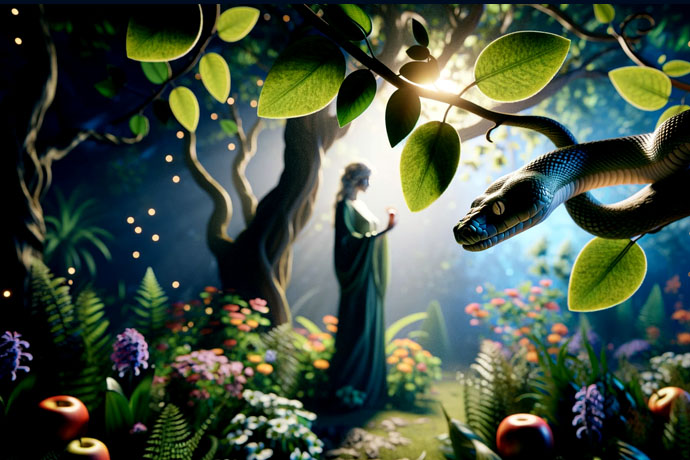
The Fall

The book Camino documents her 500-mile trek along a pilgrim’s path in northern Spain. She claims that her journey led her spiritually back through thousands of lives to the start of the universe. On the beach she shouted I am God, Shirley MacLaine, standing on the beach with her hands raised in the air.
Shirley MacLaine says that her spirit guide, supposedly her “Higher Self,” told her, “Each soul is its own God. You must never worship anyone or anything other than self. For you are God. To love self is to love God.”6 New Age pantheism deifies self and recognizes no higher moral absolute.
Genesis 2:24Therefore shall a man leave his father and his mother, and shall cleave unto his wife: and they shall be one flesh. 25And they were both naked, the man and his wife, and were not ashamed.
Genesis 3:1 Now the serpent was more subtle than any beast of the field which Jehovah God had made. And he said unto the woman, Yea, hath God said, Ye shall not eat of any tree of the garden? 2 And the woman said unto the serpent, Of the fruit of the trees of the garden we may eat: 3 but of the fruit of the tree which is in the midst of the garden, God hath said, Ye shall not eat of it, neither shall ye touch it, lest ye die. 4 And the serpent said unto the woman, Ye shall not surely die: 5 for God doth know that in the day ye eat thereof, then your eyes shall be opened, and ye shall be as God, knowing good and evil. 6 And when the woman saw that the tree was good for food, and that it was a delight to the eyes, and that the tree was to be desired to make one wise, she took of the fruit thereof, and did eat; and she gave also unto her husband with her, and he did eat. 7 And the eyes of them both were opened, and they knew that they were naked; and they sewed fig-leaves together, and made themselves aprons. 8 And they heard the voice of Jehovah God walking in the garden in the cool of the day: and the man and his wife hid themselves from the presence of Jehovah God amongst the trees of the garden.
There is no chapter in all of Holy Scripture that is more broadly despised in the culture at large than this one. A talking snake, An angel with a sword flashing to keep people out of the garden. All those little line-diagram cartoons with Adam and Eve, with a little snake twisting around in the background and an apple somewhere.
It’s all a bit of a joke, but I am persuaded that unless we come to grips with this chapter in the Bible, we’re not going to make much sense of the rest of the whole Bible. We’re not going to come to any agreement as to what the solution is if we can’t agree as to what the problem is.
This chapter sets out mankind’s problem.
If what we need above all else is the forgiveness of our sin, if what we need above all else is reconciliation with the God who made us, then we need a Savior. None of the Bible makes
sense without this chapter. That’s certainly what Paul thought. He can set up his understanding of who Jesus Christ is in terms of a kind of running contrast between Adam and Christ.
in Romans 5 we read, “Consequently just as the result of one trespass was condemnation for all flesh, so also the result of one act of righteousness was justification that brings life for all men.” 1 Corinthians 15: “For since death came through a man, the resurrection of the dead comes also through a man.”
How deceitfully repulsive was the first temptation.
The Serpent is introduced, Exactly what the communication arrangements were in Eden, we cannot possibly know.
Whether the Serpent symbolizes the Devil or embodies the Devil, we cannot exactly know either. What is clear from later in Scripture is that the Serpent was certainly the locus by which Satan himself was made known. In Revelation 12, Satan is described as “that old serpent.” We are told right away that this Serpent was not an independent or autonomous being.
He was more crafty than any of the wild animals the Lord God had made, the Bible does not set things up as if there is a good person, God, and a bad person, the Serpent, or the Devil. It is not as if these two sort of fight and then you hope the good guy wins. It’s not the way things are set up.
There’s a great deal of popular religion in Western culture generally that assumes that sort of thing. There is, out there, the Force. Then there is the light side of the Force and the dark side of the Force, the good side of the Force and the bad side of the Force. Which side wins?
The way God sets things up is; He made the whole show. You begin to have rebellion amongst the creatures that he himself made, whether in the Serpent or in his own image-bearers, human beings made in his image and likeness. If we do not see that, we will not come to grips with what the rest of this chapter has to say.
“Now the serpent was more crafty than any of the wild animals.” It’s not suggesting that God made him a bit of a sneaky character. The word rendered crafty is often rendered in the Hebrew Bible prudent. Proverbs 12: “A prudent man keeps his knowledge to himself.” Proverbs 14: “The prudent are crowned with knowledge.” Exactly the same word as here.
The same word can suggest conduct that in a noble or right or clean person is prudent. In a person that is already degenerate, that same capacity turns toward craftiness and scheming. Without explaining how this created being fell, nevertheless that’s the hint that’s already given. This created serpent was already beginning to be in rebellion and turning his prudence toward craftiness.
He begins with a question, not a contradiction.
He merely entertains a possibility. He says to the woman, “Did God really say, ‘You must not eat from any tree in the garden’?” By raising a question, he merely injects the right amount of skepticism. A slightly incredulous, “Did God really say that?”
This is both upsetting and mildly flattering. It sneaks in the assumption without actually saying so that we may stand in judgment of God’s Word.
“Did God say that? Well, let me think about that now. Moreover, he follows his smuggled-in assumption with exaggeration. He says, “Did God really say, ‘You must not eat from any tree in the garden?’
God had forbidden only one tree in the garden. What Satan does is focus on the one thing that God forbade, exaggerate it, and make that the entire focus of attention in order to sneak in the assumption that whatever else God is, he’s an almighty killjoy. He exists to make life as miserable as possible for you.
Because that is the way God is Eve: therefore you have the right to rebel.
“The woman said to the serpent, ‘We may eat fruit from the trees in the garden ” She rebukes his exaggeration. He did not forbid everything. So far, she’s on the right track. “We may eat fruit from the trees in the garden, but God did say, ‘You must not eat fruit from the tree that is in the middle of the garden, and you must not touch it, or you will die.’
God had forbidden them to eat it. He didn’t say anything about touching. Probably she’s now become a little sensitized and she’s beginning to wonder herself if maybe God is a killjoy so she ratchets up the negation.
She could have and should have said, There’s nothing wrong anywhere. This is so spectacular, and I don’t even have a long memory back toward anything. I don’t have any bad memories anywhere. Everything that I eat is good and the work is wonderful and the air is clean and God is the very center of my being; he’s my delight.
My husband and I, we walk with him in the cool of the day in an intimacy, for he is God. He made us. He knows everything. He knows what is wise. He knows what is good. I exist for his very pleasure, and you’re suggesting that he doesn’t know what he’s doing and I should stick it to him?” That’s what she should’ve said.
Instead, she wants to begin to entertain the possibility of standing in judgment of God.
Encouraged, he comes back, ‘You will not surely die,’ the serpent said to the woman. ‘For God knows that when you eat of it your eyes will be opened, and you will be like God, knowing good and evil.’
Now for the first time, Satan introduces a flat-out contradiction of what God says.
The first doctrine to be denied is the doctrine of judgment. It is commonly so. If you want to escape the authority of God in Scripture, begin by denying any sanctions. Then it’s safe to rebel against him. Emphasize that he’s the God of love. Forget that his holy perfection demands retribution.
“You will surely not die.” Indeed, God himself is the liar. Not only is he the killjoy, he’s not really telling you the truth. “God knows that when you eat of this fruit your eyes will be opened, and you will be like God, knowing good and evil.”
Here is the Serpent’s big ploy, the total temptation.
Where they are nevertheless at this point is innocent.
In the last verse of chapter 2, we read: “The man and his wife were both naked, and they felt no shame.” Whatever this is saying about their wardrobe or lack thereof, the point is the symbol-ladenness of it. They are completely open to each other and feel no shame. What would it be like not to feel any shame whatsoever about anything you have ever said or done?
It wasn’t always so. At this point, they were naked and unashamed. They had nothing to be ashamed of. Nothing. They were innocent. Now what the Devil is promising them is an advance on innocence. The heart of the deceitfulness of his temptation is that what the Serpent promised them was partly true and totally false. The truth is that in one sense, by succumbing to this temptation, human beings were opening up to some kind of deeper level of moral consciousness.
After the fall, “The Lord God said, ‘The man has now become like one of us, knowing good and evil.’ There is a sense now in which they have come to know good and evil. In that sense, they have become more godlike. They have opened up to a deeper level of moral consciousness. Yet it was all a lie, a big, vicious lie.
For God knows the difference between good and evil from the outside. He knows about the difference between good and evil from his omniscience. He knows not only all things that have been and all things that are and all things that will be, but even all things that would have been under different circumstances. He knows about good and evil.
These, his image-bearers, learn about good and evil from the inside. They learn about evil by being evil. In that sense, what Satan promised was a total lie. It is a lie so big as to overturn an entire worldview, an entire frame of reference. The incentive is to become like God, to refuse to recognize my place as a creature and become like God. That’s the motive.
To achieve it, in fact, by defying him. The result is that in the future, God will be regarded at least as a rival, if not as an enemy. Here is where we need to think very clearly about this tree and its fruit. The fruit was not an apple. No apple is mentioned. It is not as if pears and pineapples are okay, but God has it in for apples; he’s a bit arbitrary and whimsical when it comes to fruit.
This temptation was bound up with a move into experience that would illuminate good and evil experientially from the inside by defying almighty God.
The temptation was not simply an invitation to break a single rule, though it was that.
It was an invitation rather to begin a revolution,
to start thinking differently about where the center of everything is.
In the beginning, there was God. Human beings made in his image rightly related to him. They woke up and thought about him. They loved him. They cherished him.
They were rightly related to each other because they were rightly related to him. Now with each human being wanting to be at the center of the universe, then God himself gets relegated to the second division. God now if he, she, or it exists, jolly well better exist to please me or, frankly, I’ll find another God,
And there is the beginning of idolatry, and because I am at the center of the universe, but you, you stupid twit, you think that you’re the center of the universe, pretty soon you start fighting me and I start fighting you. It is not long then before there is fratricide, in the next chapter, and rape and war and hate and lust and greed and animosity. All stemming from idolatry.
All stemming from the simple fact that we say, “I will be God!” That is what this sin really is. It’s a revolution against God, against the Maker, the Maker whose world Adam and Eve are enjoying, whose presence they delight in. “When the woman saw that the fruit of the tree was good for food and pleasing to the eye, and also desirable for gaining wisdom, she took some and ate it.”
The woman saw that it was good for food; that is, physically appealing. She saw that it was pleasant to the eye; that is, aesthetically pleasing. She saw that it was desirable for gaining wisdom; that is, mentally transforming. She saw all these things and she made her own judgment. “This is good.”
Already we’re a long way removed from chapters 1 and 2. In chapters 1 and 2, God made something, and he said that it was good. He made something else, and he saw that it was good. He made the whole thing, and he saw that it was very good, for God alone is completely equipped to define what is good and what is evil.
But already this right the woman wants to arrogate to herself. She will define what is good and what is evil. Until we get to the horrid situation in the prophet Isaiah, who describes men and women who put light for darkness and darkness for light, who put good for evil and evil for good. Is that so uncommon in the United States? The woman follows her impressions instead of her instructions, her desire to be fulfilled instead of her desire to obey.
She wants to be like God instead of to love God. She takes some and she eats.