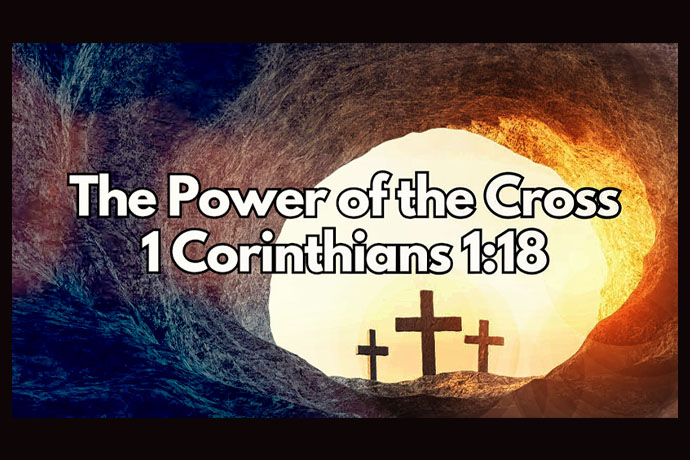
The Cross

1 Corinthians 1:18
18 For the word of the cross is to them that perish foolishness; but unto us who are saved it is the power of God. 19 For it is written, I will destroy the wisdom of the wise, And the discernment of the discerning will I bring to nought. 20 Where is the wise? where is the scribe? where is the disputer of this world? hath not God made foolish the wisdom of the world? 21 For seeing that in the wisdom of God the world through its wisdom knew not God, it was God’s good pleasure through the foolishness of the preaching to save them that believe. 22 Seeing that Jews ask for signs, and Greeks seek after wisdom: 23 but we preach Christ crucified, unto Jews a stumblingblock, and unto Gentiles foolishness; 24 but unto them that are called, both Jews and Greeks, Christ the power of God, and the wisdom of God. 25 Because the foolishness of God is wiser than men; and the weakness of God is stronger than men.26 For behold your calling, brethren, that not many wise after the flesh, not many mighty, not many noble, are called: 27 but God chose the foolish things of the world, that he might put to shame them that are wise; and God chose the weak things of the world, that he might put to shame the things that are strong; 28 and the base things of the world, and the things that are despised, did God choose, yea and the things that are not, that he might bring to nought the things that are: 29 that no flesh should glory before God. 30 But of him are ye in Christ Jesus, who was made unto us wisdom from God, and righteousness and sanctification, and redemption: 31that, according as it is written, He that glorieth, let him glory in the Lord.
What would you think of a church building adorned with a fresco of the mass graves of Auschwitz, the worst of the Nazi death camps?
Even to ask questions like that produces a kind of shudder of embarrassment. The images are so grotesque and abhorrent and shocking because of Western history in the last 50 or 60 years, but that was the sort of shocking overtone associated with the word cross or crucifixion in the first century. In the first century, the Romans had a variety of ways of executing people, but the worst of them by far, not just in terms of pain but in terms of cultural shock value, was crucifixion.
It was reserved only for non-citizens. No Roman citizen could be executed by crucifixion apart from the explicit sanction of the emperor. In general it was reserved for traitors and slaves, and in the literature from 200 BC to well into the present era, whenever the cross is mentioned there are overtones of shudder and horror.
Yet today, crosses dangle from our ears. We sport them upon our lapels,. We put them on our buildings. Our bishops wear them around their necks. Nobody’s embarrassed, and thus it is hard to hear the sheer audacity of a verse like 1 Corinthians 1:18. “The message of the cross is foolishness to those that are perishing, but to us who are being saved it is the power of God.”
To understand the sheer power of what Paul is saying we need to think ourselves back into the first century and then work forward again to our present era. It may be helpful to follow the theme in the three paragraphs of our text: first, the foolishness of the cross, then second, the outreach of the cross, and then lastly, the proclaimers of the cross.
The foolishness of the cross.
Paul says, “Christ did not send me to baptize but to preach the gospel, not with words of human wisdom …”
The exact expression is “not with wisdom of words.” That is with wisdom of eloquence, with wisdom of rhetoric. “… lest the cross be emptied. But the word of the cross,” he says, “is power. I haven’t come with the wisdom of word; I have come with the word of the cross.”
Paul insists that the message of the cross, by God’s determination, divides the entire human race absolutely.
Every culture has various ways of classifying people.
In the ancient world, there were slaves and there were free. Then there were Greeks, that is, Greek-speakers who embraced most people in the empire, and then there were the barbarians. Then there were the Roman citizens, and then there were the non-citizens.
He divides the race into those who are perishing and those who are being saved.
50 billion years into eternity, if we dare to speak of eternity in the categories of time, it won’t matter too much whether in your life you were slave or free or barbarian or Greek or white or black or British or American or whatever. It will only matter whether you’re saved or perishing.
The Bible has a lot to say about justice, and etc, but the ultimate polarity is, is the person reconciled to the living God or not?
Paul says, “on the axis of that polarity, the cross will appear one way to one group, and it will appear another way to another group.”
The dividing point between the two groups is the message of the cross. To the one it’s foolishness, and to the other it’s not only wisdom, it’s transforming power. It’s life-changing.
Paul emphasizes God’s purpose by citing Scripture. This did not come about accidentally. He says in verse 19, “It is written …” Now he quotes Isaiah 29. God has already declared himself on this question,
“I will destroy the wisdom of the wise” God has said. “… the intelligence of the intelligent I will frustrate.” That is, the message of the cross is nothing other than God’s way of doing what he said he would do. He would set aside and shatter all human pretensions to strength and wisdom.
Strictly speaking, this is bound up with the Bible’s view of sin. Sin is not seen in the Bible primarily as a social pathology or something naughty, It is seen as principled defiance of our Maker.
That means that fallen man thinks of themselves as at the center of the universe.
He asks three stinging rhetorical questions. “Where is the wise man?”
Now, the wise man in the Greco-Roman world was a person with a kind of public philosophy that explained everything.
Your worldview explained your world for you, and it was advanced by the academics of the day in the marketplace and in teaching platforms as the best way of understanding life, and describing family, and ordaining moral structures in a society.
Paul is saying, in effect, “Which of the schools of philosophy of the day figured out the cross?”
How about capitalism, did it think its way through to the cross?
How about democracy, does democracy as a system, as a political way of organizing a nation, think its way through to the cross?
Paul says, “why do you hold up these competing structures of thought as if they are at the very acme of what is central and good and wholesome, if they cannot get to what is foundational in reconciling men and women to their Maker?”
“Where is the expert in law? Where is the scholar?”
“Where is the theologian?” Do theologians, by themselves apart from what God has disclosed, do they think themselves through to the cross?
The point is that in the cross God has already passed judgment on the world.
The wisdom of God determined that the world, through its wisdom, would not know him. That is, once this world has already rebelled against him, once this world has already become so self-satisfied and smug, whether in its political or its social or its religious systems, that in fact it’s self-proclaimed autonomy is precisely at the heart of the problem, God determines, through his wisdom, to save men and women outside all the wisdom they can think of.
If not, we’re simply going to pat ourselves on the back for all eternity about how wise we were to think up some way they could manage to outsmart God or save themselves.
The reason why this is so destructive of the world’s wisdom is that a god discovered by human wisdom will be both a projection of human fallenness and a source of human pride, and this constitutes the worship of the creature, not the Creator.
Paul divides those who perish into two groups who represent the fundamental idolatries of every age.
“Jews demand miraculous signs, and Greeks look for wisdom.”
In both cases, in other words, that represented by the Jew and that represented by the Greek, there is a profound self-centeredness and God is not taken on trust.
He must present his credentials to human beings. We want to approve him.
The outreach of the cross.
By and large, the people in Corinth who have become Christians are not the wise or the glamorous or the gifted or the saintly. No, by and large, with some wonderful exceptions, they’re nobodies. That’s what he says.
“Brothers, think of what you were when you were called.” Verse 26. “Not many of you were wise by human standards. Not many were influential. Not many were of noble birth. But God chose the foolish things of the world to shame the wise.” In other words, Paul wants the church to recognize the point.
Paul is not saying here that you cannot be a Christian if you have a decent mind. For a start, he’d exclude himself. He is saying, “Look around the world. Look in your own church. Look at who are Christians. Does God give a certain kind of extra percentage, a handicap, perhaps, to certain people and not others? So what are you boasting about?
Being wise, powerful, or wellborn cannot be a criterion of being a Christian, and it is important to understand that at Cambridge University., but it is never a criterion for being a Christian. If anyone approaches God on such terms, he or she is necessarily excluded. That would be a kind of domestication of God by the wise or the educated or the wealthy or the wellborn.
That is why so many people the Lord calls are the poor and the disenfranchised.
“God chose the weak things of the world to shame the strong. He chose the lowly things of the world and the despised things and the things that are not to nullify the things that are.” Why? What was the ultimate end here? “So that no one may boast before him.”
No one is going to stand before God on the last day and say, “Well, you know, the gospel came to a lot of people, a lot of friends, and basically I was smart enough to make the right decision.”God acts this way so that no one will boast. His actions prove that he is gracious. He does not owe the world forgiveness, and he chooses the people who seem most in need of help.
No. “It is because of him that you are in Christ Jesus, who has become for us wisdom from God—that is, our righteousness, holiness, and redemption. Therefore, as it is written, ‘Let him who boasts, boast in the Lord.’ ”
That is, Christ is not our wisdom in the same way that the Jews look for wisdom or the Greeks look for wisdom, in a philosophical structure that explains everything. He’s our wisdom along certain axes. Righteousness is in the legal realm. Holiness is in the religious realm. Redemption is in the realm of social structure, slavery.
You see, in the righteousness realm, how is a guilty person, a rebel, to approach a holy God, a God who is right, who demands that people be right?
He takes their punishment. That’s why Paul says the cross is the place where God is both right and the one who makes right, who puts right, who declares right, who justifies (same word), those who are guilty and sinners. That’s what the cross has done.
The proclaimer of the cross.
The pretensions and arrogance of the Corinthians were opposed not only by the foolishness of the cross, and exposed by the outreach of the cross, but also by Paul’s own example when he first went to Corinth and preached to them. That is, even the preacher who had introduced them to Jesus had self-consciously turned away from showmanship and self-reliance.
Paul writes, “When I came to you, brothers, I did not come with eloquence or superior wisdom as I proclaimed to you the testimony about God.” Now it’s hard for us to come to terms with a verse like that, because we no longer live in days where rhetoric is viewed with great honor.
There’s no rhetoric. There’s no training. There’s no evaluation. It’s just a talking head.
Until the turn of the century, rhetoric was taught in all the major Western universities. Rhetoric was on the curriculum, and it was judged to be part of a proper education, to know how to speak, to present a case, to know the forms and devices of rhetoric. The trouble is, when that is done it can become an end in itself, so how you say something may be more important than what you say. That’s the kind of thing that Paul faced in the first century.
“When I came to you, brothers, I did not come with eloquence or superior wisdom …” What he means is the wisdom of philosophical rhetoric. “… as I proclaimed to you the testimony about God.” What did Paul do when he was there? First, he says, “I resolved to know nothing while I was with you except Jesus Christ and him crucified.”
“Not only so,” He also says, “I came to you in weakness and fear and with much trembling.” After all, he’d gotten beaten up and thrown in jail in Philippi a few months back, run out of town on a rail in Thessalonica, been in pretty horrendous debates in Athens, and now he comes to Corinth, a bit of the armpit of the empire. It’s not surprising he’s a bit nervous at this point.
But it is frequently when the preacher is ill or weak or overwhelmed or afraid that the power of God comes down and people are transformed. He was determined to focus on the cross, not to impress people with his eloquence. He himself was scared witless and sometimes ill. In fact, according to Acts, chapter 18, God had to give him special encouragement even for him to stick it out.
“Not only so,” he said, “but my message and my preaching were not with wise and persuasive words.” That is, “I wasn’t manipulative. I wasn’t fooling you.”
When people are genuinely converted you can tell the difference. He wants this “… so that your faith may not rest on men’s wisdom, but on God’s power.”
May the power of the gospel utterly transform all of your living and being during this year and for all eternity, amen.