Subtle Ways We Abandon the Authority of Scripture in Our Lives

This abandonment leads to a weak conscience, which in turn, paves the way for us to conform our lives to the worlds ideas and beliefs.
Eerdmans not long ago published a book, The Enduring Authority of the Christian Scriptures. The hope and prayer that guided the project were that this volume of essays would be used by God to stabilize worldwide evangelicalism, and not only evangelicals, but all who hold to confessional Christianity.
With this thought we are not thinking of the college student brought up in a confessional home that turns away after college. We are thinking about subtle ways in which we may reduce Scripture’s authority in our lives, and the “we” refers to many Christians in the world, especially the Western world, and not least pastors and scholars.
There is An Appeal to Selective Evidence
One appeal is the simple refusal to talk about disputed matters in order to sidestep controversy in the local church. For the sake of peace, we offer (weak treatment that cause no problems, treatments of hot topics in the forlorn hope that some of these topics will eventually go away.
The sad reality is that if we do not try to shape our thinking on such topics under the authority of Scripture, the result is that many of us will simply pick up the culture’s thinking on them, and conform to the world.
The best antidote is systematic expository preaching and teaching, because it forces us to deal with texts as they come up.
Preachers and Teachers are Embarrassed before the Text
To often preachers avoid certain topics, in part because those topics embarrass them. The embarrassment may arise from the preacher’s awareness that he has not yet sufficiently studied the topic so as to give him the confidence to tackle it. Topics like, eschatology, transgenderism, or because of some general unease at the topic, or because the preacher knows his congregation is sharply divided on the topic.
Sometimes it happens just because the preacher really does not like the subject even though it surfaces fairly often in the Bible (hell, eternal judgment). In its ugliest form, the preacher says something like this:
Our passage this morning, Luke 16:19–31, I wish I could avoid these passages. They leave me distinctly uncomfortable. But of course, I cannot ignore them entirely, for they are right here in the Bible, after all. In doing this the preacher has formally submitted to Scripture’s authority while presenting himself as someone who is more compassionate or more sensitive than Jesus. This is as deceptive as it is wicked
What a contrast from the apostle Paul’s view.
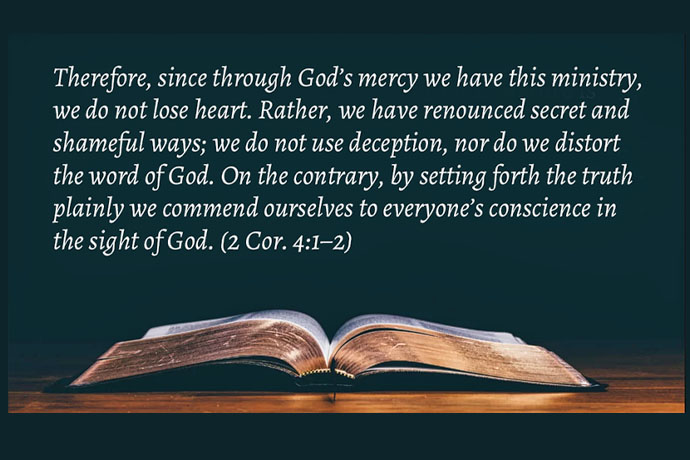
Therefore, since through God’s mercy we have this ministry, we do not lose heart. Rather, we have renounced secret and shameful ways; we do not use deception, nor do we distort the word of God. On the contrary, by setting forth the truth plainly we commend ourselves to everyone’s conscience in the sight of God. (2 Cor. 4:1–2)
When people preach and teach things that Legitimize what God Condemns
Not that long ago Zondervan published Two Views on Homosexuality, the Bible, and the Church; this book bills these two views as “affirming” and “non-affirming,” and two authors support each side. Both sides, we are told, argue “from Scripture.”
The format of such volumes, x views on y, is intrinsically slippery. It can be very helpful to students to read, in one volume, diverse stances on complex subjects, but the format is in danger of suggesting that each option is equally “biblical” because it is argued “from Scripture.
Of course, Jehovah’s Witnesses argue “from Scripture,” but most of us would hasten to say that their exegesis, nominally “from Scripture,” is woefully lacking.
It is generally the case that books of the “x views on y” format operate within some implicit confessional framework or other. These publishing’s are is designed simultaneously to assert that Scripture is less clear on the said topic than was once thought, and to redefine, once again, the borders of evangelicalism. On both counts, the voice of Scripture as the (the rule that rules), though theoretically still intact, has in fact been subtly reduced.
“An Evangelical Approach to Sexual Ethics,” Stephen Holmes says,
Sola Fide. (faith alone) I have to stand on that. Because the Blood flowed where I walk and where we all walk. One perfect sacrifice complete, once for all offered for all the world, offering renewal to all who will put their faith in Him. And if that means me, in all my failures and confusions, then it also means my friends who affirm same-sex marriage, in all their failures and confusions. If my faithful and affirming friends have no hope of salvation, then nor do I.
This is an abuse of the evangelical insistence on sola fide (faith alone). I do not know any Christian who thinks that salvation is appropriated by means of faith plus an affirmation of heterosexuality.
Faith alone is the means by which sola gratia (grace alone) is appropriated. Nevertheless, that grace is so powerful it transforms. Salvation by grace alone through faith alone issues in a new direction under the lordship of King Jesus. Those who are sold out to the “acts of the flesh . . . will not inherit the kingdom of God” (Gal. 5:19–21). The apostle Paul makes a similar assertion in 1 Corinthians 6:9–11:
Or do you not know that wrongdoers will not inherit the kingdom of God? Do not be deceived: Neither the sexually immoral nor idolaters nor adulterers not men who have sex with men nor
thieves nor the greedy nor drunkards nor slanderers nor swindlers will inherit the kingdom of God. And that is what some of you were. But you were washed, you were sanctified, you were justified in the name of the Lord Jesus Christ and by the Spirit of our God.
In the context of Paul’s thought, he is not saying that without sinless perfection there is no entrance into the kingdom, but he is saying that such sins, whether greed or adultery or homosexual practice or whatever, no longer characterize the washed, sanctified, and justified.
It is one thing to affirm with joy that sola fide means that we appropriate the merits of Christ and his cross by faith alone, not by our holiness, that holiness is the product of salvation, not its condition. But, it is quite another thing to say that someone may self-consciously affirm the non-sinfulness of what God has declared to be sin, of what God insists excludes a person from the kingdom, and say that it doesn’t matter because sola fide will get them in anyway.
The Scriptures make a lot of room for believers who slip and slide in “failures and confusions,” as Holmes put it, but who rest in God’s grace and receive it in God-given faith; they do not leave a lot of room for those who deny they are sinning despite what God says. Sola gratia and sola fide are always accompanied by sola Scriptura, (scripture alone).
Despite the best efforts of bad exegesis, the Bible makes it clear that treating homosexuality as if it were not a sin but a practice in which people should feel perfectly free to engage keeps one out of the kingdom ( 1 Cor. 6:9–11). There is nothing more serious than that, and the seriousness is present.
“The Art of Imperious Ignorance”
This is a quotation borrowed from Mike Ovey’s column in a 2016 issue of Themelios. This is the stance that insists that all the relevant biblical passages on a stated subject are exegetically confusing and unclear, and therefore we cannot know the mind of God on that subject.
We can reduce the authority of scripture by too little reading, especially the Reading of Older Commentaries and Theological Works
The more general failure of too little reading contributes to some of the paths that tend with time to hobble the authority of Scripture. The obvious one is that we do not grow out of youthful errors and reductionisms; we prove unable to self-correct; our shallow theology becomes ossified.
If we integrate more reading of, say, John Chrysostom, John Calvin, etc, we might be inclined to devote more attention in our addresses to what it means to be made in the image of God, to the dreadfulness of sin, to the nature of the gospel, to the blessed Trinity, to truth, to discipleship, to the Bible’s insistence that Christians will suffer and so on.
The authority gets silenced when there is an undisciplined Passion on the Technical dealing with scripture.
By the “technical” we mean the biblical study that deploys the full use of literary tools that begin with the original languages and pay attention to syntax, literary genre, textual criticism and literary criticism, parallel sources, interaction with recent scholarship, and so on.
We must be careful, for a manipulation of the tools and interaction with the scholars of the guild can sometimes become more important than trembling before the word of God.
Some so disdain careful and informed study that they seduce themselves into thinking that pious reading absolves one from careful and accurate exegesis. In both cases, the Bible’s real authority is diminished.
That division of tasks suggests there is no need to be devotional when using technical tools and no need for rigor when reading the Bible devotionally. Far better to insist that even when they are wrestling with difficult verbal forms and challenging syntax, what they are working on is the word of God, and it is always imperative to cherish that fact and treat the biblical text with reverence.
We reduce scripture authority when we place more undisciplined Confidence in Contemporary Philosophical Agendas
Charles Taylor, argues that language is in some measure cut off from reality: it is not so much something that designates as it is the medium in which we exist. He says, there is no fixed “meaning” to texts (which is very hard to square with the conviction expressed in Jude 3).
Jude 3 Beloved, while I was giving all diligence to write unto you of our common salvation, I was constrained to write unto you exhorting you to contend earnestly for the faith which was once for all delivered unto the saints.
One form of this approach to texts is, that a “good” reading meets particular needs on the part of the reader or community and must not be thought of as conveying timeless truth.
This generation is not the first one to make such mistakes. Every generation in this sin-addled world experiments with a variety of philosophical stances that can easily (sometimes unwittingly) be used to subvert what Scripture says.
Authority of Scripture is reduced by anything that reduces our trembling before the Word of God.
“These are the ones I look on with favor: those who are humble and contrite in spirit, and who tremble at my word” (Isa. 66:2). “ ‘All people are like grass, and all their glory is like the flowers of the field; the grass withers and the flowers fall, but the word of the Lord endures forever.’ And this is the word that was preached to you” (1 Pet. 1:24–25; Isa. 40:6–8).
The things that may sap our ability to tremble before God’s word are many. Common to all of them is arrogance, arrogance that blinds us to our need to keep reading and rereading and meditating upon the Bible if we are truly to think God’s thoughts after him.
Because the endless hours of data input from the world around us swamp our minds, hearts, and imaginations. Moral decay will drive us away from the Bible: Moreover, our uncharitable conduct may undermine the practical authority of the Bible in the lives of those who observe us. Failure to press through in our studies until we have happily resolved some of the intellectual doubts that sometimes afflict us will also reduce the fear of the Lord in us, a subset of which, of course, is trembling before his word.
——————–
To maintain a clear understanding and respect for biblical authority, it’s important to regularly assess how we approach Scripture. Here are some questions that can help keep our view of biblical authority grounded:
- Do we approach Scripture with humility and reverence?
The Bible is not just a book; it’s the Word of God. Approaching it with humility acknowledges that we are learning from God’s authority, not treating it as something to be shaped by our own preferences.
- Do we believe that the Bible is inspired by God and therefore authoritative in all areas of life?
This is foundational. If we lose sight of the Bible as the divinely inspired word, we can start treating it as just a collection of ancient writings that may or may not be relevant.
- Do we interpret Scripture in light of its historical and literary context?
Misunderstanding the context can lead to misapplication of the text. The Bible was written in specific cultural, historical, and literary contexts that shape how it should be understood.
- Do we let our personal preferences or cultural trends influence our interpretation of the Bible?
The Bible is often countercultural and challenges our natural inclinations. If we interpret it through the lens of our own biases, we risk distorting its message.
- Do we submit our thoughts and life-style to biblical teaching?
True submission to biblical authority requires ongoing personal reflection and alignment of our lives with the truth of Scripture. It’s not just about intellectual assent but about obedience.
- Do we take the Bible as a whole, or do we pick particular verses to support our own views?
The Bible is a unified story, with a clear overarching narrative of God’s redemption. Isolating verses can lead to misunderstanding and manipulation of Scripture to fit personal agendas.
- Are we open to correction when Scripture challenges our worldview or our behavior?
Part of submitting to the Bible’s authority is being open to change. If Scripture does not challenge us, we may not be reading it in the right way.
- Do we consider the role of tradition and the Church in interpreting Scripture?
We are not the first to read and interpret the Bible. The Church, both historically and globally, has wisdom that can guide us in understanding God’s Word. Ignoring that can lead to isolation in interpretation.
- Do we call on and rely on the Holy Spirit to guide us in our understanding of the Bible?
The Holy Spirit is our guide in understanding truth (John 14:26). Without His help, we might approach the Bible with a purely intellectual mindset, missing its transformative power.
- Do we understand the importance of doctrine and how it relates to everyday living?
Doctrines, such as the nature of God, salvation, and the Church, are not abstract concepts but truths that should shape how we live. If we neglect doctrine, we risk losing sight of the authority Scripture has in guiding our lives.
- Are we committed to studying Scripture regularly, both individually and in our small groups?
Regular study in the Scriptures helps us grow in our understanding of God’s Word and prevents us from drifting away from its authority. Church also provides accountability and the opportunity to learn from others.
- Do we really trust that God’s Word is sufficient for all matters of faith and practice?
Sometimes, we might feel the need to look elsewhere for guidance, whether it’s in culture, human wisdom, or even experiences. Trusting the sufficiency of Scripture ensures we maintain its rightful place in our lives.
- Do we allow the scripture to comfort and also challenge us?
The Bible speaks both words of comfort and conviction. If we only embrace the parts of Scripture that affirm us, we risk neglecting the parts that challenge us to grow and change.
- Are we willing to obey Scripture even when it goes against the grain of society or our own desires?
Obedience to Scripture can be difficult, especially when it conflicts with personal desires or societal expectations. Upholding the Bible’s authority means being willing to submit to it even when it’s hard.
- Do we pray for wisdom and understanding when we read and study the Bible?Prayer is an essential part of engaging with Scripture. It’s not just about reading, but about asking God to reveal His truth and to help us live it out.