Revelation 21:9ff What is missing There is no temple there.

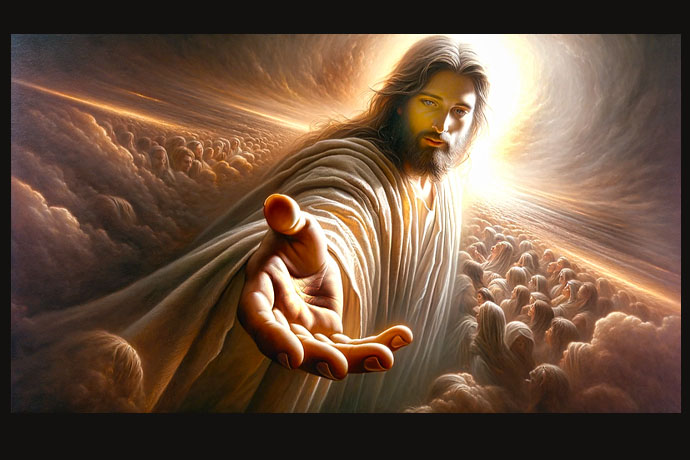
The heart of this chapter is the beatific vision: God, so spectacularly, transcendentally glorious that we will never exhaust his spectacular glory. Our words fail us. Our vision is too small. We cannot see clearly, but we see Christ and the Christ who died on the cross, the roaring lion and the slaughtered lamb is now the Lamb who sits with the Father on the throne. Father and Son constitute the light of that place.
We will see him face to face. There is no more night there. There is no more temple there. We will be with him forever. That, brothers and sisters in Christ, changes how we live. It changes what we perceive our treasure to be. It changes our direction. It changes our goals. We cry with the church in every generation, “Even so, come, Lord Jesus.” Let us pray.
Ancient Jerusalem had a temple, and before Jerusalem became the capital city, then wherever the capital city was, somewhere not too far away the tabernacle was, but now there is no temple because there is no mediation. God himself is always there.
More than 30 times in the book of Exodus alone, you find some variation on this clause: “See that you build it according to the pattern showed you on the mount.” Moses constructed everything according to the pattern showed him on the mount. That sort of phrase is repeated again and again and again.
Those were the days before prefab. Not the temple in Jerusalem, It was built of stone. There was no drywall, there was no hydraulics. There was no prefab, and it was illegal to use a hammer within the sound of the temple precincts. Everything had to be cut and measured elsewhere and then brought by hand, (stone, whopping big blocks of it) and put carefully in place.
Then when the thing was built, the glory of God came down upon the tabernacle, which great glory was repeated in its descent at the time of the temple. Do you recall when the glory came down upon the temple? All of the priests had to leave because the glory was so spectacular that they were crushed by it. They just left. Then the great prayer of dedication by Solomon.
Once a year, the people enter symbolically in a mediated way through the high priest. Then in the devastating vision of Ezekiel 8–11, Ezekiel is transported in a vision 700 miles back to Jerusalem. He sees all the sin, the shame of the whole place, and the glory of God rises from the temple and moves to the mobile throne already depicted in Ezekiel 1, and then abandons the city, crosses the Kidron Valley, and parks on the Mount of Olives.
What’s this saying? It’s saying that God has abandoned the temple. God has abandoned Jerusalem. So when Nebuchadnezzar and his hordes come through, it’s not because God wasn’t strong enough to handle them, but because God is using them precisely to effect his judgment. When the temple is rebuilt, there is no mention anywhere of the glory returning, but one day in the streets of Jerusalem there was heard a voice that said, “Destroy this temple, and in three days I will raise it again.”
No Temple
There’s no special place for mediation, no special place to meet with God for only a sanctified few, the elite of the elect of the priestly class. “The Lord God Almighty and the Lamb are its temple.”
Already in the days of his flesh, you’ll remember from John 2, Jesus, looking at the great masonry of the temple of Jerusalem with all of its splendor said, “Destroy this temple, and in three days I will raise it again.” His opponents didn’t have a clue what he meant. His disciples didn’t have a clue what he meant.
John remarks, “After Jesus had risen from the dead, then they remembered his words and they understood the Scripture.” The temple he was speaking of was his own body. Yes, the Lord God Almighty and the Lamb are its temple because, you see, Jesus himself by his death and resurrection is the great mediation. He is the great place where people come to meet God.
That’s the whole point.
You don’t need the symbols anymore. You don’t need the metaphors. You don’t need the temple structures. You are always and forever with Christ himself, who is our temple.
His enemies didn’t understand what he meant, and his friends didn’t understand what he meant, but after Jesus rose from the dead, then they did. Here was the true meeting place between God and human beings. The temple was not an end in itself. It was one more pointer, like the sacrifices, like the priests, like the lamb, like the bull, like the goat … one more pointer toward him who would fulfill all of these patterns in himself.
In a derivative way, we, the church of Jesus Christ, are the temple, and in a still further derivative way, the individual Christian is the temple of God, that is, the place where God takes up his residence by his Spirit. Now we come to another mixed metaphor. We come to the New Jerusalem, and the whole city is built like the Most Holy Place. That indicates that we are all now in the presence of God.
Or to change the whole thing again and look at it a different way, there is no temple at all, because the Lord God Almighty and the Lamb are its temple. There’s no need for mediation. All of the mediation has been done. There’s no sun, no moon, we’re told, for the glory of God fills this entire universe, and there is no more night. This is not talking any more about the astronomical principles of the new heaven and the new earth than the lack of water is talking about the hydrological principles of the new heaven and the new earth.
There is no sun or moon there.
This is not talking about the astronomy of the new heaven and the new earth. It is saying at a time when there was no electric power, when people knew what night was, and night was the time of darkness and possibilities of dangers when thieves could hide more readily, then it was important to have a sun and a moon.
All that we know of light is mediated light, but now we’re in the light of God, unqualified, with no cycles of day or night.
The glory of God …” God’s disclosed presence, all that he is. “… gives it light, and the Lamb is its lamp. The nations will walk by its light, and the kings of the earth will bring their splendor into it.”
“The glory and honor of the nations will be brought into it. Nothing impure will ever enter it, nor will anyone who does what is shameful or deceitful, but only those whose names are written in the Lamb’s book of life.”
There is no impurity there.
“Nothing impure will ever enter it, nor will anyone who does what is shameful or deceitful, but only those whose names are written in the Lamb’s book of life.” Is there any sense yet in which you’re homesick for heaven? if you’re not homesick for heaven, when you read such words as these, you probably don’t hunger for purity.
That is why serious Christians across the centuries have always prayed, “Forgive my sin and make me on earth just as holy as a pardoned sinner can be this side of the consummation, and then at the consummation finish the job and glorify your Son.”
That is why there is such a strong contrast between verse 7 and verse 8. “He who overcomes will inherit all this, and I will be his God and he will be my son.” There’s a sense in which we’re already son, but then we will be the son without the footnotes, without the residue of sin, without the corruption that still traps us now.
There we will reflect God.
The contrast is painfully, desperately sharp: “But the cowardly, the unbelieving, the vile, the murderers, the sexually immoral, those who practice magic arts, the idolaters and all liars, they will be consigned to the fiery lake of burning sulfur. This is the second death.”
The catalog of sins concludes with all liars. The phrase likely points to a focus on those whose Christian profession is betrayed either by compromising behavior or false doctrine.
This is the second death.”
This passage is not saying that we really never did belong to any of those classes. “Bad people go in this direction; good people go in this direction. Just be good enough and you’ll get to heaven.”
There’s no way in the light of this book as a whole that is what this text is saying. Already as early as the vision of chapters 4 and 5, we have learned there we have been purchased for God by the blood of Christ, by the blood of the Lamb. That is why we have access into the very presence of God. Our sins have been paid for by another.
As far as I can see in Scripture, there is no hint anywhere that people in hell genuinely repent. Even in the parable of the rich man and Lazarus, the rich man lifts his eyes in torment and somehow he is enabled to see, in the story, Abraham and Lazarus afar off. Considering how he had treated Lazarus during the days of his flesh, what do you think the rich man in hell should say? What do you think he would say?
Wouldn’t you expect him so say, “Oh Lazarus, did I get that one wrong! I am so sorry. Will you please forgive me?” Wouldn’t you expect that? He doesn’t even address him; he was a nobody in the days of his flesh. The rich man doesn’t deal with nobodies. He goes right to the top. “Father Abraham,” he says, “tell Lazarus to go and dip his finger in water and bring me something to cool my tongue. It’s pretty hot here.” Where’s the repentance in that?
He still thinks he’s at the center of the universe. He’s still going to order Lazarus around. There’s no brokenness, there’s no contrition, there’s no shame. Before the story is over, he’s actually arguing theologically with Abraham: “No, Father Abraham, you got that one wrong. If someone rose from the dead that would really make a difference.
All the promises of God made to the earthly saints in the letters are fulfilled in this section. How important it is to reflect on the fact that God is faithful to His promises and that it is not unspiritual or selfish to suppose He rewards those who seek and serve Him, since that is His will for us. God does want our best. How often do we list the promises He has already fulfilled for us and use that as an encouragement for the fulfillment of all that is yet to come