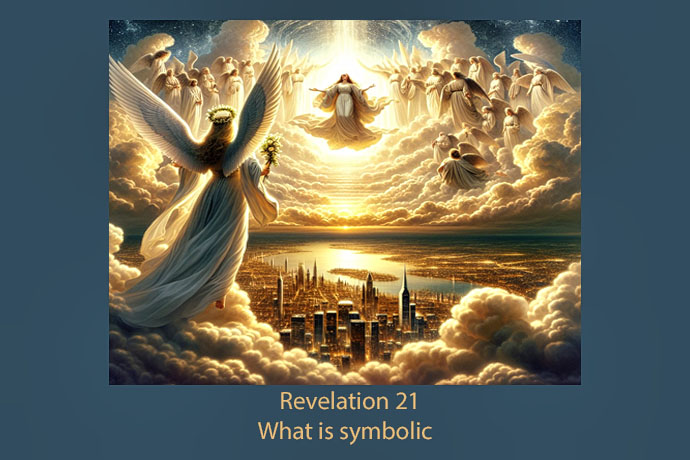
Revelation 21 What is symbolic

At one level, much of the language already used up to this point has been steeped in symbolism, New Jerusalem, and so forth, but now, the interpreting angel in the vision goes to great lengths to make John reflect on particular elements of the symbolism, and the language is extremely symbol-laden. In verses 9–10, for example, he makes it abundantly clear that the wife, the bride of the Lamb, is the New Jerusalem.
The New Jerusalem is in the new heaven and the new earth and the bride is in Jerusalem. They’re all the same thing. They’re being looked at from different angles.
The one new detail in verses 9–10 is the identification of the bride’s husband at the end of verse 9. “The wife of the Lamb, the identification is obvious, it is Christ. The intriguing thing is you’re still in the realm of mixed metaphor. Why don’t you say the wife of the groom or even the wife of the husband or the wife of Christ or the wife of Messiah? Why say the wife of the Lamb? Now suddenly she’s a ewe sheep.
You’re mixing your metaphors all the time, you have to come to terms with that and not try to be too literalistic or you just make hash of it again and again and again. She’s the wife of the Lamb not because you think of the Lamb primarily in terms of being a husband but because the Lamb is the one who is identified from chapter 5 on as Christ, who is also the lion, who brings about all of God’s redemptive purposes.
The one who brings about all of God’s redemptive purposes, by virtue of the fact that he is a lamb, is the one who enters into this perfect consummation of unity with the bride. That’s the logic behind it, but it’s all in such compressed, symbol-laden language you could make hash of this pretty fast if you tried to draw pictures or something.
From here to the end of the book, the Lamb is now front and center.
v14: “The twelve apostles of the Lamb.” V22: “The Lord God Almighty and the Lamb are its temple.” V23: “The Lamb is its lamp.” V 27: “Only those whose names are written in the Lamb’s book of life.” Chapter 22:1: “From the throne of God and the Lamb.” V3: “The throne of God and the Lamb will be in the city.”
So God and the Lamb, God and the Lamb, God and the Lamb. This is central now throughout the whole thing. That is not accidental. John is transported in the Spirit to a high mountain, presumably one final vision.
He’s transported to a high mountain is simply to gain a vantage point from which he can see the New Jerusalem coming down. We’re not supposed to say, “Well, where is this mountain located? Does it belong in some other country or some other universe?” It just is confusing the symbolism. There’s nothing outside the new heaven and the new earth or nothing outside the New Jerusalem in this new language.
It is reminiscent of Moses being called up on the mount of God to look at things from God’s perspective or Jesus, in visionary experiences with the Devil, being offered all the kingdoms of this world. Obviously, you can’t get on a mountain high enough to see them all. It was a visionary experience.
He sees the New Jerusalem coming down, this descent of the New Jerusalem coming down is merely an expansion of what we’ve seen in chapter 21:1–8
This is not another coming down. It’s the same one, only it’s now expanded a little bit so that there are more elements of the symbolism that are unpacked for us. This is evidence that the book of Revelation is not particularly interested in being sequential in its thought.
What does John see?
The city shines with the glory of God. The language of the Old Testament is still heavily being used. This is drawn from Isaiah, 60. “Arise, shine, for your light has come, and the glory of the Lord rests upon you.” This is addressed to Zion, another name for Jerusalem.
There are Old Testament allusions to almost everything John says.
So now you have this city shining out with the glory of God, and its brilliance is like that of a very precious jewel, like a jasper, as clear as crystal. “Shining with the glory of God” means the presence of the Lord is powerfully there.
The jasper whether an opal or a diamond, because they didn’t know how to cut them, was opaque. That means is it’s shimmering, it’s sparkling. Not that it’s clear or transparent but that it’s shining with splendor.
The high wall with 12 gates with an angel at each gate. Twelve means an abundant entrance, and is reminding us again of the 12 tribes and of the 12 apostles. It is all of the people of God enter this city. The 12 gates of the New Jerusalem are named after the 12 tribes, only in John’s vision not just for the 12 tribes but for all of the nations of the earth.
The wall itself is not for defensive posture, who’s going to attack at this stage? It’s merely part of an ancient city, majestic, giving the impression of security. That’s what is meant the whole place is secure.
The 12 foundations Apostles. Historically speaking, the church does rest on the apostles. All that we’ve learned of Christ has come down to us metered through the apostles one way or the other, directly or indirectly. In that sense, the church does rest as a foundation on the apostles. All of the people of God rest on the apostles.
In verses 15–17, an angel measures the city using a golden measuring rod. The reed was just over 10 feet long. The point here is its enormous size. There’s room for all, and it is not built like any city you’ve ever seen; it’s built like a perfect cube.
What does that mean?
You don’t build a city this way, It’s telling you again this is a symbol-laden vision. There is only one cube in all of Scripture. What is it? The Holy of Holies. That is where God dwells, where God manifests himself in glory, whether in the temple or the tabernacle.
It is now that God manifests himself in the whole city. In ancient Jerusalem, God manifested himself once a year to a high priest, not in the court or the temple but only in the Holy of Holies. Now the whole city is where God manifests himself. You’re back to this imagery of God being with his people, with all of his people. Not mediated through prophet, priest, king, or temple but all of the people of God.
The spectacular building materials
Jasper speaks of the shimmering glory of the presence of God. Even the wall announces God’s extravagant glory. The city is made of pure gold. There may be an allusion here to Herod’s temple, which had gold sheeting on the front of it that reflected the early morning sun’s rays so brilliantly people had to turn away. This is saying this is more spectacular yet. It is absolutely glorious.
So pure is this gold it is compared with transparent crystal. You can’t see through gold, no matter how pure it is. That’s not the idea, it means that it is so pure it shines and shimmers and is a brilliant reflector. That’s the idea, not that it’s transparent. The foundation stones are decorated with all kinds of precious stones. The point is that the eternal dwelling of God is so superb it is utterly breathtaking and beyond anything we can imagine.
There may be two other allusions here. The selection of stones is akin to the stones used in the breastplate of the high priest. It’s not quite the same but almost, which may be a way of saying that the whole city is shimmering with priestly function or stands already in the immediate presence of God or something like that.
There’s another possible allusion here. v13 There is the strange sequence of the points of the compass: east, north, south, west. That’s not going around clockwise or counterclockwise or in the common “north, south, east, west.” It really is a very strange sequence: east, north, south, west. Why?
When the stones are placed around a square in the order given in verse 13 … east, north, south, west, and compared with the 12 signs of the zodiac, each of which has a stone equivalent, the order is the exact reverse of the path of the sun through the 12 signs.
That could just be fortuitous, not sure that it is. In which case, the vision insists that it has nothing to do with pagan speculations about the city of the gods or astrology or anything like that. It’s the opposite of all that. “Whatever God is doing in the new heaven and the new earth, it’s just the opposite of whatever you pagans are doing.”
From the Bible’s point of view, it is either a load of codswallop, as if the stars can dictate your destiny and future because of being born in some particular place (that is such a fatalistic view of reality), or it is something used by the demonic world itself, ultimately, to manipulate you into worshiping and fearing what you should not either worship or fear. If you serve a sovereign God who can be trusted, you don’t have to worry about stars. God made the stars.
Just as astrology has come back in a great deal in the Western world in the last 30 to 40 years (as people abandon belief in God, they’re opened up to belief in almost any sort of nonsense), so also in the ancient world belief in astrology was very common, and it may be here that John is taking a kind of surreptitious sideswipe at it as he goes by. “Our expectation is completely the reverse of anything yours is.” I’m not sure. It may be. Otherwise, it’s a singularly fortuitous arrangement.
The gates are made of great pearl. There may even be an allusion here to Jesus’ parable of the pearl of great price. You sell everything for this. You walk on streets of gold. Of course, that is so often taken in the most physical and literal sense by those who want wealth above all things, but the point is not so much the wealth as the sheer splendor of it.
This is another way of saying the same thing. This is so spectacularly perfect that there is nothing of the mediocre or of the slovenly or of the poor or of the broken in it. So the New Jerusalem, the bride of the Lamb, is steeped in symbolism. That’s what’s symbolic.
What is missing.
There is no temple.
“The Lord God Almighty and the Lamb are its temple.” That’s not quite the same language as saying that the city is a cube, but it means the same thing.
The whole city is a cube, that means the whole city is the Most Holy Place. That’s where God is. Another way of saying it is there’s no need for a temple at all here because the Lord God and the Lamb are the temple.
“Which is it? Is it this way or is it this way?” It misses the point. You’re mixing your metaphors to get across one driving idea. The driving idea is sheer, unlimited, unqualified, God-centered divine self-disclosure. There’s no place now for ritual or priest.
In times past, the texts say again and again, “No one can look on me and live,” but now all who are there are so transformed they do nothing but remain in his presence all the time. The angels around the throne cover their faces with their wings as they cry, “Holy, holy, holy!” Now God takes up his abode with human beings in all the unshielded splendor and radiance of his being. Nothing masks it.
Then no sun or moon, we’re told. Why? For the glory of God gives it light, it’s symbol-laden language to drive home a point.
the glory of God is so spectacularly wonderful you don’t need any other help, thank you. Even the sun seems paltry in this light.
No night, if there’s no sun, of course there’s no night,. It’s still the symbolism. The night in the ancient world was the time of danger. That’s when you shut the city walls.
Paul says in his epistles, “Don’t be children of night, but be children of the day.” It’s symbol-laden language for saying, in effect, “This will be a time of unmitigated goodness.”
We’ve seen no temple, no sun or moon, no night, no danger. Now, “Nothing impure will ever enter it, nor will anyone who does what is shameful or deceitful, but only those whose names are written in the Lamb’s book of life.”
Have you ever thought what it would be like, at the greatest stretch of your imagination, to be really, utterly, unqualifiably clean?. That’s the way heaven is.
“Nothing impure will ever enter it, nor will anyone who does what is shameful or deceitful, but only those whose names are written in the Lamb’s book of life.”
Remember back in 21:8 where we were given the he catalog of sins, it concludes with all liars. The phrase likely points to a focus on those whose Christian profession is betrayed either by compromising behavior or false doctrine.
We can not misunderstand this passage. This passage is not saying that we really never did belong to any of those classes. “Bad people go in this direction; good people go in this direction. Just be good enough and you’ll get to heaven.”
There’s no way in the light of this book as a whole that is what this text is saying. Already in the vision of chapters 4 and 5, we learned we have been purchased for God by the blood of Christ, by the blood of the Lamb. That is why we have access into the very presence of God. Our sins have been paid for by another.
Those whose names were not written in the book of life, they have become as detestable as the things they loved, to use the language of Hosea.
As far as I can see in Scripture, there is no hint anywhere that people in hell genuinely repent. Even in the parable of the rich man and Lazarus, the rich man lifts his eyes in torment and somehow he is enabled to see, in the story, Abraham and Lazarus afar off. Considering how he had treated Lazarus during the days of his flesh, what do you think the rich man in hell should say? What do you think he would say?
Wouldn’t you expect him so say, “Oh Lazarus, did I get that one wrong! I am so sorry. Will you please forgive me?” Wouldn’t you expect that? He doesn’t even address him; he was a nobody in the days of his flesh. The rich man doesn’t deal with nobodies. He goes right to the top. “Father Abraham,” he says, “tell Lazarus to go and dip his finger in water and bring me something to cool my tongue. It’s pretty hot here.” Where’s the repentance in that?
He still thinks he’s at the center of the universe. He’s still going to order Lazarus around. There’s no brokenness, there’s no contrition, there’s no shame. Before the story is over, he’s actually arguing theologically with Abraham: “No, Father Abraham, you got that one wrong. If someone rose from the dead that would really make a difference.
All the promises of God made to the earthly saints in the letters are fulfilled in this section. How important it is to reflect on the fact that God is faithful to His promises and that it is not unspiritual or selfish to suppose He rewards those who seek and serve Him, since that is His will for us. God does want our best. How often do we list the promises He has already fulfilled for us and use that as an encouragement for the fulfillment of all that is yet to come?