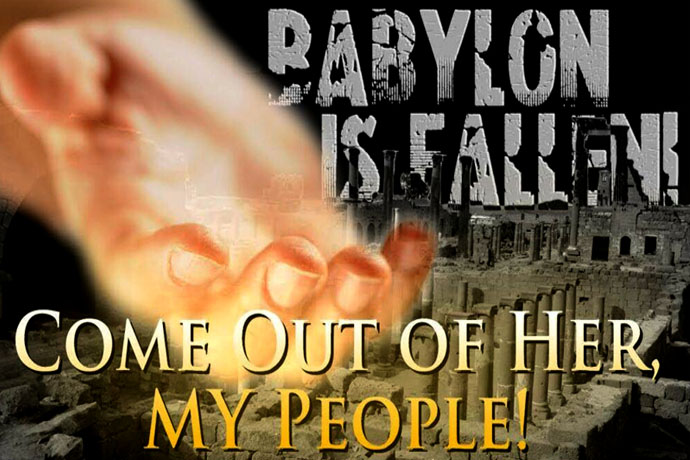
Revelation 18 The Just Judgment of God

When do we want, justice, when taken advantage of, or when our child is guilty?
“Man’s capacity for justice makes Democracy possible; but Man’s inclination to injustice makes Democracy necessary.”
Reinhold Niebuhr, The Children of Light and The Children of Darkness:
God’s provision of salvation is expressly directed towards his enemies (Rom. 5:8). We are not to confuse God’s justice with the expression of it. Rather, if the gospel is the greatest expression of God’s justice, we must say that it certainly means far more than giving to each one what he deserves (Rom. 3:21–26). Human beings deserve judgment, yet a gracious God gives them forgiveness and salvation.
A terrible vision of punishment of sin is given in Plato’s Republic “For every wrong which they had done to any one they suffered tenfold”
The expectation of judgment to come, which is found in the literature of all or nearly all ancient nations, and in modern heathenism, was evoked probably, and is easily explained, by the INEQUALITY of retribution IN THE PRESENT LIFE
The idea of justice is to be right. The standard for justice is God’s character, not human or political achievement. This fact illustrates that God’s character provides the measure. He is just par excellence. For example, the king and the judge are called to rescue the oppressed and downtrodden (Psa. 72:1–4; 82:1–8). To do this is to participate in God’s deeds of salvation from the effects of sin, Jer. 22:16, which is a foretaste of the coming eternal salvation.
God as a Measure of Justice
The concept of righteousness has never been easy to explain. However Hebrew usage helps us to define the concrete idea. In Deut 25:13–16 the law says, ‘You shall not have in your bag diverse weights, a great weight and a small weight! But you shall have a perfect, a righteous weight.’ There could not be a double standard for buying or selling; the Hebrew had to have a measurement to conform to the standard.
Eschatology is the sphere where ultimately full justice will take place, yet we must be careful not to attribute moral value to eschatology itself. Such an error could go hand-in-hand with the soterism attributed to history by Marxist determinism, Darwinian evolution, and ‘Yuppie’ success and progress. History is the realm where moral value occurs, but is not the source of it. Salvation and goodness erupt from above and come from God.
God’s creation was a just world with righteous people. His word, an expression of his character, was the governing factor; and his presence as a model for his people was the apex of the perfect world.
On the other hand, the Bible points out the impossibility of expressing God’s love without the consideration of concrete activity on behalf of fellow human beings (Jas. 2:14ff.; 1 Jn. 3:10ff.).
Can we measure love in concrete actions better than we can justice? God is love and God is justice, and we cannot say that both categories are abstract unhistorical entities whose value lies precisely in their transcendent nature.
In verse 6, “God is just: He will pay back trouble to those who trouble you and give relief to those of you who are troubled, and to us as well. This will happen when the Lord Jesus is revealed from heaven in blazing fire with his powerful angels. He will punish those who do not know God and do not obey the gospel of our Lord Jesus.2 Th 1.;6
Judgment
Revelation 18: 19And they cast dust on their heads, and cried, weeping and mourning, saying, Woe, woe, the great city, wherein all that had their ships in the sea were made rich by reason of her costliness! for in one hour is she made desolate.
With this final lament by the maritime industry the sorrow and frustration of all who have profited from Rome’s/Babylon profligacy come to a close. Each part of society has mourned the fall of Rome in terms of its own personal advantage. The city has come to ruin, and so have the special benefits of all who have served her for personal gain. In times of crisis human nature inevitably reveals how self-centered and opportunistic are its concerns.
20 Rejoice over her, thou heaven, and ye saints, and ye apostles, and ye prophets; for God hath judged your judgment on her. 21 And a strong angel took up a stone as it were a great millstone and cast it into the sea, saying, Thus with a mighty fall shall Babylon, the great city, be cast down, and shall be found no more at all. 22 And the voice of harpers and minstrels and flute-players and trumpeters shall be heard no more at all in thee; and no craftsman, of whatsoever craft, shall be found any more at all in thee; and the voice of a mill shall be heard no more at all in thee; 23 and the light of a lamp shall shine no more at all in thee; and the voice of the bridegroom and of the bride shall be heard no more at all in thee: for thy merchants were the princes of the earth; for with thy sorcery were all the nations deceived. 24 And in her was found the blood of prophets and of saints, and of all that have been slain upon the earth.
Judgment Enjoyed
It is the church glorified, not believers on earth, who are invited to rejoice.
The church victorious is to rejoice that God the righteous judge has turned back the evidence laid against believers and in turn has served to bring judgment upon the accuser himself.
It is best to see the suffering saints who cried for vengeance in 6:9–11 at the center of the heavenly throng who are exhorted to rejoice in.
v:20 is the climax of the saints’ cry for vindication from 6:10, though anticipated in various ways also in other verses.
The focus is not on delight in Babylon’s suffering but on the successful outcome of God’s execution of justice, which demonstrates the integrity of Christians’ faith and God’s just character
God will judge Babylon just as severely as she persecuted others in order to make the punishment fit her crime.
The rejoicing does not arise out of a selfish spirit of revenge, but out of a fulfilled hope that God has defended the honor of His just name by not leaving sin unpunished and by showing His people to have been in the right all along and the verdict rendered by the ungodly world against the saints to be wrong.
Judgment Completed
The judgment of Babylon is expressed parabolically through the vision of an angel who took up a stone like a great millstone and threw it into the sea. The picture is based on Jer. 51:63, where Jeremiah commands his servant Seraiah to “tie a stone” to a scroll (“book”) containing the prophecy of Babylon’s judgment, and to “throw it into the middle of the Euphrates,” declaring in the process that in this same way will Babylon sink down and never again rise.
The angel interprets the action as symbolizing the disappearance of Rome/Babylon. The word translated “with such violence” appears in its cognate verb form in Mark 5:13 to describe the herd of swine that rushed down the steep bank into the lake, and in Acts 19:29 of the crowd of people who rushed into the theater in Ephesus.
The huge millstone does not just fall, but is violently hurled into the sea. This stresses how suddenly and spectacularly the judgment of God will be executed not only upon an ancient city but ultimately upon the entire antichristian world in its opposition to God.
The absence of all light adds to the desolation of the fallen city, the blackness of night blankets the deserted and lonely metropolis. Finally, the joy of matrimony, that closest bonding of human relationships, is likewise past.
Judgment Justified
22–23 asserted that Babylon’s judgment is suited to its crime, and vv. 22–23 reveal how the punishment fits the crime, which continues to depict the effects of Babylon’s destruction, especially most immediately from the millstone portrayal
Passages from Jeremiah 25 (judgment on unfaithful Israel) and Ezekiel 26 (judgment on Tyre) continue to be pieced together to depict this judicial principle (Ezek. 26:13: “and the sound of your harps will be heard no more”; Jer. 25:10: “I will take from them … the voice of the bridegroom and the voice of the bride, the sounds of the millstones and the light of the lamp”).
The statement in v. 14, “and all things that were luxurious and splendid have passed away from you and men will no longer find them,” is elaborated in more detail in vv. 21–23a. Babylon’s persecution was selective in John’s day, but he foresaw a time in which she would attempt to exterminate completely the Christian community (11:7–10; 20:7–9; cf. also 13:16–17).
God will likewise punish her for her persecution and attempted annihilation of the church by overthrowing her completely.
23b The angel’s pronouncement of devastation begun in v. 21 continues. These merchants were concerned only for their own glory instead of acting as stewards responsible for what had been entrusted to them by God.
The point is that the chief purpose of humanity according to Revelation is to glorify God and to enjoy Him, not to glorify oneself and enjoy one’s own achievements (e.g., 4:11; 5:12–13; 7:12; 15:3–4; 16:9; 19:1, 7). Self-glorification necessitates judgment in which a forced humbling occurs. It is idolatrous for Babylon and her allies to see themselves as “great” (11:8; 14:8; 16:19; 17:5, 18; 18:2, 10, 16, 19, 21,
One reason for Babylon’s judgment is that all the nations were deceived by your sorcery.
v24 Another reason for Babylon’s judgment is; in her was found the blood of the prophets and of saints and of all who have been slain on the earth.
Rome’s guilt extends to all who have been slain upon the earth because she is the reigning sovereign of the entire world
Spiritual Babylon is not one specific nation at a given point of time, but rather represents all forms of evil government from the resurrection of Christ until His return. In John’s day, the Roman Empire represented this wicked system, for by his time Christians had been persecuted not only in Israel, but throughout the Roman Empire.
The concluding clause all who have been slain on the earth points to a universal reference well beyond the Roman Empire and its time. This description of all who have been slain may be literal and allude to Christian martyrs, but it is best taken figuratively for all kinds of persecution, including death (see on 6:9; 13:15).
John portrays the eschaton in figures taken from that specific cultural setting. It is incumbent on us, living at a much later period in history, to interpret those same figures in the eschatological setting toward which we are rapidly moving. It will happen exactly has John has laid out. The last great secular society will demand that Christians wear the “mark of the beast,” but genuine believers remain true to the Lordship of Christ; as a result, religious persecution will follow.
REFLECTION ON 18:20–24
They do not rejoice because they have “won” at the expense of others, but because God has been vindicated. The lost, on the other hand, cannot see past their own self-interest. The suffering of others, even the destruction of an entire world system, concerns them only because of the negative effect on their own fortunes.
Here is the difference between the kingdom of darkness and the kingdom of light. What ultimately divides the two is the willingness (or lack thereof) to recognize who God is and to give Him the honor and worship He alone is due.
Particularly in the West, we live in a profoundly anthropocentric culture which utterly fails to place God and His glory at the center, and if we do not resist this, we will find ourselves slipping all too easily into the hold of the kingdom of darkness.