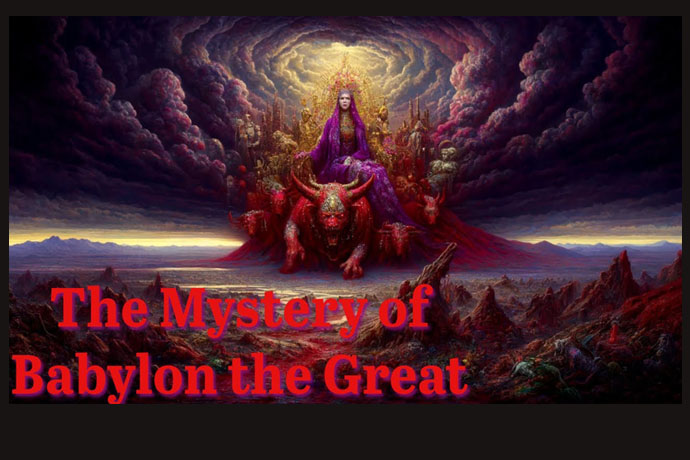
Revelation 17

7-18
The Beauty of the Beast
“The woman was dressed in purple and scarlet, and was glittering with gold, precious stones, and pearls. She held a golden cup in her hand, filled with abominable things and the filth of her adulteries. This title was written on her forehead, Mystery, Babylon the Great, the Mother of Prostitutes and the Abominations of the Earth.
She is identified with this beast. She’s riding a beast, who, is that power controlled by Satan who incarnates himself in successive antichrists in historical opposition and persecution of the people of God.
To say that she rides the beast is not trying to establish her form of locomotion. The point is that under the harlot, supporting the harlot is the beast. It’s not just a political power. You’re seeing that behind the superficial, sociological, phenomenological level is Satan and his prime power incarnated this way. That’s what’s going on.
The heads and horns represent the fullness of power held by evil kingdoms who persecute God’s people, since this is their figurative meaning in Daniel 7 ten kings in Dan. 7:24. The beast’s red color associates him with the red dragon of 12:3. The color indicates royal attire and hence kingship, but more particularly the persecuting nature of the dragon in 12:3 and the beast here, who spill the red blood of the saints.
The blasphemous names, as in 13:1, refer to the beast’s false claims of universal sovereignty. Though closely associated with the beast, the woman is not to be equated with the beast. That the woman rides the beast indicates her alliance with it. She represents the ungodly world as it works with the state socially, culturally, and economically to persecute Christians. They are also mutually involved in deception of ungodly multitudes throughout the earth
The description of the woman confirms that she represents worldly economic forces which are in collusion with the state in persecuting Christians, 14:8; 17:2.
A golden cup, seeming so precious and pure, but, in fact, it’s filled with abominable things and the filth of her adulteries.
The fullness of blasphemies are not so much because this beast and this woman are swearing all the time, are blaspheming. They’re blaspheming in the sense not that they’re throwing curses against God but that they are engaged in such wholesale self-deification. There are all kinds of people who never blaspheme overtly, who never say, “Cursed Jesus” or something like that, but who are blaspheming all the time by trying to make themselves the center of the universe. It’s a form of self-deification.
Who the Woman Really Is
5 The nature of the woman is revealed by the fact that upon her forehead a name was written, a mystery: “BABYLON THE GREAT, THE MOTHER OF HARLOTS AND OF THE ABOMINATIONS OF THE EARTH.”
In Revelation, a name on a forehead reveals the individual’s character and relationship either to God (7:3; 14:1) or to Satan (13:16; 14:9). The woman’s name reveals clearly her alliance with the beast. The first part of the name, Babylon the great, comes directly from Dan. 4:30, where it expresses the extent of Nebuchadnezzar’s power, about which he boasts.
His proud independence from God led to his downfall. The mystery of the name refers to the “mystery” (Dan. 4:9) of the dream Nebuchadnezzar had which warned him of the disaster ahead should he continue in his pride. Revelation connects this mystery with the mystery of the last-days fall of spiritual Babylon, which will fall because of pride and evil Dan. 2:28–29, partly in the background here.
This was a mystery prophesied and in the days of the seventh trumpet, according to 10:7) shortly to be fulfilled. The mystery refers to what is contained in the hidden counsel of God and now being revealed to His servants. In 1:20 and 10:7, the “mystery” involved the unexpected though not contradictory way in which Daniel’s prophecy about the establishment of Israel’s latter-day kingdom and the defeat of evil empires was beginning to be fulfilled.
The notion of “mystery” in both those chapters is that the kingdom begins ironically through the suffering of Christ and His people
the kingdom of evil will turn against itself and begin to self-destruct even before the return of Christ, who will finally demolish Babylon.
The woman is given the additional titles, Mother of harlots and of the abominations of the earth, thus indicating her central role in directing idolatrous practices and false religion.
Babylon is portrayed as a woman in the desert and also as a city (18:10), thus bringing her into contrast both with the mother of 12:1, who also lives in the desert, and with the bride of 19:7–8; 21:2, 10, who is also described as a city (21:2).
That such a contrast is intended is evident from the strikingly identical introductory vision formulas for the harlot and the church in 17:1 and 21:9–10. Such contrasts with the church throughout the ages, both on earth and glorified, make clear that Babylon is not a geographical locality but a demonically-directed economic and spiritual reality present throughout the church age. The woman in ch. 12 gave birth to the church, while the harlot of ch. 17 attempts to destroy the church.
Reflections
What is the relevance of the Babylonian prostitute for all ages. If the woman represents cultural, economic, and idolatrous religious power united in institutional form throughout the ages, how would that institution be identified or express itself in that particular part of the contemporary world where we live today (government, church, business, school, etc.)?
On temptations to compromise. In what ways can modern-day institutions of the world that are evil appear good and admirable in the eyes of Christians? In what ways are believers tempted to compromise with these institutions?
what aspects of the ungodly world’s influence on us have the potential of numbing us from reflecting on the reality of God’s coming judgment?
On the sources of persecution. What institutions carry out persecution against Christians today in those countries where believers suffer for their faith? Are there religious institutions that cooperate with political and/or economic institutions in persecuting Christians? If so, which ones? Is anything like this beginning to take shape on the horizon in western Europe or North America?
Watch out John
“Why are you so astonished? I will explain to you the mystery of the woman and of the beast she rides, which has the seven heads and ten horns. The beast, which you saw, once was, now is not …”
Remember all of that? “Now is not.” At the moment, the beast doesn’t exist but will come out of the Abyss (already introduced in chapter 9) and go to his destruction. He’s the one that receives the fatal wound, if you recall, and then everybody is surprised because he comes back again. “The inhabitants of the earth whose names have not been written in the book of life from the creation of the world will be astonished when they see the beast, because he once was, now is not, and yet will come.”
They always think he dies. They always think he’s gone, yet he keeps coming back again. “This calls for a mind with wisdom. The seven heads are seven hills …” Clearly, therefore, an identification with Rome and the Roman Empire. Then later on the seven kings. We’ve been over that passage too: the difficulty of identifying them, and it may simply mean that there are simply more to come; the full number is not yet all there. In any case, the result of all this kingly power and beastly power, which we’ve looked at before, is verse 14: making war against the Lamb.
How can Christians increase their awareness of what institutions around them are evil and so protect themselves from being deceived and consequently compromising in some way? If v. 7 provides the answer for John, how could it provide an answer for Christians today?
REFLECTION ON 17:8–14
On finding wisdom in the Word. “Here is the mind which has wisdom” (v. 9) is a critical phrase at the heart of this section. God has provided wisdom to those who study and heed His Word. The phrase directs us back to Dan. 11:33 and 12:10, which clearly state that only those with wisdom and insight will have a true understanding of God’s actions in history, especially in the latter days (which have been inaugurated at Christ’s first coming). The commentary sets forth the proposition that careful examination of Scripture yields an accurate interpretation of the career of the beast and the various kings and kingdoms referred to in these verses, some of which are in existence during the church age. Here, as often elsewhere in Revelation, is particularly demonstrated the truth that the meaning of the various visions must be sought first and primarily from Scripture, rather than only from current events. How should this alert us to the paramount importance of finding wisdom first in the Word of God rather than in the world around us? Many, among even sincere believers, have seriously misunderstood passages like this because they have strayed from this important principle.
REFLECTION ON 17:15–18
On the presence of the harlot within the church. a series of detailed parallels between the OT Jezebel and the Babylonian harlot. Rev. 2:20–24 suggests that a spirit of Jezebel is active in at least one of the seven churches. The figure of the harlot here also draws on other OT passages alluding either to unfaithful Israel or to pagan nations. We expect to find false ideology in the world (= the pagan nations), or even in dead or ungodly religious systems (= unfaithful Israel), but it is hard to contemplate such false teaching operating within what professes to be the body of Christ.
How are we to identify such idolatrous, Jezebelic activity and false teaching in the church today?
How important is it to realize that even in the church we may be confronting supernatural spiritual dynamics of an evil nature? Remember that Jezebel’s teaching in Revelation 2 is called “the deep things of Satan” (2:24). Satan still masquerades an as angel of light. What strategies can we employ to discern false teaching and to defeat the attacks of the enemy in the form of false teaching in the church? How can we discern when the world (that is, the Babylonian world system) exercises influence within our own churches?
Saints who do not compromise with the idolatrous world are to rejoice over God’s judgment of it because this demonstrates the integrity of their faith and of God’s justice and glory and leads to God’s consummate reign and union with His people (18:1–19:10)
The promise of the angel in 17:1 that he would show John the harlot’s judgment is fulfilled in detail throughout ch. 18. Ch. 17 focuses on the beast and his allies (and thus what precipitates the woman’s fall in ch. 18). 18:1–19:6 (or 19:8) pictures Babylon’s demise as a continuation of the vision begun in 17:3 (which itself elaborates on 16:14–21). Note the verbal repetition of 17:2 in 18:3. Both ch. 17 and ch. 18 are developments of the initial announcement of Babylon’s fall in 14:8. The events depicted in ch. 18 are not set out in a pure chronological sequence, but are laid out in this way:
Ultimately, “The Lamb will overcome them because he is Lord of lords and King of kings—and with him will be his called, chosen and faithful followers.” You’re getting closer and closer, as you move on in the book, to the final conflict. Chapter 18 is the fall of Babylon. In chapter 19, Christ is acknowledged as the great Lord of Lords and King of Kings. You’re getting closer and closer with each step of the revelation to this final conflict.
“Then the angel said to me, ‘The waters you saw, where the prostitute sits, are peoples, multitudes, nations and languages. The beast and the horns you saw will hate the prostitute.’ ” Now that’s interesting. “The beast and the ten horns you saw will hate the prostitute. They will bring her to ruin and leave her naked; they will eat her flesh and burn her with fire.” That’s an extremely important passage.
If the beast is the embodiment of all of Satan’s power in concrete historical persons, situations, and so on that manifest themselves in concrete historical realities, what it’s really saying is that these terrible kingdoms ultimately destroy themselves.
Here’s this harlot, this particular empire, the Roman Empire, riding on the beast, thinking it has all the power, but, in fact, that kind of power finally proves destructive. You don’t get a thousand-year Reich. It destroys itself.
That kind of raw abuse of power finally turns out to feed on itself. It destroys itself. You think of the fantastic power of the Russian Empire. One way or the other, it destroyed itself. It’s hard to believe how thoroughly it’s destroyed and how fast. Where were all our pundits before 1989? Where were the wise men? Where were the state department officers who got that one all right?
“But he who sits in the heavens laughs. The Lord shall have them in derision.” While we’re building more and more and more bombs, they’re destroying themselves economically until they don’t even have enough to lift a slingshot. They can’t even feed their own troops.
There’s a sense in which a certain kind of evil totalitarianism feeds on itself and destroys itself and sometimes does it with remarkable rapidity. It eats its own flesh, burns its own people.
That’s what has happened here. “They will bring her to ruin and leave her naked; they will eat her flesh and burn her with fire.” I suspect a mixture of those sufferings is bound up with the fact that the harlot is pictured in different ways. “Burn her with fire.” Well, she is a city as well. The city is burned with fire.
“They will eat her flesh.” Don’t forget that the beast is also seen as a lion and a leopard. “Leave her naked.” She’s a whore who has been stripped to shame her. The various images of who these pagan people are are picked up in the forms of suffering that are described as well. But she is destroyed.
“For God has put it into their hearts to accomplish his purpose by agreeing to give the beast their power to rule, until God’s words are fulfilled. The woman you saw is the great city that rules over the kings of the earth.” Do you see that? Passages like that destroy utterly any notion of ontological dualism. They destroy utterly any suggestion that Satan and God are roughly on the same pinnacle.
At the end of the day, God can control even their evil minds and use their evil for their own self-destruction until God’s appointed time is at hand for his ultimate consummative regeneration. That is why the people of God are encouraged to trust this God, to abandon themselves to him and to endure. The end is coming.