Revelation 16 The Bowls

The final series of eschatological woes is not a chronological continuation of the preceding ones. It refers to the same period but presents it from a different perspective. It is a vision of cosmic catastrophe in which the preceding visions are paralleled but intensified. All the world is struck by the blow against the sun and by the darkness, and everything in the sea dies. Not just the earth but the cosmos itself (heavens, sun, dry land, sea, rivers) is struck (16:1–8). Human rebellion against God has infected the creation itself (cf. Gen. 3:17; Isa. 24:5–6). As it is to be redeemed (21:1–22:6; cf. Rom. 8:18–23), so it passes through the judgment.
There are many similarities between these bowls and the trumpet plagues.
The trumpet judgments were calls to repentance; the bowl judgments are visitations of punishment when hope of repentance is passed. The trumpet judgments were partial, touching only a third part of their objects; the bowl judgments are final, touching the whole of the object.
No attempts to determine the special meaning of the objects visited by the wrath of God, land, sea, rivers, and sun, has yet to be successful. The general effect of God’s final retributive wrath alone appears to be important. The bowls are grouped four, two, interlude, and one, just as were the seals and the trumpets.
These scenarios are not simple descriptions of future events but warnings that are designed to move the readers of Revelation to repentance and renewed commitment to the ways of God and the Lamb. Although the trumpet plagues warn of disasters that affect a third of the earth, and the bowl plagues portend more complete judgments on the worshipers of the beast, both consider whether people will repent or refuse to repent in the face of God’s judgment (9:20–21; 16:9, 11, 21).
John freely employs the vocabulary of natural disaster to describe the prophetic visions of the imminent and catastrophic future of human history. it is true that both series deal with the same crucial period of time just before the end,
1 the trumpet-plagues are partial in their effect (one-third of the earth is burned, 8:7; one-third of the sea becomes blood, 8:8; see also 8:9–12), while the bowls are universal (“every living thing in the sea died,” 16:3; “every island fled away,” 16:20) and final;
2 the trumpets are to a certain extent a call to repentance, while the bowls are the pouring out of divine wrath; and
3 people are affected indirectly by the first four trumpets but are directly attacked from the outset by the bowls.
Grievous Sores (16:1–2)
This passage reminds us of the sixth plague of Egypt (Ex. 9:9), when boils broke out on the Egyptians. God promised to send Israel this plague if they rebelled against Him (Deut. 28:27, 35); and no doubt the unbelieving Jews will suffer along with the unbelieving Gentiles. Note that these sores still trouble the world when the fifth vial is poured out (v. 11). The affliction did not soften their hearts; men still blasphemed God and refused to bow before Him.
The first angel is dispatched and carries out his awesome task of pouring out the wrath of God upon the followers of the beast. Those who once bore the mark of the beast are now visited by the “marks” of God. We are reminded of the sixth Egyptian plague in which sores in the form of boils and abscesses broke out on people and beasts throughout the land (Exod 9:9–11). Job spoke from experience of the pain and irritation of such afflictions (Job 2:7–8, 13).
God vindicates those who resist the beast by bringing them to life in heaven (15:2), one might also expect God to punish those who worship the beast by bringing them to a gruesome death on earth. But this does not occur. Where John once saw “the mark of the beast,” he now sees “a foul and painful sore” upon the beast’s followers (16:2).
the mark is now matched by a sore that brings affliction. Painful though it is, however, the sore that God inflicts upon the followers of the beast is less severe than the death that the beast inflicted upon the followers of the Lamb.
Water to Blood (16:3–7)
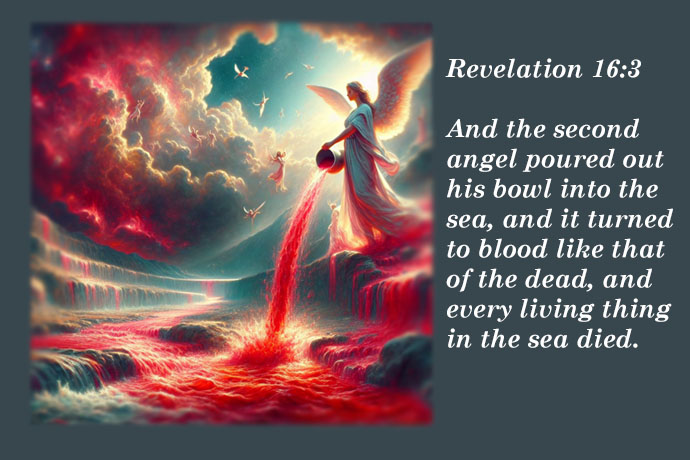
The second angel goes to the earth and pours his bowl on the sea, turning it to blood. This parallels the first plague of Exod 7:19ff. in which the waters of Egypt were turned to blood. It also parallels the second trumpet in which a burning mountain fell into the sea, turning it to blood (8:8–9). in all three instances it is water, one of humanity’s basic requirements, that is affected by divine judgment. The sea becomes like the blood of a dead person, all sea life dies.
Revelation does not explain why innocent creatures or innocent people perish.
Here is the real question: Why do the ungodly survive?
Why have God’s judgments not annihilated those who oppress the faithful?
The vision of the sea turning to blood warns that those who perpetuate injustice will bear the consequences of their deeds. The inhabitants of the earth have shed the blood of the saints (6:10), and now waves of bloody water wash up on their shores.
The beast slew God’s faithful witnesses, leaving their dead bodies in the streets (11:8–9), and now the sea itself assumes the quality of a corpse. The ungodly may not yet have perished, but this plague warns that God’s justice will prevail. If God has spared them it is not because God is indifferent to evil, but that God has granted them the chance to repent.
The third angel pours a bowl of wrath into the rivers and springs of water, which become as bloody as the sea (16:4). An angel announces that this plague carries out divine justice, declaring that since the wicked have “shed the blood of saints and prophets, you have given them blood to drink. there is, to be sure, a poetic justice in that people who have shed streams of blood are now made to drink from blood-filled streams.
they are not killed but given blood to drink. There is a strange restraint in the justice of God. Earlier, the saints under the altar asked how long God would delay in avenging their blood upon the inhabitants of the earth (6:9–11). Here a voice from the altar suggests that the prayers of the saints have received an answer that does not entail a full retribution on the wicked but a mitigated judgment that is declared to be “true and just” (16:7). The purpose of the plagues is not simple punishment. Rather, like the plague that turned the Nile River into blood before the exodus (Exod. 7:17–21), the plagues in Revelation are designed to bring repentance.
Scorching and Darkness (16:8–11)
The judgments from the fourth and fifth angels involve the heavens. The fourth angel causes the sun to scorch men. This is a sharp contrast with the trumpet judgment in 8:12, where a part of the sun was darkened. In this case, God allows the sun to burn men, to give them, as it were, a foretaste of hell. This is the day Malachi promised would “burn as an oven” (Mal. 4:1–2). Did sinners repent? No! Such is the hardness of the human heart!
The issue of repentance is made evident after the fourth angel pours a bowl of wrath on the sun, so that the adversaries of God suffer from fierce heat (16:8). Like previous plagues, this one stops short of destroying the wicked, and John now focuses attention on the issue of how one responds to the plagues. This is the reason that judgments have been interrupted and messengers sent out. The worshipers of the beast, however, refuse to repent and to glorify God (16:9). Their response makes clear that they suffer affliction, yet still refuse to worship God.
These visions present two options:
People can join in giving God the glory, as the heavenly chorus does (4:11; 5:13; 7:12; 15:4),
or People can join in blaspheming God, as the people do here. The sharp alternatives would strike readers in different ways, just as the gospel does today.
The fifth angel brings darkness. It is possible that this darkness covered only the immediate kingdom of the Beast, where his throne, his seat, was located. This darkness parallels the ninth plague of Egypt (Ex. 10:21–23). Satan is the prince of darkness, so it is only right that darkness should invade his kingdom. This is another foretaste of hell. Still, they will not repent. William Newell says, “Men who will not be won by grace will never be won at all.”
We have already learned that the beast received its throne from Satan the dragon (13:2) and then blasphemed God, slaughtered the saints, and demanded allegiance from people of every tribe and nation (13:5–8 God is indeed just, so, God must keep the beast from further terrorizing the earth. God’s angel does not destroy the beast’s kingdom but immerses it in darkness, like the darkness that engulfed Egypt before Israel’s deliverance from bondage (Exod. 10:21). Once again, the plague presses people to repent. The vision makes clear that if they refuse to change, it is not because God has prevented it, but because they are firmly allied with the beast (Rev. 16:11).
Gathering of the Armies (16:12–16)
The sixth angel pours his bowl on the river Euphrates so that its water dries up. In the past, the waters of the Red Sea parted so that Moses could lead the people of Israel out of Egypt (Exod. 14:21–22), and the Jordan River parted so that Joshua could lead them into the Promised Land (Josh. 3:14–17), but here the waters of the Euphrates dry up “to prepare the way for the kings from the east” (Rev. 16:12). The vision evokes a sense of threat against the powers that oppressed the people of God in different periods (compare Isa. 50:2; Nah. 1:4).
The imagery is not confined to one period of time, but it evokes associations from different times in order to convey a warning about the vulnerability of these oppressive powers.
Centuries before Revelation was written, the people of Judah were dominated by the Babylonians, but the Persians came from east of the Euphrates to conquer Babylon, allowing the Judean exiles to return home. In John’s time, the dominant power belonged to the Romans, who had periodically done battle with the Parthians from east of the Euphrates. The imagery is not confined to one period of time, but it evokes associations from different times in order to convey a warning about the vulnerability of these oppressive powers.
If the two plagues unleashed by the previous bowls brought a negative response from the followers of the beast, this bowl brings a negative response from the beast and its closest allies (Rev. 16:13). Rather than surrendering in light of their coming defeat, the adversaries of God intensify their opposition. Foul spirits that look like frogs, which were regarded as unclean and not to be put into the mouth, come out of the mouths of the dragon, the beast, and the false prophet, who was formerly depicted as the beast from the land (13:11). In a last-ditch effort to retain their control, these spirits lure the kings of the earth for the final great battle on the Day of God Almighty (16:14–16).
Before any battle takes place, the seventh angel tosses a bowl of wrath into the air, unleashing lightning, thunder, and hundred-pound hailstones (Rev. 16:17–21). A voice from God’s throne declares, “It is done!” so that at last the judgment of God would appear to be complete. Earlier, an angel condemned Babylon, who made “all nations drink the wine of the wrath of her fornication” (14:8); and now God gives the city “the wine-cup of the fury of his wrath” (16:19).
The world is struck by an earthquake more violent than any that have occurred since the creation of humankind. The earthquake shatters Babylon and the cities of the world collapse into rubble. The islands and the mountains of the world vanish. Yet the comment that concludes this scene of devastation does not focus on the annihilation of the wicked but on their refusal to repent.
The word “Armageddon,” in contemporary culture, has become almost synonymous with nuclear warfare and the annihilation of civilization. Popular treatments of Armageddon usually feature missiles with atomic warheads, squadrons of aircraft, and tank brigades colliding in the Middle East. The description of the great battle does not occur until 19:11–21, a passage that strangely omits all references to tanks and missiles. Two questions are important.
Is the name literal or symbolic?
It is clear that when John addresses his readers, he uses the literal names of the cities in which they live: Ephesus, Smyrna, Pergamum, and so on (1:11). It is also clear that he uses Hebrew names symbolically when he nicknames his opponents Balak, Balaam, and Jezebel, figures associated with false worship in the Old Testament (2:14, 20).
John uses these symbolic names to tell readers something about the false teachers in their communities. Since John regularly uses Old Testament names in a symbolic rather than a literal sense, it seems evident that “Armageddon”, might be taken symbolically rather than literally.
What does the name signify?
Old Testament references to Megiddo often link it to battles in which the adversaries of Israel are defeated. Taken together, the associations suggest that Megiddo is a place name that precedes the coming destruction of the adversaries
The Mystery of God Finished (16:17–21)
In 10:6–7, God promised that “the mystery of God” would be finished when the seventh angel poured out his vial; now we see this fulfilled. The events described in this section look forward to the fall of Babylon and the return of Christ to reign.
The utterance and a loud voice came out of the temple from the throne is that of either God or Christ, since it comes from the throne itself. The announcement “It is done” marks the historical realization of the purpose of the seven bowls stated in 15:1: “in them (the bowls) the wrath of God is finished.”
The declaration is the converse (using the same Greek verb) of Christ’s accomplishment of redemption at the cross (“it is finished” in John 19:30). It is a part of the same event of final judgment of the wicked referred to in Rev. 21:3–6, where the same phrase, “a loud voice from the throne” (21:3), is followed by “it is done” (21:6). There the focus is on final punishment of the wicked and the destruction of the old cosmos (21:1, 8), as well as on the complete redemption of God’s people in a new creation (21:1–7, 9–22:5).
These features of cosmic destruction from the OT are now applied typologically to the unqualified judgment at the end of world history. But the escalated nature of the application here is expressed by the phrase such as there had not been since man came to be upon the earth, so great an earthquake was it, and so mighty.
this wording is taken from Dan. 12:1, and there will be a time of distress such as never occurred since there was a nation until that time. Daniel describes the tribulation at the end of history, when God’s people will be delivered and undergo a resurrection to life, but the wicked will be raised to “disgrace and everlasting contempt” (Dan. 12:2). In the context of the plague of hail (cf. v. 21), note that Daniel’s wording is itself a typological application of Exod. 9:24, where there is fire flashing in the midst of the hail so severe “such as had not been in all the land of Egypt since it became a nation.”
The depiction is fashioned according to the biblical expectation of a catastrophic earthquake accompanying God’s latter-day appearing at the final judgment (Hag. 2:6; Zech. 14:4; Heb. 12:26–27). The object of judgment is explicitly identified: And Babylon the great was remembered before God
That the cities of the nations fell describes the universal extent of the last judgment to take place in history. It is not just Rome or some later great capital of evil which is decimated, but all the world’s cultural, political, and economic centers, because they are part of the great city and world system of Babylon. The picture here, give her the cup of the wine of His fierce wrath, develops the similar picture of the last judgment in 14:8, 10, where Babylon the great has fallen and her patron nations are made to “drink of the wine of the wrath of God, which is mixed in full strength in the cup of his anger” (14:10).
Babylon herself, the inducer of the nations’ intoxication, will be punished in like manner, under God’s judging hand, by being made to drink the wine that leads to her own destructive intoxication. On the OT background of the pouring out of wine as describing the unleashing of divine judgment see on 14:10. The judgment highlights that Babylon’s punishment fits her crime, as she destroyed (11:18), so shall she be destroyed.
The people suffering the judgment blasphemed God because of the plague of the hail, because its plague was extremely severe. This does not necessarily mean that some were left after the judgment of the hail, but that they were blaspheming during the onslaught of the woe, just as in 6:15–17 people undergoing the commencement of the final judgment try to hide during its execution (note also the parallel between 6:14 and 16:20 noted above). In contrast to vv. 9 and 11 above, which also refer to people blaspheming, there is no mention of people refusing to repent, which also suggests that the end has come, so that no room is now left for repentance.
The repetitive character of the visions again shows that Revelation does not predict a neat sequence of events that will allow readers to discern where they are on God’s timeline. Instead, the book repeats a similar message of warning in multiple ways.
These visions are designed to set forth the promise of the ultimate triumph of righteousness over all the evil forces which oppose it. This was its message to the Christians of Asia Minor about A.D. 95. It assured them of the certain victory of Christianity over Rome. In a similar way today it assures us of the certain triumph of Christ’s cause over the cause of evil in every age. In this respect the philosophy of the history method of interpretation is correct. The vision is given to us under the symbolism of several pictures setting forth the doom of Rome.