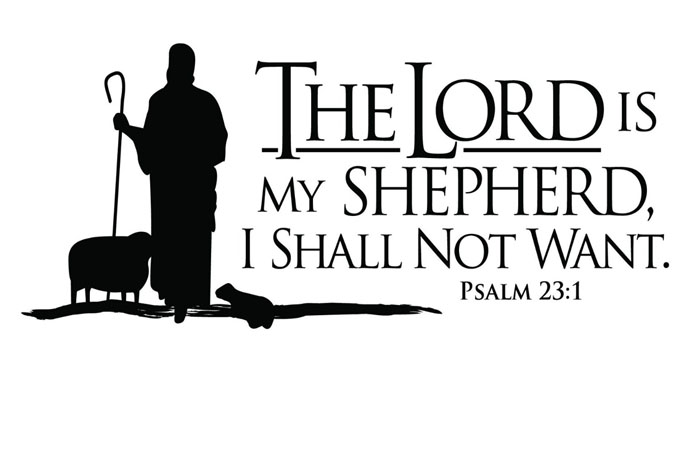
Psalm 23

The LORD is my shepherd; I shall not want. 2 He makes me to lie down in green pastures;He leads me beside the still waters. 3 He restores my soul; He leads me in the paths of righteousness For His name’s sake.4 Yea, though I walk through the valley of the shadow of death, I will fear no evil;For You are with me; Your rod and Your staff, they comfort me.5 You prepare a table before me in the presence of my enemies; You anoint my head with oil;My cup runs over. 6 Surely goodness and mercy shall follow me
All the days of my life; And I will dwell in the house of the LORD Forever.
David reaches for the most comprehensive and intimate metaphor for God he can think of.
David himself has been a shepherd a long time and he knows the long hours and hard work involved. He has experienced the kind of bond that is formed between shepherd and sheep.
In this psalm, David thinks about God as if he, David, were a sheep. This is, if you will, a sheep’s-eye view of God.
David himself has been a shepherd for so long that he thinks he understands how sheep think, if I may put it that way. This is, in a sense, the psalm of the sheep. It’s a sheep’s view of how he would try to describe God. From this perspective, David immediately begins with a view of the shepherd and the sheep that only a person who himself was a shepherd would view in such comprehensive categories.
The shepherds sheep experience contentment.
“The Lord is my shepherd, I shall lack nothing. We need to remember that when David writes this, there is antecedent revelation.
There is revelation that he has already read, known about, and experienced. He has a Bible, it is not as complete as our Bible, but he already has the books of Moses. He already knows something of the early history of Israel. He knows about God as Creator. He knows about God as covenant Lord.
He knows that this term rendered Lord, Yahweh, is the name, the covenant name by which God revealed himself to Moses and others. “I am that I am,” the transcendent Lord who will not be reduced to the status of a local vassal king for one tribal grouping. This is the one who spoke and worlds leaped into being. This is the one who is Creator.
He understands that not one falls to death without his sovereign sanction. Yet he says, “The Lord, this Lord, is my shepherd.”
Despite all those who say that Old Testament saints only thought corporately, they had no idea of the individual, here David refutes them all and says, “The Lord is my shepherd.”
That forces every thoughtful reader to ask, “Can I repeat that? Is it true of me? Can I say where I am, ‘The Lord is my shepherd’ or is that merely some ancient creedal formula used at deathbeds, funerals, romanticized ecclesiastical occasions? Or is this the very confession of my soul?” We remember the words of Jesus in John 10.
“My sheep hear my voice and they know me and they follow me.” “The Lord is my shepherd, therefore …” (That’s the logic that’s presupposed even if there’s no particle.) “Because the Lord is my shepherd, therefore, I shall lack nothing.” At the level of the metaphor, that means that the sheep will enjoy all the shade they need, all the pastureland they need.
“I shall lack nothing.” David is articulating is the rare jewel of contentment. He expresses it in a variety of ways.
“He makes me lie down in green pastures.”
Shepherds tell us that sheep never lie down when they’re hungry. They stand to eat.
They lie to ruminate. Sheep don’t lie down when they’re harried. Sheep don’t lie down when there’s danger about. Here are fat, well-favored, contented sheep with green grass, still waters. They are not spooked. We remember that Scripture teaches godliness with contentment is great gain.
We live in a most discontent society. We have so much and we are content with so little. We live in a generation that seeks some sense of fulfillment, of self-identity through travel or pleasure or bigger houses or more money.
Here the sheep are content, Here is a person whose contentment is in the shepherd and all that the shepherd provides. “I love the Lord.” That’s what the psalmist is saying. “I’m happy with him, and therein is my contentment.
We are so strong on making Christianity a creedal religion that we have forgotten that God is to be experienced. Do not misunderstand , I know well that if you try to build your entire Christian faith on mere experience, you will quickly be lead astray. But if faith is ever reduced to mere propositions, what do we have that the devils don’t have?
The kingdom of God, we are told, is not meat and drink but love and joy and peace in the Holy Spirit. “My peace I leave with you,” he says. “Not as the world gives, give I to you.”
Ephesians 5, the apostle draws a contrast between being filled with wine, in which is excess, and being filled with the Spirit, the idea is that wine will make you high and make you feel good, but there are nasty ramifications. You lose control. You lose accuracy. You lose responsibility. You become cruel. There’s a hangover. There’s a headache.
What do you want to be high on that ground for? Get high on the Spirit, instead. That’s the idea. Find your satisfaction and fulfillment there
“The Lord is my shepherd; therefore, I shall not want.” There is the ground for all, all contentment. All the provision that he makes for quiet waters and adequate nourishment all springs from this first point. “The Lord is my shepherd.”
The sheep experience contentment and assurance.
Verse 3: “He restores my soul. He guides me in paths of righteousness for his name’s sake.”
The word behind my soul as often in Scripture here means something like, my life, myself. He restores me. He restores my life. Shepherds tell us that a sheep can be cast. A cast sheep is a pitiful sight. The sheep lies on its back, feet in the air, unable to turn over, flailing away, unable to stand up, bleating pitifully.
“He restores my life.” For a sheep in such a position is dead.
We are sheep, on occasion, we who are the Lord’s sheep are going nowhere in our spiritual life, captured and snared, distracted by worldly lust. In that state we are easy prey to every spiritual vulture, every pack of dogs that comes along unless the shepherd finds us.
David had been through periods like that when spiritually, morally he’d had it. He could say, “He restores my soul.” The shepherd finds the sheep and picks the animal up.
Luke 15, He finds the one that was lost. There Jesus unpacks the parable for us and says, “Does not the shepherd rejoice over one sinner that repents more than over 99 that do not need repentance?”
We, who are the sheep of the Lord, need restoration.
We draw great confidence from the fact that it is written, “He who has begun a good work in you will perform it to the end.” The entire ground of our assurance lies in this truth. “He restores my soul
“He guides me in paths of righteousness.”
At the level of sheep this simply means, “He guides me in right paths, not the paths that are dangerous or the paths that take me back to the same pasturelands where overgrazing can ultimately kill the grass and, therefore, leave me with nothing.
He guides me in right paths, paths that are good for me. He takes me on to fresh pastureland where there’s not danger, away from barbed wire or savage animals. He leads me in right paths.”
This shepherd leads us in these right paths. This we are told, “… for his name’s sake.”
Ezekiel when he describes the new covenant in Ezekiel 36:22 but for the sake of my holy name, which you have profaned among the nations where you have gone. I will show the holiness of my great name … He guides me in paths of righteousness for his name’s sake.
The sheep experience security.
Walking through the valley, In ancient Israel, valleys were thought of as dangerous places.
The valley the shepherd was concerned with was, where the animals came, the wild animals, lions as there were in those days in Palestine, where the wolves were, where the dangers were, they were all down in the valleys.
You got up a little higher, then there were not so many dangers for the animals. The valley is the dark place in biblical metaphor, even though it’s also the place where there’s often the water. What does the psalmist say? “Even though I walk through the valley of the shadow of death, I will fear no evil.”
“Even though I walk through the darkest valley, you are with me, shadow of death, clearly, that’s what the expression means in some places.
Job 38:17. “Have the gates of death been shown to you?” Line two, “Have you seen the gates of the shadow of death?” Death is parallel to shadow of death. That’s the same expression as here.
David is saying, Even though I walk through those dark valleys that all of us recognize are so dangerous, even the worst one, the one we all fear, the valley of the shadow of death, I will fear no evil …because you are with me.”
The rod was a weapon, carried on the belt, used for defense. Sometimes to cuff the sheep if they were uncooperative. Also, to drive off enemies. The staff was a walking stick with a hook used for control, for there is security in discipline.
He comes to our defense through the darkest valleys, even the valley of the shadow of death. In Puritan times, Christians wrote books on how Christians died. We don’t do that today. We now hide Christian death, except in very romantic cases, with a plethora of euphemisms. “
The sheep experience safety.
Verse 5: “You prepare a table before me in the presence of my enemies. You anoint my head with oil; my cup overflows.”
Sometimes the pastureland develops certain dangers, noxious weeds of some sort, deadly to full-grown sheep and is always deadly to little lambs. the shepherd will walk up and down pulling out weeds. “The shepherd is preparing a table before me, and this even in the presence of my enemies.”
That is, the very enemies of the sheep that destroy the sheep. The enemies of nature, the dangers of weather, of wild animals, of buzzards, of eagles in Palestine.
“You anoint my head with oil.” Both then and now sheep were subject to all kinds of lice and bugs and flies.
The nose flies get inside and deposit their eggs on the mucus membrane.
The anointing here works at the level of sheep. It’s protection against the irritants and the dangers, just as taking out the weeds is protection as well.
That is what the psalmist says again. He prepares a table. He anoints me with oil and thus protects me from the things that could harm me. I have safety in this shepherd.
It is the equivalent to a well-known passage in Romans. “What, then, shall we say in response to this? If God is for us, who can be against us? He who did not spare his own Son, but gave him up for us all—how will he not also, along with him, graciously give us all things?
The sheep are satisfied.
“Surely goodness and love will follow me all the days of my life, and I will dwell in the house of the Lord forever. It follows me in the sense of pursuing me. God will never let me go.
No matter how far I wander, they pursue me. They come after me. They follow me. Just as God’s wrath pursues and follows the ungodly, so his love and his steadfast goodness pursue me and follow me all the days of my life. Finally, “I shall dwell in the house of the Lord forever.” I shall be with the shepherd. Sheep show a certain kind of contentment when the shepherd is around.
They can be startled and spooked by a jackrabbit that runs off or a dog that’s dumped into their flock. They are spooky, superstitious animals that run at the slightest concern. Then the shepherd walks into the flock, and if it’s a good shepherd, they are stilled. Their ideal of what is good is to be with such a shepherd. “… and I will dwell in the house of the Lord forever.”