Praise God for His Justice

1 I saw in heaven another great and marvelous sign: seven angels with the seven last plagues—last, because with them God’s wrath is completed. 2 And I saw what looked like a sea of glass mixed with fire and, standing beside the sea, those who had been victorious over the beast and his image and over the number of his name. They held harps given them by God
3 and sang the song of Moses the servant of God and the song of the Lamb: “Great and marvelous are your deeds, Lord God Almighty. Just and true are your ways, King of the ages. 4 Who will not fear you, O Lord, and bring glory to your name? For you alone are holy. All nations will come and worship before you, for your righteous acts have been revealed.” 5 After this I looked and in heaven the temple, that is, the tabernacle of the Testimony, was opened. 6 Out of the temple came the seven angels with the seven plagues. They were dressed in clean, shining linen and wore golden sashes around their chests. 7 Then one of the four living creatures gave to the seven angels seven golden bowls filled with the wrath of God, who lives for ever and ever. 8 And the temple was filled with smoke from the glory of God and from his power, and no one could enter the temple until the seven plagues of the seven angels were completed.
At this point, John saw the seven angels holding the seven vials of God’s wrath, poised for action. Before the angels pour out their judgments, there is an “interlude” of blessing. Before sending the “third woe” (Rev. 11:14), God once again reassures His faithful people.
This entire scene is reminiscent of Israel following the Exodus. The nation had been delivered from Egypt by the blood of the lamb, and the Egyptian army had been destroyed at the Red Sea. In thankfulness to God, the Israelites stood by the sea and sang “the song of Moses.”
The Tribulation saints whom John saw and heard were standing by the “sea of glass” in heaven (Rev. 4:6), just as the Israelites stood by the Red Sea. They were singing “the song of Moses” and also “the song of the Lamb.” “The song of Moses” is recorded in Exodus 15, and its refrain is: “The Lord is my strength and song, and He is become my salvation” (Ex. 15:2).
This scene would give great assurance and endurance to suffering saints in any age of the church. It is possible to be victorious over the world system! One does not have to yield to the “mark of the beast.” Through the blood of the Lamb, we have deliverance. Our Lord’s work on the cross is a “spiritual exodus” accomplished by His blood.
In their song, the saints praise God’s works as well as His ways. The earth-dwellers certainly would not praise God for His works, and they would never understand His ways. God’s works are great and marvelous, and His ways are just and true. There is no complaint here about the way God permitted these people to suffer! It would save us a great deal of sorrow if we would acknowledge God’s sovereignty in this same way today! “The Lord is righteous in all His ways, and holy in all His works” (Ps. 145:17).
God’s justice in Revelation
The saints are pictured standing on the sea and praising God and the Lamb for their victory.
This gives assurance that in the very place where they suffered and were sometimes apparently defeated, God’s people will be vindicated and will give praise to Him and the Lamb for deliverance.
The visions are intended to confront readers with vivid portrayals of eschatological truth rather than to supply them with data for a precise chronology of the consummation.
Before the seven bowls of plagues are poured out, the conquerors of the beast sing to God the song of Moses and the song of the Lamb (15:3–4). This is followed by the appearance of the temple in heaven and the outpouring of God’s wrath.
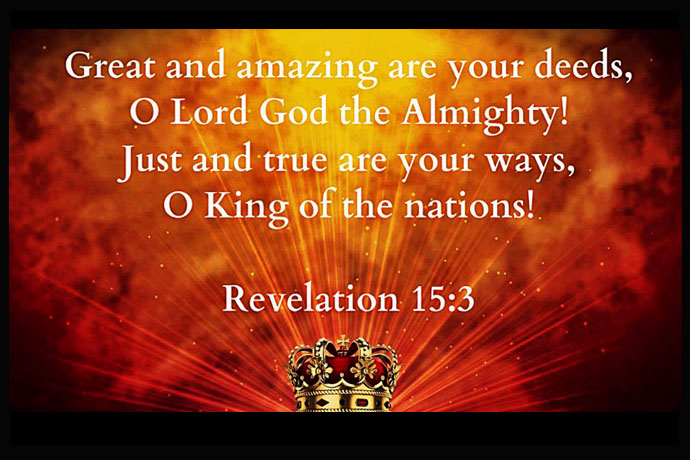
The faithful do not sing about their own deliverance but celebrate God’s position as King of the nations. Instead of focusing on the destruction of Israel’s enemies, as does the song of Moses in Exodus 15, the song in Revelation 15 focuses on the conversion of the peoples of the world. The lyrics begin, “Great and amazing are your deeds, Lord God the Almighty! Just and true are your ways, King of the nations!”
Just as the Israelites praised God by the sea after He had delivered them from Pharaoh, so the church praises God for defeating the beast on its behalf. Like God’s people of old, so God’s new covenant people praise Him by singing the song of Moses the bond-servant of God. Moses
That this is also a “new song” is evident since they sing not only the old song of Moses but also the song of the Lamb, which has hitherto not been sung.
Therefore, the song is sung in praise not only to God but also to the Lamb, since 5:9ff. also lauds the Lamb for His redemptive work (and implicitly also the new song of 14:3).
The great and true acts of the Sovereign stated in v. 3b are the reason that people should fear and glorify Him. The words the saints are singing, Who will not fear, O Lord, and glorify Thy name? recall Jer. 10:7: “Who would not fear Thee, O King of the nations?” Surely they will fear Him, both texts suggest, because they have witnessed His great and righteous acts. Jer. 10:1–16 contrasts God with humans and idols, affirming that God alone is due worship. The singing saints here likewise know worship is due God and the Lamb only, in contrast to the beast and his image. God is worshiped because He is holy:
The song of victory that concludes this cycle celebrates a favorable response to the angel’s message, fixing before the reader’s eyes the hope of the world joining in praise of God. The vision of hope in 15:2–4 does not mean that the end of ends has come, however, for even before the song of triumph has been sung, John warns that more plagues will occur (15:1). The spiraling pattern that has repeatedly taken readers through sequences of threats into scenes of heavenly celebration is about to do the same again.
The angels come from the presence of God, the temple in heaven, and receive from one of the living creatures the golden bowls of divine wrath. Immediately the temple is filled with the glory of God so that no one can enter until the plagues have been completed.
By casting up an impenetrable veil of smoke, God ensures that the angels who are to pour out the plagues upon the earth will not be able to turn back until their grim task is completed.
The “great voice” out of the temple commands the seven angels to pour out the contents of their vials (Rev. 16:1), after which he announces “It is done!” (Rev. 16:17) The “mystery of God” is finished! (Rev. 10:7) The martyrs in glory had asked, “How long?” (Rev. 6:9–11) and now their cry would be answered.
The seven angels emerge from the heavenly temple (Rev. 11:19), because their work is holy as are the judgments they bring. The angels’ clothing reminds us of the priestly garments, for their service is a divine ministry. When the Old Testament tabernacle and temple were dedicated, these earthly buildings were filled with God’s glory (Ex. 40:34–35; 2 Chron. 7:1–4); but now the heavenly temple is filled with smoke (see Isa. 6:4; Ezek. 10:4). This smoke likewise is evidence of God’s glory and power.
The seven bowls are clearly modeled on the Exodus plagues, and the song of 15:3–4 is an imitation of the song of Moses after the Red Sea crossing.
This is probably the sequential order in which John saw the visions rather than the chronological order of the events depicted in the visions. Therefore, the bowls do not have to be understood as occurring as the last events of history but are the last of the formal sevenfold visions John saw,
The bowls go back in time and explain in greater detail the woes throughout the age culminating in the final judgment.
One indication of this is that the final judgment has already been described as happening at the end of the seals (6:12–17; 8:1), at the end of the trumpets (11:15–19), and most recently in 14:8–11.
The introduction to the bowls is now resumed.
He sees the temple of the tabernacle of testimony in heaven opened. The temple is called the tabernacle of testimony because it is the heavenly equivalent of the tabernacle of testimony, which was in Israel’s presence in the wilderness and is appropriate here because of the exodus context.
The “testimony” was the Ten Commandments, which Moses placed in the ark of the tabernacle. The law of the Lord is His testimony, which reveals His just will.
The “testimony” in v. 5 includes not only the law but also the “testimony of Jesus” 12:17; who sums up the OT commandments of God in Himself.
The point of the ark’s appearance, as a result of the temple being opened, in 11:19 was to emphasize that God was appearing to execute final judgment.
Here the same theme of judgment is present, though judgments leading up to the final judgment are included in the scheme of the bowls. Now the heavenly origin of their earthly testimony and judgments is in view.
6 John sees the seven angels introduced and they have been commissioned to execute the seven bowl judgments which follow in ch. 16,
Now angelic priests minister with the bowls at the heavenly altar of the tabernacle of testimony.. This connection with the altar shows that the bowl punishments are God’s answer to the saints’ prayers for vindication, 8:3–5.
The concluding statement in v8 underscores the fact that the bowl afflictions do not come ultimately from the seven angels, nor from the four living beings, but only from God. The temple is filled with smoke from the glory of God and from His power, s in Exod. 40:34–35;
God’s presence is so awesome in expressing wrath that not even heavenly beings (the angels and four living creatures were outside the temple, according to vv. 6–7) can stand in His midst: no one was able to enter the temple until the seven plagues of the seven angels were finished.
No one, not even heavenly intercessory priests, is able to hold back the hand of God when He decides to execute judgments (cf. Dan. 4:35).
Reflections On 15:5–8
On the mysterious efficacy of prayer. These verses reveal the connection between the “golden bowls of incense” (5:8; 8:3–5), representing the prayers of the saints (verbalized in 6:10 as a cry for God’s justice, and the “golden bowls full of the wrath of God,” representing God’s answer to those prayers.So much happens between the offering up of the prayers and the answer, much suffering, much persecution, much apparent delay in respite and relief. Yet the certain fact presented here is that God will answer. Often many years pass between the offering of a prayer and its answer. This too involves the faith and perseverance of the saints (14:12) and requires wisdom from God (13:18). How important it is as we pray to ask God for His perspective, not to mention His patience, in order that we keep on praying and never get discouraged, at all times remembering Jesus’ instruction that we “ought to pray and not to lose heart” (Luke 18:1).
Both trumpets and bowls present each of the plagues in the same order: plagues striking the earth, the sea, rivers, the sun, the realm of the wicked with darkness, the Euphrates (together with influencing the wicked by demons), and the world with the final judgment (with the same imagery of lightning, sounds, thunders, earthquake, and hail). The overwhelming likeness of the trumpets and bowls is a result of both being modeled on the Exodus plagues. Each woe in each sevenfold series (except for the sixth trumpet) is an allusion to an Exodus plague. Further, in each series seven angels execute the seven plagues. These observations point to the probability that the trumpet and bowl series refer to the same series of events.
The bowls go back in time and explain in greater detail the woes throughout the age and culminating in the final judgment.
The purpose of this recapitulation is to explain further the extent and application of God’s latter-day exodus judgments, which began to be explained with the trumpets. The trumpet visions may be compared to incomplete snapshots and the bowls to fuller photographs. The bowls reveal more clearly that the trumpets are predominantly plagues directed against unbelieving humanity. As the Exodus plagues are both a literary and theological model for the bowls, the bowl plagues are better viewed as judgments instead of mere warnings. They demonstrate God’s uniqueness and incomparable omnipotence, as well as His righteous judgment (16:5–6). These plagues reveal unbelievers’ hardness of heart and the fact that they are punished because of such hardness, which is expressed by their idolatry (16:2), persistent non-repentance (16:9, 11), and persecution of the saints (16:6).