Praise and joy in Heaven

Revelation 19;1-6
The text gives five reasons for heaven’s joy and praise. Heaven rejoices because full salvation has come, because justice is meted out, because rebellion is ended, because God is in control, and because the marriage of the Lamb is completed.
There is Praise because full salvation has come.
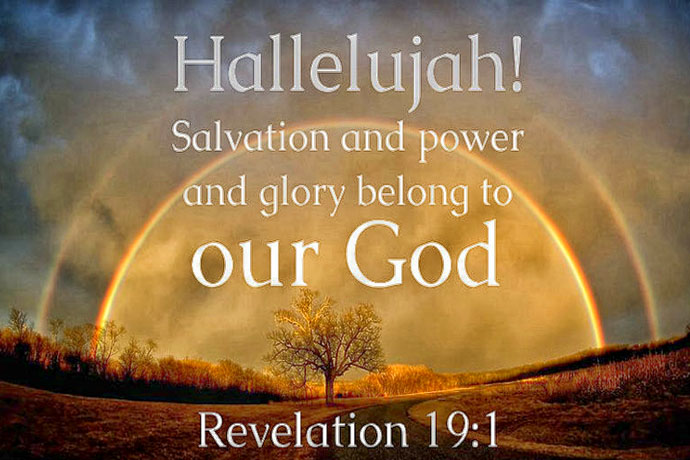
After these things I heard something like a loud voice of a great multitude in heaven, saying, “Hallelujah! Salvation and glory and power belong to our God; (19:1)
As it does throughout Revelation (cf. 4:1; 7:9; 15:5; 18:1), the phrase after these things marks the beginning of a new vision. This new vision takes place after the destruction of Babylon (chaps. 17–18) and before the triumphant return of Jesus Christ
There is joy and praise because the marriage of the lamb is completed.
“Let us rejoice and be glad and give the glory to Him, for the marriage of the Lamb has come and His bride has made herself ready.” It was given to her to clothe herself in fine linen, bright and clean; for the fine linen is the righteous acts of the saints.
Then he said to me, “Write, ‘Blessed are those who are invited to the marriage supper of the Lamb.’ ” And he said to me, “These are true words of God.” Then I fell at his feet to worship him. But he said to me, “Do not do that; I am a fellow servant of yours and your brethren who hold the testimony of Jesus; worship God. For the testimony of Jesus is the spirit of prophecy.” (19:7–10)
There is joy and praise because justice is meted out.
“Because His judgments are true and righteous; for He has judged the great harlot who was corrupting the earth with her immorality, and He has avenged the blood of His bond-servants on her.” (19:2)
Heaven rejoices because God’s judgments are true and righteous (16:7), as evidenced by the destruction of wicked, deserving Babylon. That joy over the imminent triumph of God’s justice is something that all who pray and work for righteousness can relate to. Throughout history God’s people have been disturbed by the inequity, injustice, and unrighteousness in the world, and have longed for God’s justice to come. Anticipating the coming of the Messiah.
Here it becomes explicit that God’s judgment of Babylon in chp 18 is the reason for the outburst of praise in v. 1.
The praise occurs because His judgments are true and righteous ( Ps. 19:9). He has judged the great harlot who was corrupting the earth with her immorality
He has avenged the blood of His bond-servants on her (literally from her hand),
God has avenged the blood of His servants shed by the hand of Babylon. This is the meaning of the closest OT parallel, 2 Kgs. 9:7, where God says that He will “avenge the blood of My servants the prophets, and the blood of all the servants of the Lord,
This represents a further answer to the cry of the saints in 6:10: “How long, O Lord … wilt Thou refrain from … avenging our blood on those who dwell on the earth?” Both verses allude to Ps. 79:10: “Why should the nations say, ‘Where is their God?’ Let there be known among the nations in our sight, vengeance for the blood of Thy servants, which has been shed,” so that the church is included in the Israelite “servants” who cry for vengeance.
3 As in v. 1, the repetition of Hallelujah! and its following explanation again provides the further basis for the first Hallelujah! and shows that what is precisely underscored is the finality of Babylon’s judgment: her smoke rises up forever and ever.
There is joy and praise because rebellion is ended.
A second time they said, “Hallelujah! Her smoke rises up forever and ever.” (19:3)
Babylon’s judgment provoked the first outburst of heavenly rejoicing; the aftermath of her destruction prompts the heavenly chorus for a second time to say, “Hallelujah!”
That the smoke rises up forever and ever indicates that this judgment is final, permanent, and irreversible. The language is similar to that used of God’s destruction of Sodom and Gomorrah
This is a reference originally to God’s judgment on Edom (“its smoke shall go up forever,” Isa. 34:10). Here the fall of Edom is taken as an anticipatory typological pattern of that of the world system, which will never rise again after God’s judgment. The same verse has been alluded to in 14:11 to refer to the smoke of the torment of individual unbelievers. Babylon is spoken of corporately, but its members are also referred to individually, in the same way that the bride of Christ is alluded to both corporately and as a group of individuals (see on vv. 7–9). The fates of the corporate and the individual are inextricably linked, as 18:4 demonstrates: those wishing to be saved must leave Babylon or suffer her fate.
There is joy and praise because God is in control.
And the twenty-four elders and the four living creatures fell down and worshiped God who sits on the throne saying, “Amen. Hallelujah!” And a voice came from the throne, saying, “Give praise to our God, all you His bond-servants, you who fear Him, the small and the great.” Then I heard something like the voice of a great multitude and like the sound of many waters and like the sound of mighty peals of thunder, saying, “Hallelujah! For the Lord our God, the Almighty, reigns.” (19:4–6)
The twenty-four elders and the four living creatures now join in the exclamation of the saints; they fell down and worshiped God who sits on the throne saying, “Amen. Hallelujah!” “Amen,” is a Hebrew word expressing trust, is part of their declaration of praise. The phrase echoes Ps. 106:48, where the wording (“Amen. Hallelujah”), as in Rev. 19:4, functions as part of Israel’s thanksgiving to God for gathering them to Himself after delivering the nation from their enemies who oppressed them (cf. Ps. 106:42–48 with Rev. 19:1–2, 7–9). Now the consummate Amen. Hallelujah! is expressed because God’s end-time covenant community have been decisively delivered at the end of history.
5 A voice came from the throne, possibly that of Christ (in line with the similar expressions in 6:6; 16:1, 17). If this is the voice of Jesus, He stands as the great representative of the saints confirming and assenting to their prior rejoicing. But on the analogy of John 20:17 (“I ascend to My Father and your Father, and My God and Your God”), might Jesus not rather have said “My God,” to distinguish Himself from His earthly followers? If from the throne is understood as “from the area around the throne,” the voice could also be that of another heavenly creature.
The voice declares Give praise to our God, all you His bond-servants, you who fear Him, the small and the great. Those exhorted to praise are first called all you His bond-servants. They are the ones whose blood was shed by Babylon,” v. 2). All believers are included in this number, for all believers bear the name “bond-servant”
v6 This segment ends here as it began in v. 1 The same innumerable multitudes shout even louder: And I heard, as it were, the voice of a great multitude and as the sound of many waters and as the sound of mighty peals of thunder, saying, “Hallelujah! For the Lord our God, the Almighty, reigns. The phrase “the sound of abundant waters” is used of the noise made by the four cherubim in Ezek. 1:24
In Ezek. 43:2 (LXX) the same phrase in Hebrew is interpreted as “a voice of a camp, as the voice of many redoubling their cries,” which likely refers to angels, but would have been easily susceptible to application to heavenly saints by later readers, which is the reference here.
The expression the Lord … reigns could be a sweeping allusion to a series of Psalms and other OT passages that use the same expression to refer in context to God establishing His kingship after judging Israel’s enemies, especially in Canaan and culminating in David’s occupation of Jerusalem (Pss. 93:1; 96:10; 97:1; 1 Chron. 16:31; plausibly also Pss. 47:3, 7–8; 99:1).
Isa. 52:7 (using “God” instead of “the Lord”); Zech. 14:9; and Rev. 19:6 use the expression to speak of the eschatological future, when God would again establish His kingship universally on earth after defeating His enemies, of which the Psalm accounts were anticipatory models. The Isaiah and Zechariah passages are uppermost in mind, since Rev. 19:6 indicates the future fulfillment of those two end-time prophecies.
In light of this OT background, the Greek verb may best be translated “begun to reign” (with an ingressive sense), since, in view of Babylon’s defeat (ch. 18), it is the establishment of God’s rule that appears to be in mind. Although in one sense God’s reign is timeless (the Lord … reigns), in another sense it is truly fulfilled in the created universe only as a result of His final judgment of Babylon and can thus be said to have “begun.”
The parallel in 11:17: “We give Thee thanks, O Lord God, the Almighty … because Thou … hast begun to reign.” it is also a development of 11:15: “The kingdom of the world has become the kingdom of our Lord, and of His Christ; and He will reign forever and ever.”
Let’s reflect on 19:1–6
Often our praise of God is focused on what He has done for us, whether our salvation or things related to our daily lives. Here the praise of the saints is centered on who God is and what He has done entirely apart from the circumstances of our individual lives. Praise for the fact that His judgments are righteous and true, the fact that He has judged the harlot, and the fact that He reigns over all.
While there is nothing wrong with our praising God for what He has done in our lives, it is always a good thing to acknowledge His faithfulness and providential mercies toward us, how often do we step back and thank Him simply for who He is and what He has done in the wider context of His creation, and what He has done simply for the glory of His name?