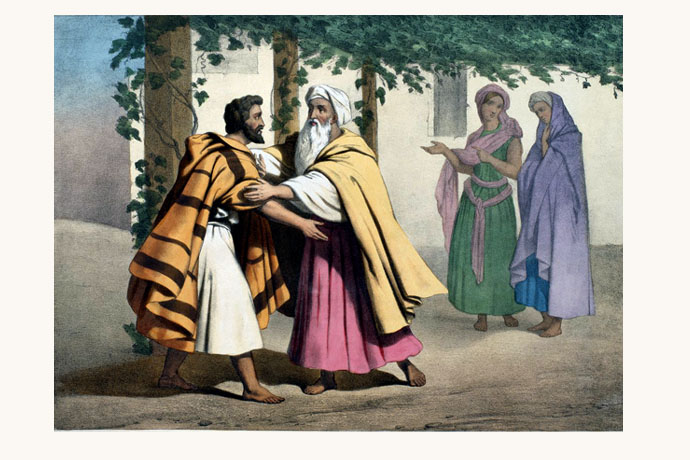
Meeting Uncle Laban

From the spiritual mountaintop of Bethel, Jacob descended into everyday life where he met uncle scheming Laban.
Genesis 29:12 And Jacob told Rachel that he was her father’s brother, and that he was Rebekah’s son: and she ran and told her father.
Jacob’s Service for Laban’s His Daughters
29:18 And Jacob loved Rachel; and he said, I will serve thee seven years for Rachel thy younger daughter. 19 And Laban said, It is better that I give her to thee, than that I should give her to another man: abide with me.
Jacob is Committed to Rachel
20 And Jacob served seven years for Rachel; and they seemed unto him but a few days, for the love he had to her.
Laban Tricks Jacob in Marriage
The deceiver himself is deceived. Laban was not about to forfeit his elder daughter’s chances for marriage, so he forced Jacob to marry her. Jacob had lied about the firstborn (27:19); now he is lied to about the firstborn (29:26). “The way of transgressors is hard” (Prov. 13:15). He fulfilled the week of marriage celebration for Leah, then married Rachel and began his second term of service for another seven years.
Jacob’s House in Divided
When a marriage begins with sin, there is usually division and unhappiness in the home. At first, neither of the two wives bore children, but it was obvious that Jacob loved Rachel more and that he “slighted” (hated, v. 31) Leah.
It is obvious that Jacob did not have a spiritual home: his wives disagreed and used him as a pawn in their lives.
This account covers fourteen years in Jacob’s life, years of toil, trial, and testing. God used Laban and the difficult circumstances of life to discipline Jacob and prepare him for the tasks that lay ahead.
Jacob’s Schemes for Laban’s Cattle (30:25–43)
30;25 And it came to pass, when Rachel had borne Joseph, that Jacob said unto Laban, Send me away, that I may go unto mine own place, and to my country. 26Give me my wives and my children for whom I have served thee, and let me go: for thou knowest my service wherewith I have served thee.
Jacob had served for fourteen years, and he realized that he must strike out on his own and provide for his large family. He asked Laban to send him away; however, crafty uncle was not about to lose so valuable a son-in-law. Jacob had worked fourteen years for his two wives; now he could work for the cattle he would need in order to get established on his own.
Of course, Laban covered the evil motive of his plan by using the Lord’s name (v. 27) and by asking Jacob to choose the terms. “Name me your wages, and I will give it.” Laban asked, but Jacob refused a gift, for the last time he accepted Laban’s “gift” he was deceived (29:19).
Jacob offered to work as Laban’s shepherd, if Laban would give him the “rejects” of the flocks and herds. Oriental sheep are white and goats brown or black. By accepting the striped, spotted, and speckled animals, Jacob was apparently giving Laban the better deal. It was certainly an act of faith on Jacob’s part.
But the schemer went to work, Jacob used his own plan. The special rods and sticks at the troughs probably did not influence the sheep; it was God who determined what kind of sheep and goats would be conceived.
Jacob did use “selective breeding”, so that only the stronger cattle conceived. We learn from 31:7–8 that Laban changed the terms of the contract several times as he saw Jacob’s flocks increasing, but God overruled Laban and made Jacob a wealthy man.
Jacob’s Sneaks Away from Laban’s House
31;1 And he heard the words of Laban’s sons, saying, Jacob hath taken away all that was our father’s; and of that which was our father’s hath he gotten all this glory. 2And Jacob beheld the countenance of Laban, and, behold, it was not toward him as beforetime. 3And Jehovah said unto Jacob, Return unto the land of thy fathers, and to thy kindred; and I will be with thee. 4And Jacob sent and called Rachel and Leah to the field unto his flock
There were three reasons that led in Jacob’s decision to leave: the changed attitude of Laban; the need for establishing his own home; and, most of all, the direct leading of the Lord.
God had reminded Jacob of his Bethel vow. The backslider now had to return and fulfill his promises to the Lord who had blessed him. Rachel and Leah agreed to go, but their decision was based on material considerations, not the will of the Lord. We wonder if the wives knew anything about Jacob’s Bethel experience until now.
‘Mum’ is the word—Jacob sees no need to tell Laban about the matter; indeed, Jacob seems up to his old tricks in that he waits to take off till Laban is preoccupied with sheep-shearing.1 My concern here is to isolate the testimony this passage intends to give, and I think that testimony revolves around two major themes.
Laban Chases them Down
The first theme we can call hard protection (vv. 22–29, 43–55). Laban receives word of Jacob’s flight ‘on the third day’ (v. 22), likely the third day after Jacob had gone. It then took Laban & Co seven days (v. 23) to catch up with Jacob’s outfit in the hill country of Gilead east of the Jordan River.
One can be excused for being cynical about Laban. He is all fluster and bluster. He claims Jacob has ‘carried off’ his daughters as if they were prisoners of war (v. 26). He rails at Jacob because the latter’s devious departure has deprived him of throwing a proper send-off celebration (v. 27), as if the tight-wad were longing to underwrite such an occasion.
Why should such a father and grandfather be robbed of saying a proper and fond farewell (v. 28)? If Laban wondered why Jacob had left ( v. 30), Jacob was perfectly candid: ‘Because I was afraid’—afraid that Laban would ‘tear away’ his daughters from Jacob (v. 31)., Jacob is saying, ‘Because I have had no reason to trust you whatsoever; I wouldn’t put anything past you.’
God warned Laban before he even faced Jacob, so there was no reason for Jacob’s fear (v. 31; see also Prov. 16:7). Laban “put on a front” and made it look as though he was offended, when he was probably glad to be rid of the man who was outsmarting him and getting richer. His real concern comes out in v. 30—someone had stolen his idols! Hidden sin led to more sin as Rachel, the thief, lied to her father and her husband, while angry Laban examined everything in the caravan.
Watch yourself, that you not speak anything to Jacob from good to evil.’ The sense seems to refer to the whole spectrum of speech, especially threatening talk. TEV probably catches the sense—‘Be careful not to threaten Jacob in any way.’ God’s threat stifles Laban’s threats, as if he says, ‘Laban, you mess with Jacob and you’re street pizza.’ So Laban yammers a bit more (v. 43), but all he can do is call for a treaty
That is precisely what God does in verses 24 and 29. He is the God who intimidates Laban, who threatens him should he try to harm Jacob in any way. He so much as says: If you threaten Jacob, Laban, it’ll be the last thing you do; you harm Jacob and you’re toast. Laban has met God the Intimidator.
Twenty years’ pent-up anger now revealed itself, and Jacob “laid it on the line” to his father-in-law. Laban was an idolater, and Jacob a backslider—how could there be any agreement between them? The only redeeming thing in Jacob’s angry speech is that he gave God the glory for his success (v. 42).
Laban and Jacob make a covenant (vv. 43–55).
31;44 And now come, let us make a covenant, I and thou; and let it be for a witness between me and thee. 45And Jacob took a stone, and set it up for a pillar. 46And Jacob said unto his brethren, Gather stones; and they took stones, and made a heap: and they did eat there by the heap. 47And Laban called it Jegar-saha-dutha: but Jacob called it Galeed.
These two men did not trust each other, so they set up a pillar to remind both of them that God was watching. Instead of witnessing to their friendship (as the “Mizpah Blessing” states), these stones witnessed to their mutual distrust of one another. The two men did not even speak the same language! (Both names mean “heap of witness” or “heap of testimony
Jacob’s twenty years of servitude were over, but he needed still to go back to Bethel
I suppose we can see why He did that in Genesis 31. Here is Jacob and his relatively small clan—not necessarily sanitized or highly sanctified but all the ‘church’ there is at this point in the world. Could Laban have smashed them? Apparently so. But if Jacob and company go belly up, God’s people cease to exist in this world. So when threatened and powerless with no other help, God intervenes to protect.
Let’s make a few observations. First, what a ridiculous question Laban asks! What sort of deities are they if they can be effortlessly pilfered? What helpless things (cf. Judg. 18:24). Second, ignorance brings such tension into the situation. Jacob boldly declares that if Laban finds his gods with anyone of his entourage, that person ‘will not live’ (v. 32). Then we are told that Jacob didn’t know Rachel had ‘lifted’ them (v. 32b). What Jacob did not know could hurt him. What irony seems to leak out of the text here!
Third, readers want to know why Rachel swiped these idols. When verse 19 tells of Rachel’s theft it calls them teraphim, apparently ‘household idols.’ In this case they were small images since Rachel could stash them in the camel’s saddle (v. 34). One meets various answers regarding Rachel’s motive. Some think possession of such deities had something to do with family inheritance or leadership, others think they may have been looked on as protection deities. I doubt Rachel looked on them as protective—that she sits on them (v. 34) seems to convey a lack of respect. I think Rachel stole them simply because Laban ticked Rachel off; she knew he prized these teraphim and she wanted to gall him and drive him up a wall.7 Not everything needs to be explained via Near Eastern parallels; it may be a matter of simple (and accumulating) animosity.
Fourth, these idols are both warm and, if we believe Rachel, unclean (vv. 34–35). Warm, because Rachel is sitting on them, unclean, because, as she ‘apologizes’ to Laban, ‘Sorry, Dad, but I’m having my period.’
Those are the observations. What seems to be the driving point of the episode? I should think it is the mockery of idols, of false gods. The text implies that idolatry is ludicrous, but when the Bible is ‘humorous’ it is also serious. And we, probably like Laban, may not see our idolatry at all. We are Anglicans or Baptists or Presbyterians or Pentecostals and our idolatry is much more sophisticated. Rachel can’t sit on our idols.
Then some of us may be slaves of recognition. I usually don’t sing part of ‘Be Thou My Vision.’ One stanza begins, ‘Riches I heed not, nor man’s empty praise.’ Riches don’t bother me much, but ‘man’s empty praise’? I’ll take all I can get, thank you, empty or not. If only Rachel could sit.
The trouble is that we cannot usually see these idols unless the Holy Spirit unleashes some of His scathing sarcasm and exposes the helpless things. It’s a saving work when the Holy Spirit starts making fun of our idols.
The teaching of this passage can be summed up in two statements: (1) God will certainly preserve His people in this world—a word of comfort; and (2) ‘Little children, keep yourselves from idols’ (1 John 5:21)—a word of correction.