Judgment is Coming Part 1

This section is divided into two parts: the heralds (three angels) and the harvest (two metaphors about harvest), and both sections talk about judgment in horrendous terms.
The Bible dares to mention the wrath of God more than 600 times, but it never does so out of some vicious glee that smirks at the mention of hell.
The person who talks about hell most frequently in the Bible is the Lord Jesus himself. The same Lord Jesus who weeps over the city. Lk 19:41 As he approached and saw the city, he wept for it.
We’re not evaluating an abstract notion of punishment in hell. We’re talking about something that will be in our own future if we do not embrace the escape that God has graciously provide through Jesus’ sacrifice.
For anybody who has followed the Bible’s storyline concerning judgment, what we see here in chap 14 should not be too surprising.
When you stop to think through what the Bible says about judgment, there is much in there from Genesis 3 on: the judgment of the flood, the sacrificial system with all those dead animals, the cycles of decay under the judges in Israel when the nation sank down again and again and faced various kinds of judgment, the judgment that fell on the kings of Israel when they were increasingly perverse and corrupt, and on and on all the way through.
Then there is Jesus himself with blistering language in Matthew 23 condemning some of the sins in his day, and Jesus again saying more about hell than any other person in the Bible. So none of this should surprise us if we have followed the Bible’s storyline at all.
In our culture it is hard to think about this topic because anger is often connected in the public mind with intolerance, narrow-mindedness, and bigotry. The category of righteous anger is not near the top of our scale of virtues here in the West and not much in the rest of the world.
The Heralds (Rev. 14:6–13)
In verse 6 the first angel summons all humankind to fear God and worship him.
His proclamation is not for the angelic hordes of heaven but for people living on the earth.
But what is this “eternal gospel” he is proclaiming? There are two views:
One group says that the “eternal gospel” in verse 6 is given its content in verse 7. So the eternal gospel is what this angel says in verse 7: “Fear God and give him glory, because the hour of his judgment has come.
In this case it sounds like the eternal gospel is some kind of generic idea like, you might not have heard of Jesus and might not have known the truth, but sort of worship the God who has manifested himself in nature and you will be all right.
This does not make much sense, for two reasons:
- By the time this book was written, about AD 90, the word “gospel” already has a fixed meaning. That “gospel” is the great news of what God has done in Jesus Christ’s death and resurrection on behalf of his desperately needy image-bearers.
Earlier in this book, in two spectacular chapters, Revelation 4–5, John has a vision that shows us what the gospel really is, what it looks like. God is presented in the setting as transcendent, so spectacularly glorious that even the highest order of angels cover their faces before him and cry, “Holy, holy, holy is the Lord God Almighty!” (4:8).
Then in Revelation 5, a drama begins. In the right hand of this God, we are told, is a scroll sealed with seven seals, and this scroll turns out to be the book that contains all of God’s purposes for judgment and blessing for the entire universe. As the drama is set up in this vision, an angel proclaims to the whole universe, “Who is worthy to break the seals and open the scroll?” (Rev. 5:2).
No one is found who is worthy: no angelic being, no human being, no one in the abodes of the dead, no one.
So John, in his vision, weeps because in the symbolism of the vision, unless somebody does come along with the qualifications to approach this God, take the scroll, and break the seals, God’s purposes for judgment and blessing will not come to pass. That is, history becomes meaningless. There is no final accounting. There is no righteousness. The sufferings of the church are useless. So John weeps.
Then one of the interpreting figures taps him on the shoulder and says, in effect, “Stop your crying, John. Look! The lion of the tribe of Judah has triumphed so as to open the scroll!”
The gospel is what God has ordained through his Son, this lion-lamb, to pay the price of sin, to take on the effects of the curse, to release his people, to gather and transform men and women from every tongue and tribe and people and nation. This is the good news.
(2) So in Revelation 14:6–7, the connection between these two verses has got to be seen another way. It is not that verse 7 gives us the content of the gospel. The content of the gospel is defined by Jesus on the cross and has already been laid out for us in Revelation 4–
The meaning of the word here must be determined ultimately by the immediate context. The angel announces not a different gospel, but one that carries dire consequences if it is rejected, as Paul underscores in Rom. 1:16ff.; 2 Cor. 2:14–16; and Acts 17:18–32.
The connection between Revelation 14:6 and 14:7 runs like this: Granted that the gospel is here, granted that it is being proclaimed to everyone, granted that this is the sole means by which God’s purposes for salvation and judgment come to pass, then fear God and give him glory because the hour of his judgment has come. Worship him who made the heavens, the earth, the sea, and the springs of water.”
So verse 7 does not give us the content of the “gospel” mentioned in verse 6, but the motive to respond to the gospel, since the end is so close. People everywhere are called to respond in worship to their Creator, since “the hour of his judgment has come.”
This description further confirms that these are unregenerate multitudes, the majority of which are not expected to respond favorably to the gospel announcement. The same universal formula for humanity has been used since 10:11 of all in the world who are idolaters.
The second angel announces the impending downfall of paganism.
This angel follows and says, ‘Fallen! Fallen is Babylon the Great,’ which made all the nations drink the maddening wine of her adulteries” (14:8). in the Bible Babylon becomes a kind of symbol for paganism that runs wild and is finally destroyed.
Babylon, became synonymous with the spirit of godlessness that in every age lives in those who worship themselves, their successes, and their possessions, anything but the Creator.
Fallen! Fallen is Babylon the Great: that is, this is an announcement of the impending destruction of every culture, not least Rome itself, that arrogantly sets itself up against God. Pagan Rome “made all the nations drink the maddening wine of her adulteries.” In biblical language these “adulteries” are a figure of speech of those rejecting God.
In the context of Matthew 24 the preaching is not to result in the conversion of masses throughout the world. The majority of the world will remain antagonistic (24:9). False prophets will arise, and apostasy even will increase within the believing community itself (24:10–12, 15, 23–26), as in the context of Rev. 14:6–7.
Rev. 14:7 poses the difficult question of whether the command is expected to result in genuine conversion or is a compulsory edict for antagonistic humanity, signifying that they will be forced to acknowledge the reality of God’s imminent judgment (as in Phil. 2:9–11).
The ungodly social, political, and economic system dominated by the Roman Empire placed believers in the same position as Israel was in under Babylon. Just as Babylon destroyed the first temple and sent Israel into exile, so Rome came to be called “Babylon” in some sectors of Judaism because it also destroyed the temple in Jerusalem and exiled Israel.
The third angel vividly portrays the torments awaiting those who worship the beast
Revelation 12:9 pictures the devil himself, referred to as “that ancient serpent,” which again calls to mind Genesis 3.
v9 If anyone worships the beast [that is, Satan’s own emissary] and its image and receives its mark on their forehead or on their hand, 10 they, too, will drink of the wine of God’s fury, which has been poured full strength into the cup of his wrath. They will be tormented with burning sulfur in the presence of the holy angels and of the Lamb. 11 And the smoke of their torment will rise for ever and ever. There will be no rest day or night for those who worship the beast and its image, or for anyone who receives the mark of its name.
God’s wrath poured out in full strength? What does that mean?
The image is drawn from wine-drinking practices in the ancient world.
When you produce wine, it comes out about 30 proof, that is, about 15 percent alcohol. It can go up or down a bit, but it is not a distilled product where you can control the amount of alcohol. It is a fermented process, so it depends on the sugar content, the temperature, the kind of berry, and so on, but commonly wine is about 30 proof. In the ancient world, however, it was very common to “cut” the wine with water, somewhere between one part in ten (one part of wine to ten parts of water) and one part in three. Most table wines that people drank in the ancient world were cut.
This image is a way of saying that in the past, God’s wrath has been diluted. It is as if the text were saying, “This is now the wine of God’s wrath poured out full strength. Any manifestation of God’s wrath that you have seen so far, the exile, for example, plagues in the Old Testament, disease, war, any of these things that you have seen as horrible manifestations of God’s wrath, they were the diluted form. Now God’s wrath is poured out full strength.”
Various images are used to get the point across: “burning sulfur in the presence of the holy angels and of the Lamb” (14:10) does not mean that the angels and the Lamb are sitting there laughing and saying, “I told you so.” It means that there is enough awareness in these people of the angels and the Lamb to whom they no longer can have access, that that is part of their torment. There is no way out. “And the smoke of their torment will rise for ever and ever” (14:11).
The Harvest
The arrival of God’s judgment is depicted in two agricultural portraits.
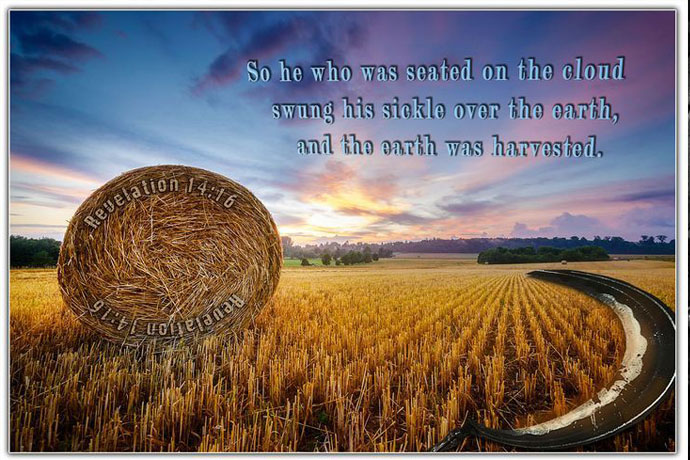
THE GRAIN HARVEST
The point of these three verses is very simple: a set time is coming when the harvest will take place, and there is no escaping it.
Life does not go on and on endlessly. This is not Hinduism where there are cycles of existence. History in the Bible is teleological, that means it is heading somewhere, it has a goal, an end. It begins somewhere, and it ends somewhere; it heads toward the end God has appointed. When the time comes and the Lord himself swings his sickle, time as we know it will be no more, and judgment will be final.
THE TREADING OF THE WINEPRESS
This final vision emphasizes the violent thoroughness of God’s wrath when it is finally poured out. In the ancient world, vine keepers would take the grapes they gathered and put them into a great stone vat. At the bottom of the vat were little holes, and when the grapes were squashed the juice would run out through those holes and along stone channels into collecting pots. So you would put the grapes into this vat and the servant girls would kick off their sandals, pick up their skirts, jump in, and stamp down the grapes. That would make the juice flow. Then the juice would be collected, and from it would come the fermentation and the wine that marked the vineyard’s prosperity.
But now this imagery is used to portray people being thrown into the great winepress of God’s wrath, people who are being trampled underfoot so thoroughly and in such numbers that their blood flows out from the channels to a height of a horse’s bridle for a distance of almost two hundred miles.
This is imagery, as sulfur, darkness and chains, but they are not imagery of nothing. In each case they are meant to tell us something important about the awfulness of the final judgment on those who have spurned the “eternal gospel.” Here the point of the imagery is the violent thoroughness of God’s wrath when it is finally poured out.