Jacob

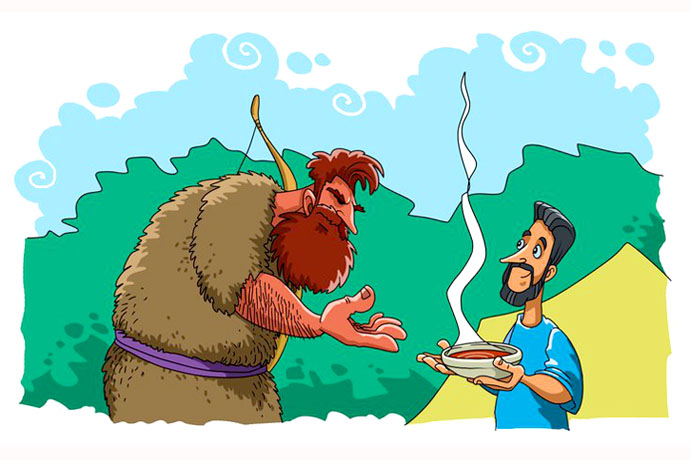
Genesis 26:33 And Jacob said, Swear to me first; and he sware unto him: and he sold his birthright unto Jacob. 34 And Jacob gave Esau bread and pottage of lentils; and he did eat and drink, and rose up, and went his way: so Esau despised his birthright.
27:1 And it came to pass, that when Isaac was old, and his eyes were dim, so that he could not see, he called Esau his elder son, and said unto him, My son: and he said unto him, Here am I. 2 And he said, Behold now, I am old, I know not the day of my death. 3 Now therefore take, I pray thee, thy weapons, thy quiver and thy bow, and go out to the field, and take me venison; 4 and make me savory food, such as I love, and bring it to me, that I may eat; that my soul may bless thee be fore I die.
5 And Rebekah heard when Isaac spake to Esau his son. And Esau went to the field to hunt for venison, and to bring it. 6 And Rebekah spake unto Jacob her son, saying, Behold, I heard thy father speak unto Esau thy brother, saying, 7 Bring me venison, and make me savory food, that I may eat, and bless thee before Jehovah before my death. 8 Now therefore, my son, obey my voice according to that which I command thee. 9 Go now to the flock, and fetch me from thence two good kids of the goats; and I will make them savory food for thy father, such as he loveth: 10 and thou shalt bring it to thy father, that he may eat, so that he may bless thee before his death.
18 And he came unto his father, and said, My father: and he said, Here am I; who art thou, my son? 19 And Jacob said unto his father, I am Esau thy first-born; I have done according as thou asked me: arise, I pray thee, sit and eat of my venison, that thy soul may bless me. 20 And Isaac said unto his son, How is it that thou hast found it so quickly, my son? And he said, Because Jehovah thy God sent me good speed. 21 And Isaac said unto Jacob, Come near, I pray thee, that I may feel thee, my son, whether thou be my very son Esau or not. 22 And Jacob went near unto Isaac his father; and he felt him, and said, The voice is Jacob’s voice, but the hands are the hands of Esau. 23 And he discerned him not, because his hands were hairy, as his brother Esau’s hands: so he blessed him. 24 And he said, Art thou my very son Esau? And he said, I am. 25 And he said, Bring it near to me, and I will eat of my son’s venison, that my soul may bless thee. And he brought it near to him, and he did eat: and he brought him wine, and he drank. 26 And his father Isaac said unto him, Come near now, and kiss me, my son. 27 And he came near, and kissed him: and he smelled the smell of his raiment, and blessed him,
This is one of the most gripping stories in Genesis.
Will Jacob’s disguise deceive his father? Will he receive the blessing before Esau returns? This poses moral and theological problems. Does God approve of Jacob’s cheating? Will he endorse a blessing gained under false pretences?
On first reading we tend to see Rebekah and Jacob just as rogues who exploited the blindness of Isaac to do down Esau. In reality, the situation is not so black and white. Esau had married two wives, which was a bad step in itself. Moreover, they were Hittites, Canaanites (23:3).
Abraham had been most concerned that Isaac should not marry a Canaanite girl (24:3); why had not Isaac insisted on, or even arranged, a suitable match for Esau? Worse still, Isaac on his deathbed flouted convention and showed total bias towards Esau. When patriarchs knew their death was near, they were expected to summon all their sons and give them each a blessing . Now, lamely pretending he does not know the day of his death, Isaac summoned only his favorite, Esau. No wonder Rebekah, who had long preferred Jacob (25:28), was incensed.
It is not clear how far Jacob approved of Rebekah’s scheme to outwit Isaac and obtain the blessing. His reluctance to cooperate may have been prompted as much by fear of being caught out as by moral scruples.
Nevertheless, despite the underhand way in which Jacob obtained the blessing, it was still valid. Isaac’s last words predicted the future relationship between Jacob (Israel) and Esau (Edom). The nation of Israel would usually dominate Edom. Israel would enjoy a settled agricultural existence, whereas Edom would be more of a nomadic people in the dry wilderness areas
Here again, as often as it is in Genesis, this new step forward in the history of salvation is set against the backdrop of unscrupulous behavior by the patriarchs involved. Once again, it is God’s mercy, not human merit, that is the ultimate hope of redemption (Rom. 9:10–18).
Jacob Deceives Isaac
The story of Isaac’s family is too familiar. Starting out well, full of glorious promise, it degenerated into shambles. What happened and how it came to pass is clearly explained in this chapter and careful study of it proves beneficial to all who take seriously the divine structure of the family.
A marriage made with care and, children that were bathed in prayer. The careful and prayerful preparations for the marriage of Isaac and Rebekah has gone south.
The story of Eliezer’s journey bears ample proof of a family that started out right.
Isaac had “pleaded with the LORD for his wife, because she was barren; and the LORD granted his plea, and Rebekah his wife conceived.! Rebekah, when she was experiencing marked discomfort during her pregnancy, did not hesitate to “inquire of the LORD”.
Now, it seems this family is made up of people committed to their own ends which were to be achieved by any and all means irrespective of who might be abused in the process.
The Lord had stated clearly before the twins were born that the elder would serve the younger Gen. 25:23.
But apparently Isaac was not prepared to accept this piece of divine determination. He instructed Esau, make me savory food, such as I love, and bring it to me that I may eat, and that my soul may bless you before I die. He was determined that the blessing should belong to Esau. We do not know if Isaac and Rebekah were aware that the birthright had been traded by Esau to his brother but it is hard to imagine how such an event could have been kept secret.
The blessing and the birthright belonged together and so to accept and administer the blessing when it no longer applied was a fundamentally dishonest action on the part of father and son.
Families are intended to support each other, not scheme against each other. Loving is the key word, not lying! Members of a family learn to complement rather than compete. However, it
Isaac Summons Esau (27:1–4)
Isaac from his deathbed instructs Esau to obtain his favorite game in preparation for the bestowal of the blessing.
Isaac gives the blessing to Jacob
Isaac summons Esau for his blessing and requests from him some tasty game,
Isaac initiates the conferral of the blessing, and in the final paragraph it is Esau who seeks a blessing. Jacob achieved his ploy by exploiting the trust innate between a father and his son.. Isaac’s fondness for wild game that gave Esau preferred status, surprisingly becomes the vehicle by which Jacob snatches the blessing.
Isaac’s “old” age dictated preparations for succession by declaring his blessing before he dies. Actually, Isaac lived for another twenty years or more. Isaac’s blindness functions at the metaphorical level for the man’s spiritual condition when he preferred Esau for his tasty cuisine.
At Esau’s return from the field, father and son realize they have been duped, and Isaac has only an anti-blessing for Esau (v. 30–40).
Although Isaac chose Esau for the apparent advantage that a skilled hunter could bring to his table (25:28), the mention of Esau as “his older son” (v 1) perhaps indicates that he intended to practice the custom of the privilege of the first born.
Rebekah overhears her husband’s intention, and she convinces Jacob to steal the blessing by an elaborate trick.
Rebekah and Jacob exercise the plan, obtaining the blessing from Isaac when Jacob deceives his blind father. She never sees Jacob again
Jacob is the sole speaker in these dialogue sections, leaving Esau who is in the field without a voice. Rebekah presents her plan to simulate the wild game by preparing goat steaks, but Jacob
sees that the plot is imperfect, for discovery is likely since the twins’ bodies felt entirely different to the touch.
Jacob probably knew by experience that his father would commonly use touch to compensate for his inept eyesight. Personal touch and a kiss usually accompanied parental blessing.
Rebekah has a solution to Jacob’s worries when she clothes Jacob in Esau’s garments and covers his smooth skin with animal hair, so as to obstruct the perceptive touch and smell of her husband. Jacob carries out the plan fully, receiving the blessing, but the plot did not take into account the difference in Jacob’s speech.
He must lie twice, claiming that he is Esau his brother.
27:11–13 Jacob recognizes the risk that the plot involves. If it backfires by Isaac’s discovery of the ploy, Jacob will subject himself to the worst of all fates, his father’s curse. Such could be the case for anyone who misleads the blind (Lev 19:14; Deut 27:18) or dishonors his parents (Exod 21:15, 17; Deut 21:18–19; 27:16).
Rebekah replies that she will take full responsibility and Jacob must only obey her directions. Ironically, her interference results in the loss of her favorite child, who flees for his life. She never sees him again.
Nevertheless, despite the underhand way in which Jacob obtained the blessing, it was still valid. Isaac’s last words predicted the future relationship between Jacob (Israel) and Esau (Edom). The nation of Israel would usually dominate Edom. Israel would enjoy a settled agricultural existence, whereas Edom would be more of a nomadic people in the dry wilderness areas , furthermore, the promises made first to Abraham and repeated to Isaac, would now be fulfilled through Jacob.
Esau resolves to kill his brother, but Rebekah plots to dispatch Jacob under the ploy of obtaining a wife from her brother’s household.
It is apparent that Jacob’s deceit caught up with him and Rebekah. Esau’s anger at Jacob’s deed forced Jacob to leave home, so that despite Rebekah’s hope that he would only be away a few days, she never saw him again. Jacob, who cheated his father, would soon be cheated by his father-in-law Laban, who would force him to marry Leah as well as Rachel. This would be a cause of perpetual distress to Jacob for the rest of his days.
In their turn, Leah’s sons would deceive Jacob with a kid about Joseph’s fate, just as Jacob deceived his father with a kid (37:31).
What Isaac was thinking about during this episode is anyone’s guess!
This family, which started out so well, is a powerful witness to the possibilities of disintegration and disaster which can readily overtake any community of people which fails to order its lives on the clear-cut outlines of divine principles. Such is the wickedness of the human heart.