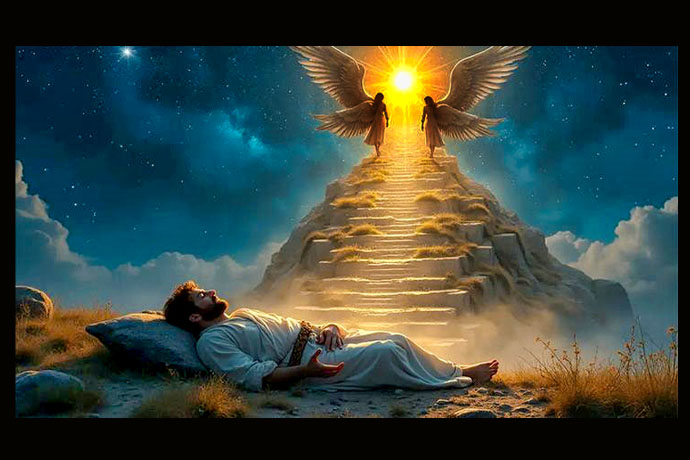
Jacob at Bethel

Genesis 28:10–22
28:1 And Isaac called Jacob, and blessed him, and charged him, and said unto him, Thou shalt not take a wife of the daughters of Canaan. 2 Arise, go to Padan-aram, to the house of Bethuel thy mother’s father; and take thee a wife from thence of the daughters of Laban thy mother’s brother.
For the first time in the Jacob narrative, this unit moves away from the strenuous conflicts of human interaction. Now we have a direct confrontation between Jacob and the God who has been at work in the battle for the birthright.
Jacob Takes a Journey
He has a theophanic encounter, with both a visual experience and a speech of promise.
Jacob responds to the encounter with a vow of faithfulness.
The encounter occurs in a place where Jacob would not expect a religious experience. It is not even a place whose name is known until the encounter. Jacob is a fugitive now outside all the protections of conventional meanings and social guarantees.
Moreover, the encounter takes place not in wakeful control but in a time of vulnerable yielding, while he is asleep. The encounter is completely at the command of God, for Jacob, it is scarcely a priority for him. He seeks only his own safety from his brother, he has no religious agenda.
This narrative raises difficult questions about the nature of an encounter with God.
Some say that this is a “primitive” religious report that has no pertinence to modern reality, for we have “outgrown” such matters.
When others try to explain it psychologically and deny its objective reality. But neither of these will work. The narrative shatters our presuppositions. It insists the world is a place of such meetings.
The startling element in the narrative is not the appearance of God, for religious phenomena are still with us in all sorts of ways. In this event, the amazement is not in the appearance, it is God! The element in the narrative that surprises Jacob and seems incredible to us is the wonder, mystery, and shock that this God should be present in such a decisive way to this exiled one.
The miracle is the way this sovereign God binds himself to this treacherous fugitive. The event is told as an inexplicable experience. It cannot be assessed by any comparisons or norms outside itself.
Jacob in the Journey
The framework of the journey is unique in that the event happens “between places” where nothing is expected. This is a “non-place” is transformed by the coming of God into a crucial place. The transformation takes place during sleep, when Jacob has lost control of his destiny.
God Shows Up
In such encounters as this one, there are often two elements, the visual and the auditory. While the former may fascinate us, the point of exposition must be the speech. It is the speech of God which changes things.
Our interpretation must not linger too long on the visual elements. Three phenomena are noted, each of which can be pursued for its “religious” dimension.
The meeting happens in a dream. The wakeful world of Jacob was a world of fear, terror, loneliness (and, we may imagine, unresolved guilt). Those were parameters of his existence.
The dream permits the entry of an alternative into his life. It is rather the presentation of an alternative future with God. The gospel moves to Jacob in a time when his guard is down.
The news is that there is traffic between heaven and earth. The object described is probably a ramp rather than the conventional “ladder.”
it has become a visual vehicle for a gospel assertion. Earth is not left to its own resources and heaven is not a remote self-contained realm for the gods. Heaven has to do with earth.
That is the substance of the vision. It shatters the presumed world of Jacob. He had assumed he traveled alone with his only purpose being survival. It was not hard then to conclude that divine reality was irrelevant. Now it is asserted that earth is a place of possibility because it has not been and will not be cut off from the sustaining role of God.
The figure of the ramp is enlivened with the presence of angels. Royal messengers of God who act to do his bidding. Their message is that the promissory Kingdom of God is now at work. The old kingdom of fear and terror is being overcome. God comes where he is not anticipated.
The center of the text is the speech of God. The visual elements are the vessels in which the treasure of promise is given.
The narrative moves to the real agenda of the speech of the Lord, it is a promise.
It expresses God’s intrusion into human reality which redefines everything. Jacob came to this deserted place, fleeing for his life, undoubtedly without promise. He departs from this encounter changed by the only thing that can change, a word which makes available an alternative future.
- The promise at the heart of this text . The promise of land is the same which had concerned Abraham and Isaac, it was given to Jacob in the oracle of 25:23, only now it is clear. For Jacob, it goes out beyond his own narrow interests.
- the promise speech extends beyond the standard promise to the fathers. It is a promise addressed peculiarly to Jacob. Jacob faces special dangers, it is God’s attentive response to his circumstance of danger.
“I am with you.” That, of course, is the intent of the ramp-ladder. Heaven has come to be on earth. This promise presents a central thrust of biblical faith. It refutes all the despairing judgments about human existence. A fresh understanding of God is required if we are to be delivered from the hopeless analyses of human possibility made by pessimistic scientists and by the poets of existence.
The fugitive has not been abandoned. This God will accompany him. It is a promise of royal dimension. (Jer. 1:19).
And this same promise was his last word to the church (Matt. 28:20), “I am with you always.”
It is the amazing new disclosure of Jacob’s God, one who is willing to cast his lot with this man, to stand with him in places of threat.
The first promise is about a presence. The second promise is about an action:
“I will keep you.” The word presents the image of the shepherd who will protect Jacob.
“The LORD bless you and keep you.” Ps. 91:11–15:
The keeper of Israel guarantees the lives of those who are exposed and defenseless.
The third element of the blessing is even more specific, the promise of homecoming.
Jacob makes contact with others in the community, a community of fugitives, the good news is the promise of homecoming.
It is clear that God does watch over his word and bring it to fulfillment.
Jacob Responds to the Encounter with God
The promise comes in a dream, but the response of Jacob comes when he is awake.
He finds the world of the dream more convincing than his old world of fear and guilt.
He accepts the fact that the kingdom is at hand. He is prepared to repent and believe. He repents, deciding here and now to abandon his old presuppositions of fear for the new reality of assurance.
Jacob comes to understand that his undefended sleep in a lonely place has been the entry way for God’s awesome power. This was the time and place when the sovereign goodness of God preempted initiative for his life.
For I am sure that neither death, nor life, nor angels, nor principalities, nor things present, nor things to come, nor powers, nor height, nor depth, nor anything else in all creation, will be able to separate us from the love of God in Christ Jesus our Lord (Rom. 8:38–39).
The dream has made this clear. God has to do with Israel. Heaven has to do with earth.
There is attention to the place of the encounter. A nameless place “between places” now it is a place to remember. Something big has happened here.
When you focus on the place, there is attention to the promise.
The promises here given and received are echoed in Psalm 23:
He is with me: I will not fear, for thou art with me (v. 4).
He will keep me: He makes me lie down, he leads me, he restores my life, he leads me (vv. 2–3).
He will give me bread to eat: He prepares a table before me in the presence of my enemies (v. 5).
I come again to my father’s house in peace: I will dwell in the house of the Lord forever (v. 6)
The appearance of God leads Jacob to make deep commitments and overriding decisions. The appearance does not leave Jacob free to be an interested spectator of some religious phenomenon.
The appearance presents a word of promise which demands a decision. Jacob now decides in ways that reshape his existence, for promises are covenantal acts. God makes promises to Israel. And in response, Israel makes vows to God. Vows are not contracts or limited agreements, but yieldings that reorient life.
The vow of Jacob may have special pertinence for the church on occasions of church membership and confirmation decisions. It models life-orienting decisions.
Jacob’s vow matches the promise
He trusts the promise-making God: “The LORD shall be my God”, v. 21.
His vow takes concrete cultic form. It leads to sustained, disciplined worship v. 22.
His vow leads to the concrete act of tithe (v. 22b). Tithe here is not a religious offering, but a recognition that the land belongs to its real owner.
Jacob the trickster is now bound to this God who presides over all the trickery yet to come in the narrative. God has been committed to Jacob since the oracle of 25:23. But only now is Jacob also bound. Jacob’s response strikes one as a genuine act of faith. But Jacob will be Jacob. Even in this solemn moment, he still sounds like a bargain-hunter. He still adds an “if” (v. 20).