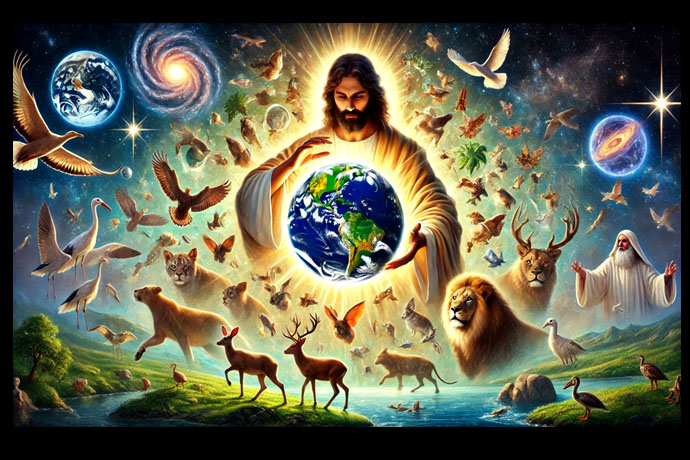
God Simply Is

The Darwinian centennial of 1959, commemorated the hundredth anniversary of the publication of Darwin’s Origin of Species, On the Origin of Species by Means of Natural Selection, or the Preservation of Favoured Races in the Struggle for Life. The celebration was held at the University of Chicago. Several modern science steps were taken there: the first atomic reactor was built there under Stagg Field, and in 1952 the famous Miller-Urey experiment had given scientists confidence that the Darwinian principle of materialistic evolution could be extended back to the ultimate beginning of life. Nobel Prize-winner Harold Urey agreed. He suggested that earth’s primitive atmosphere — composed of ammonia, methane, and hydrogen — favored the emergence of organic compounds.
In 1959 the mood at the Darwinian centennial was one of triumphalism. Darwinism had gone through a rocky period when there was much dispute about the mechanism, but then the neo-Darwinian synthesis had come to the rescue with its mathematical population genetics.
Nobel Prize-winner Harold Urey agreed. He suggested that earth’s primitive atmosphere — composed of ammonia, methane, and hydrogen — favored the emergence of organic compounds.
Neo-Darwinism seemed like the ultimate truth, a biological theory of everything.
Julian Huxley, grandson of Thomas Henry Huxley was the most prominent speaker. He declared that supernatural religion was finished and that a new religion of evolutionary humanism based upon science would become the worldwide creed. We might say he proclaimed the death of an aged tyrant called God and then credited Charles Darwin with supplying the murder weapon.
But in the 1980s, NASA scientists proved “that the primitive earth never had any ammonia, methane, or hydrogen,” NASA found it was composed of water, carbon dioxide, and nitrogen. And as one scientist put it, “you absolutely cannot get the same experimental results with that mixture.”
What are the most important lessons to be learned from Genesis 1?
Genesis 1 was not written to teach astronomy, geology, or biology. It was written to show the relationship of a specific Near Eastern people group to a creator God and their unique status in God’s divine covenantal program with them. Too much emphasis on either a scientific or “literal” reading of Genesis 1 can take away from this all-important truth.
God revealed his creation story to a people group surrounded by nations practicing animism and polytheism, and religions based on mythology. The whole chapter of Genesis 1 has a strong thrust against such mythology; for example, God created the Sun and Moon, they are not to be worshipped, God is. Also, humans are made in the image
- of God (Gen. 1:26) and are, therefore, not to worship images of wood and stone but the living God, who is creator of heaven and earth.
(3) Genesis needs to be interpreted from a Near Eastern, 2500–1500 B.C. worldview, not from a seventeenth century A.D., European “King James” worldview or a twenty-first century A.D., scientific worldview.
What Genesis 1 and 2 tell us.
They tell us some things about God, some things about human beings, and some things about how Genesis 1 and 2 fit into the whole Bible and into our lives.
The six days of creation (vv. 3–31) are told from the perspective of one who is standing on the earth’s surface observing the universe with the naked eye. Among the six days are eight creative acts, each introduced by the rubric “And God said.”
Genesis 1 & 2 Tells Us Some things about God.
It Tells Us, God simply is.
The Bible does not begin by a long set of proofs to prove the existence of God. It just begins, “In the beginning God.”
We can not evaluate the evidence and come out with a certain probability that, perhaps, a God of some sort or other exists. Then, we become the judges of God, but the God of the Bible isn’t like that. It just begins, “In the beginning God.“ He is, He is not the object whom we evaluate. He is the Creator who has made us, which changes all the dynamics.
There are many developments in Western thought we should evaluate. Before the Renaissance, even right through the early part of the Renaissance and really down to the time of the Reformation, most people in the Western world presupposed that God exists and that he knows everything. Human beings exist, and because God knows everything, what we know must necessarily be some small subset of what he knows.
The Renaissance, a term meaning “rebirth,” refers to the period roughly between 1400 and 1600 when European culture experienced a resurgence of ancient Greek and Roman aesthetic and artistic values. This cultural renewal centered on Italy during the fourteenth and fifteenth centuries, though it eventually spread northward to Germany and as far as Scotland.
The movement encompassed several defining characteristics. Humanism emerged as a major force with profound effects on theology, education, and the arts. In its narrower sense, the Renaissance involved recovering the culture of Greece and Rome and reviving classical literature and art. It represented a revolt against monastic asceticism and scholasticism, calling people away from self-mortification toward the satisfaction of all human capacities. The period marked a shift from medieval spirituality, where God held the central place, to a worldview where humans occupied center stage.
Individualism flourished as the feudal system declined and the church’s authority weakened, opening new careers to talented individuals regardless of birth and enabling capitalism to elevate artists and merchants to prominence. This produced the “Renaissance man” a cultivated figure equally skilled in athletics, music, literature, and science.
With the rise in the 1600s of what is now called Cartesian thought under the influence of Rene Descartes and those who followed him. The way of thinking about knowledge changed and the axiom that more and more people based their knowledge upon was the axiom Descartes introduced to us. That axiom was, “I think, therefore I am.”
He thought that was a foundation for knowledge. You couldn’t deny you were thinking. The very fact you were thinking showed you exist. He was looking for a foundation that Christians and atheists and Muslims, secularists, spiritual types could all agree was indisputable, and from this foundation and other approaches he, then, gradually built up a whole system of thought to try to convince people to become Roman Catholics.
Two hundred years earlier no Christian would have said that very easily, because God thinks. God knows everything. If we exist, then it’s because of God’s power. Our knowledge and even our existence are finally dependent on him, but this side of Cartesian thought, we begin with I.
Now, everything begins with me. That puts me in a place where I start evaluating not only the world around me but morals and history and God, so God now becomes simply, at best, the inference of my study. That changes everything. The Bible doesn’t run along those lines. God simply is.
God made everything that is non-God, God made everything else.
This introduces an irreducible distinction between Creator and creature. God is not a creature. In this absolute sense, we are not creators. His existence is, thus, self-existence somehow. That is, he has no cause, He just is, and He always has been.
Whereas, by contrast, everything else in the universe began somewhere, whether in a big bang or in human conception or somewhere. God made it all, that means everything in the universe, apart from God, is finally dependent upon God.
There is only one of Him.
This emerges strongly in the Bible. God openly says, “Let there be this,” and “Let there be that.” God made everything and He saw that it was very good. The Jews reverently recite to this day what is called the Shammah, Deuteronomy 6 we read the words, “Hear, O Israel: The Lord our God, the Lord is one.” There is only one of him.
Yet, even in this very first chapter there is a hint of complexity to his oneness. It’s hard to know exactly what it means, but it is quite striking, God said this, and God said that.
The Bible insists again and again and again that there is but one God.