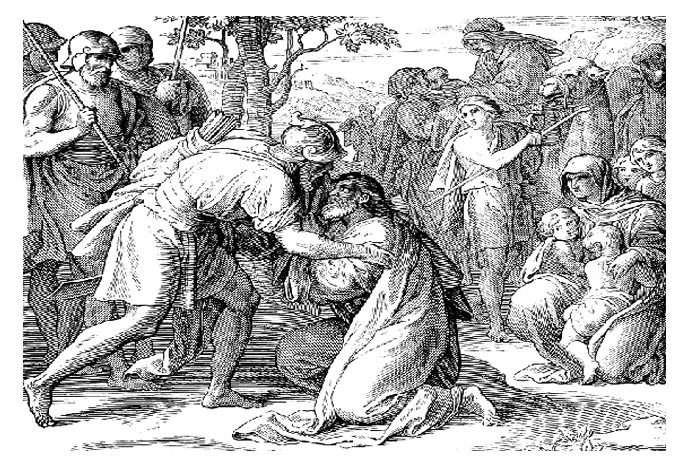
Esau and Jacob Meet

A letter from a missionary out in the jungles of New Guinea writing to his friends at home caught the nature of spiritual warfare:
“Man, it is great to be in the thick of the fight, to draw the old devil’s heaviest guns, to have him at you with depression and discouragement, slander, disease. He doesn’t waste time on a lukewarm bunch. He hits good and hard when a fellow is hitting him.
You can always measure the weight of your blow by the one you get back. When you’re on your back with fever and at your last ounce of strength, when some of your converts backslide, when you learn that your most promising inquirers are only fooling, when your mail gets held up, and some don’t bother to answer your letters, is that the time to put on mourning?
No, sir. That’s the time to pull out the stops and shout Hallelujah! The old fellow’s getting it in the neck and hitting back. Heaven is leaning over the battlements and watching. ‘Will he stick with it?’ And as they see who is with us, as they see the unlimited reserves, the boundless resources, as they see the impossibility of failure, how disgusted and sad they must be when we run away. Glory to God! We’re not going to run away. We’re going to stand.”
Jacob and Esau Meet
33:1 And Jacob lifted up his eyes, and looked, and, behold, Esau was coming, and with him four hundred men. And he divided the children unto Leah, and unto Rachel, and unto the two handmaids. 2 And he put the handmaids and their children foremost, and Leah and her children after, and Rachel and Joseph hindermost. 3 And he himself passed over before them, and bowed himself to the ground seven times, until he came near to his brother. 4 And Esau ran to meet him, and embraced him, and fell on his neck, and kissed him: and they wept. 5 And he lifted up his eyes, and saw the women and the children; and said, Who are these with thee?
Jacob had sent his servants and family ahead in chap. 32, now he takes the lead, subjecting himself to danger first
The same God who wrestled with Jacob was the One who had superintended his days from the beginning promise at Bethel to the present moment. Jacob exhibits a mood of peaceful resignation, accepting whatever God has in store for him.
After twenty years of separation the brothers at last: one bows in humility, the other embraces in love.
Jacob Sees Esau
The concubine wives and their children are at the front, making them more vulnerable than his preferred wives, Leah and Rachel. Of the two, Leah and her children are next, and last is Rachel with her lone child, Joseph. Jacob’s preferential concern for Rachel and Joseph is consistent with the special love he had for Rachel (29:30), shielding Joseph and her at the back
Jacob bows before Esau
3 And he himself passed over before them, and bowed himself to the ground seven times, until he came near to his brother.
Esau embraces Jacob
4 And Esau ran to meet him, and embraced him, and fell on his neck, and kissed him: and they wept.
Outward emotions of embracing and kissing express strong family. Not only does Jacob undergo a change in heart but also Esau, whose hatred against his only brother had melted. What precipitated the change in Esau is even more obscure than the forces that transformed Jacob.
It seems that there was some correlation between the nocturnal struggle of Jacob’s assailant and the change Esau underwent the same night. That God had forewarned Abimelech and Laban against mischief by a dream may provide a clue (20:3–7; 31:24).
The affection of Esau is a genuine outpouring of forgiveness.
Jacob and Esau Reconcile
5 Then Esau looked up and saw the women and children. “Who are these with you?” he asked.
Jacob answered, “They are the children God has graciously given your servant.”
8 Esau asked, “What do you mean by all these droves I met?” “To find favor in your eyes, my lord,” he said. 9 But Esau said, “I already have plenty, my brother. Keep what you have for yourself.”
10 “No, please!” said Jacob. “If I have found favor in your eyes, accept this gift from me. For to see your face is like seeing the face of God, now that you have received me favorably. 11 Please accept the present that was brought to you, for God has been gracious to me and I have all I need.” And because Jacob insisted, Esau accepted it.
Only at the insistence of Jacob, does Esau accept the gifts and then generously offers to accompany Jacob’s clan, thinking of protection.
The sign of acceptance with God was Esau’s reception of his “gift”. The acceptance of the gift was appropriate since Jacob already had been accepted by God and now by Esau. For Jacob the transformation of his moral character would be incomplete if he did not also experience reconciliation at the human dimension.
The implication of Jacob’s plea is that he has “found favor” with the Lord, a stature enjoyed by Noah and Moses.
Jacob and Esau Part
16 So that day Esau started on his way back to Seir. 17 Jacob, however, went to Succoth, where he built a place for himself and made shelters for his livestock. That is why the place is called Succoth.
18 After Jacob came from Paddan Aram, he arrived safely at the city of Shechem in Canaan and camped within sight of the city.
Esau returns to Seir
Esau’s descendants will reside outside the land of promise, and Jacob’s household moves closer to Canaan (Succoth) and ultimately to Shechem .
Jacob moved north and west, the opposite trek of Esau, who returned south to Mount Seir.
Jacob was the building of temporary shelters for himself and his cattle. Although Jacob may have resided at Succoth for some time, it was not a permanent settlement,
we are to assume that the Lord directed Jacob again to Canaan, the land promised him twenty years earlier.
Jacob builds an Altar at Shechem
Shechem was Abraham’s and Jacob’s first place to reside in Canaan, where each “pitched his tent” and established an “altar”.
20 And he erected there an altar, and called it El-Elohe-Israel.
Dinah, Deception, and Strife with the Hivites 34:1–31
Dinah is taken advantage of and some of the brothers seek revenge. The brothers profane the sole religious allusion (circumcision) in the account for nefarious purposes by guilefully requiring it of the Hivites. Whereas the ritual of circumcision symbolized life and blessing for Abraham’s seed and ultimately the nations, the sons of Jacob employ it for revenge and death against the nations.
Patristic and medieval Christian interpreters, denounced the deed of the brothers, where many Jewish writings praised them.
Jacob entertained the proposals of Hamor and Shechem, Jacob wants to establish favorable relations, and his sons seek vengeance.
With trickery, two of the sons, kill every male in the area.
Jacob Scolds his Sons
30 And Jacob said to Simeon and Levi, Ye have troubled me, to make me odious to the inhabitants of the land, among the Canaanites and the Perizzites: and, I being few in number, they will gather themselves together against me and smite me; and I shall be destroyed
Jacob’s concern was the impression that his sons’ actions would leave with Canaan’s inhabitants against them.
The brothers respond by a rhetorical question, angrily declaring that anyone who treated their sister in this fashion must answer for it.
Their crime from Jacob’s viewpoint shamed their father. This was in effect an attack on his patriarchal position. The cohesion of the family is crumbling, and Jacob is impotent to stop it.
Back to Bethel
35 And God said unto Jacob, Arise, go up to Beth-el, and dwell there: and make there an altar unto God, who appeared unto thee when thou fled from the face of Esau thy brother. 2 Then Jacob said unto his household, and to all that were with him, Put away the foreign gods that are among you, and purify yourselves, and change your garments: 3 and let us arise, and go up to Beth-el; and I will make there an altar unto God, who answered me in the day of my distress, and was with me in the way which I went
Against the backdrop of Jacob’s fear of the nations, God encouraged the patriarch, instructing him to depart for Bethel.
Jacob’s Invitation
“And God said unto Jacob, Arise, go up to Bethel, and dwell there.
There was the place where God appeared to Jacob and made Himself real to Jacob. This is where Jacob got right with God. This is where Jacob met God. This is where Jacob said, “Surely, the Lord is in this place; and I knew it not.” (Genesis 28:16) And he called it “Bethel”—Bethel
God gave an invitation to Jacob, and that was to come back to Bethel.
It appears at this point we could call Jacob a backslider.
It tells us that our God is the God of a new beginning. Our God is the God of a second chance.
Jacob’s Determination
35:2-3: “Then Jacob said unto his household, and to all that were with him, Put away the strange gods that are among you, and be clean, and change your garments: and let us arise, and go up to Bethel; and I will make there an altar unto God, who answered me in the day of my distress, and was with me in the way which I went. And they gave unto Jacob all the strange gods which were in their hand, and all their earrings which were in their ears; and Jacob hid them under the oak which was by Shechem.”
Jacob made a decision
He had to choose against these false idols that had come into his life, or at least the lives of his loved ones. And so he says clearly, and emphatically, by a decided choice, “Put these things away. We’re going to bury these idols.
We say, we don’t have any idols today. After all, we live in America. We’re not idolaters. I don’t have any false gods. Really, What is an idol? What is a false god? It is anything that means more to you than Almighty God. It is anything that keeps you from loving God, knowing God, serving God. It is anything that comes between you and God. That is an idol, and idolatry is the chief sin.
And here’s Jacob who is saying, “Put these things away.” Some of us have made an idol of ourselves. The Bible speaks of some “whose God is their belly.” (Philippians 3:19)
There is a Divine Cleansing
The dearest idol I have known, Whate’er that idol be Help me to tear it from Thy throne, And worship only Thee. —WILLIAM COWPER
v2: “Then Jacob said unto his household, and to all that were with him, Put away the strange gods that are among you,”—that is, his decided choice—“and be clean”—that is, the divine cleansing.
One follows the other. It is not until we confess and forsake our sins that we have mercy. It is not until we deal with idolatry that we can be clean. The Bible says, “The blood of Jesus Christ, God’s Son, cleanses us from all sin.” (1 John 1:7)
A choice that leads to that divine cleansing. Be clean. Be clean.
A Definite Change
Put away the strange gods, the choice, and be clean, the divine cleansing, and change your garments, a definite change.
V2 Put away the foreign gods that are among you, and purify yourselves, and change your garments:
The change of garments represents a sanctification, a change of life. It is symbolic of a changed life. That’s why he was saying, “Change your garments. We’re not going to be the same anymore. And to symbolize this new way, we’re going to change our very clothes.”
Put off the garments of idolatry and compromise and sin, and put on the garments of glory and praise and righteousness and true holiness.
Jacob’s Preservation
And they journeyed: and a terror of God was upon the cities that were round about them, and they did not pursue after the sons of Jacob. So Jacob came to Luz, which is in the land
Jacob’s Revelation
verse 7: “And he built there an altar, and called the place Elbethel: because there God appeared unto him, when he fled from the face of his brother.” (Genesis 35:7)
Why does he not call it anymore “the house of God”? Why does he change the name? Why is it now “the mighty God of the house of God”? I think the thing happened to Jacob that happens to so many of us: that worship and ritual and religion had taken the place of God.
God Revealed to Him the Greatness of His Power
He learned that he’d been going through form and motion, but he had lost the reality of it. And he needed to go back to the house of God to learn the mighty God of the house of God.
Jacob’s Dedication
“And God went up from him in the place where he talked with him. And Jacob set up a pillar in the place where he talked with him, even a pillar of stone: and he poured a drink offering thereon, and he poured oil thereon. And Jacob called the name of the place where God spake with him, Bethel.” (Genesis 35:13–15)