Do Not Be Conformed to the World

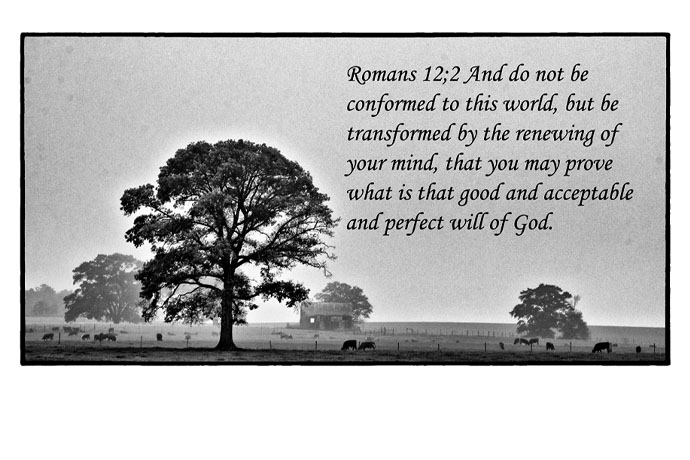
Romans 12;2 And do not be conformed to this world, but be transformed by the renewing of your mind, that you may prove what is that good and acceptable and perfect will of God.
2 Cor. 10:5 casting down imaginations, and every high thing that is exalted against the knowledge of God, and bringing every thought into captivity to the obedience of Christ; 6 and being in readiness to avenge all disobedience, when your obedience shall be made full.
Thinking differently from the “world” has been part of the Christian’s responsibility and agenda from the beginning. The language Paul uses clarifies that this independence of thought will not be easy. The assumption seems to be that the world has its own patterns, its own structured arguments, its own value systems.
Because Christians live in the world, the “default” reality is that we are likely to be shaped by these patterns, structures, and values unless we consciously discern how and where they stand over against the gospel and all its entailments and adopt radically different thinking.
Our response must not only be defensive (Rom. 12:2) but offensive, (2 Cor. 10:5).
The least that it means is that Christians, if we’re to love God at all, must bring all of our thinking and our values and our thoughts into line with God’s thoughts. That is why those who would become kings, according to Deuteronomy, chapter 17, if they were to enter this task of serving as king, they were to begin by copying out the Pentateuch, in Hebrew, by hand, not downloading from a CD onto their hard drive, copying it out by hand and then reading it every day, so that they would learn to fear God and not think of themselves as better than other people.
All of this has to do with the mind, and then Paul elsewhere can insist that we’re to think about whatever is clean and whatever is pure and whatever is noble.
Philippians 4:8 Finally, brethren, whatsoever things are true, whatsoever things are honorable, whatsoever things are just, whatsoever things are pure, whatsoever things are lovely, whatsoever things are of good report; if there be any virtue, and if there be any praise, think on these things.
Paul is saying he wants to take captive every thought system, every worldview, and every structure that elevates itself in arrogance against the God who has made this world. We go after it. We take it captive for Christ. In other words, never, ever reduce your Christianity to some touchy-feely thing that leaves the mind untouched.
In all of your discipline, offer up your best to God with your intellect, but at the same time, never, ever think that you reason people into the kingdom or that intellect alone saves. At the heart of all that transforms is the cross. That’s what Paul says. “I determined,” he says, “when I was with you to focus on Jesus Christ and him crucified. I resolved to know nothing while I was with you except Jesus Christ and him crucified.”
Paul’s point here, as the context makes clear, is that he is determined to bring every outlook, every worldview into obedience to Christ. Paul thinks world viewish.
2 Cor 10:5 casting down imaginations, and every high thing that is exalted against the knowledge of God, and bringing every thought into captivity to the obedience of Christ; 6and being in readiness to avenge all disobedience, when your obedience shall be made full.
He’s talking about the very frame of reference of all of your life. You take it all captive to Christ. That’s a gospel perspective.
How to not conform.
Neither Scripture nor experience suggests that this will be an easy task. Transparently, one of the things needed is substantial discernment, since some things the world thinks are not intrinsically. More difficult yet, the challenges are not vanquished once, enabling us to coast. Until the end of the age, the “world” continues to exist, and it keeps launching its challenges from constantly changing angles.
Hebrews 10:25 not forsaking our own assembling together, as the custom of some is, but exhorting one another; and so much the more, as ye see the day drawing nigh.
One of the strongest defenses against conforming to worldly ways is being part of a bible believing church family who share the same commitment to Christ. A strong Christian fellowship helps us remain accountable and rooted in truth, especially when we face pressures to conform.
Proverbs 4:23 “Above all else, guard your heart, for everything you do flows from it.”
Not everything in the world is overtly bad, but there’s always a subtle and most often a hard push to adopt secular values. We must learn how to discern.
Questions me must answer that can help prevent us from living like the world.
Does what we are doing or contemplate doing align with what God’s Word says?
Is the behavior we adopt honoring to God?
Is our attitude secular or is it an attitude Jesus displayed?
Are we deciding to do things because the world is doing it, and they control it? For example, the thing we want to do might not be bad in itself, but the world controls when it is offered and how it is offered?
Are we influenced by fear of man, what they think or say about us, or by a desire to please God?
Are the choices we are making being shaped by what is normal in our culture?
Are we giving in to cultural social pressures when we make decisions?
Are we making our decisions with an eternal view in mind or are they all based on what is happening today in our life, which is all very temporal.
Does this particular choice that I am about to make show that I am thinking eternally, or is it about my self-satisfaction for today or this month?
Would you and I do what we are about to do if Jesus were standing right beside us?
Are our decisions made to get approval by our peers, family etc, or to impress them?
Is what we are deciding to do serving anyone other than our self or our family? The world pushes self-centeredness, not have others in mind when you make decisions.
Would Jesus spend His time and money doing what I am about to do?
Can we honestly pray about this issue and know that God’s Word will support it? Can we find a principle in scripture that approves and validates what we are about to do or say?
Is what we are thinking about doing that our culture approves, violate our conscience?
Are the people that I spend time with encourage me to follow the world or Jesus?
Sometimes, when we resist secular ways means we have to make decisions that will make us stand out or cause us to be misunderstood. Jesus said, “If the world hates you, keep in mind that it hated me first”. John 15:18. When we live and make decisions that would honor Jesus, it most likely cause us to be rejected or ridiculed. That is when we must remember that is part of live if we are living the way Jesus desires to live. We then, can rest assured that our identity is in Christ, not in the approval of the world.
When Christians who had suffered through two centuries of waves of Roman persecution faced the stunning reality that the emperor now declared himself to be a convert, they were faced with the temptation to rethink what political “victory” looked like. They had to analyze what structures controlling Christian influence in the corridors of power might achieve, and so, to rethink the nature of the kingdom.
You can choose your own historical examples. Probably the most difficult “patterns” of thought to identify as things we should not be “conformed” to are those in any culture that the overwhelming majority in the culture think are pretty obvious, but which are skewedin respect to, or totally opposed to, the gospel.
Most of us look back on the temptations toward ascetic and gnostic movements in the second and third centuries and marvel that so many people who called themselves Christians were taken in. But the most dangerous movements in any age are those that are so widely assumed that it is very hard to see them. It is easy to discern and denounce yesteryear’s blind spots, and even feel vaguely superior because we are able to do so; it is far more difficult to discern our own.
What are some of those?
All this is the common reflection of Christians across the centuries.
What is good to analyze is the way Christians are simultaneously part of a culture and set over against it, how we are influenced by the culture for good and ill and influence it in return, likewise for good and ill.
The Internet for Example
A major issue with this is mind is, the sheer speed, volume, and democratic openness of the Internet prompts guarded thanks for access to useful information and sheer horror at the potential for abuse and corruption.
We should be thankful for the way the Internet can disseminate vast quantities of useful information, how books and other sources once available only in the best libraries are now, for countless hundreds of millions of people, only a click away.
But, equally we ought to be thankful for the way independent voices on the Internet sometimes puncture the pretentious or plainly false claims of the major traditional media. Granted, as Lord Acton insisted, that all power corrupts, and that absolute power corrupts absolutely, one does not like to see too many news sources falling into too few hands.
The Internet is gloriously irreverent to the major traditional media. That does no mean that Internet information is intrinsically more reliable than information disseminated on television or in newspapers and weekly journals; but it is clear that a multiplication of sources of information is more likely to ensure freedom and truth than entrusting all the sources of information distribution into too few hands.
There are many downsides as well. The sleaze and trash on the net are stupefying
Because the Internet is spectacularly accessible, almost anyone can voice an opinion or make a claim. In this sense, it is the most “democratic” of the media. Occasionally this means that voices otherwise silenced, voices that should be heard, are indeed heard.
Much more commonly, voices multiply that are ill-informed, opinionated, often pretentious and arrogant. A higher percentage of these voices were weeded out when the distribution was via print, radio, or television; by democratizing the delivery system, every voice can be published, and it becomes culturally unacceptable even to suggest that some voices are not worth publishing. This does nothing to enhance either discernment or self-discipline. As Michael Kinsley likes to ask, “How many blogs does the world need?”
What is interesting, and more difficult to predict, is the phenomenon called “groundswell.” Opinions and responses coagulate and drive topics and evaluations in uncontrollable and largely unpredictable directions. This can foster openness; alternatively, what is perceived to be a cultural consensus on some matter or other may simply be wrong.
A major problem is the Internet’s sheer intoxicating addictiveness, or, more broadly, we might be better to think of the intoxicating addictiveness of the entire digital world. Many are those who are never quiet, alone, and reflective, who never read material that demands reflection and imagination.
The iPods provide the music, the phones constant access to friends, phones and computers tie us to news, video, YouTube, Facebook, and on and on. This is not to demonize tools that are so very useful. Rather, it is to point out the obvious: information does not necessarily spell knowledge, and knowledge does not necessarily spell wisdom, and the incessant demand for unending sensory input from the digital world does not guarantee we make good choices.
We have the potential to become world citizens, informed about every corner of the globe, but in many western countries the standards of geographical and cross-cultural awareness have seriously declined. We have access to spectacularly useful information, but most of us diddle around on short term blogs and listen to music as enduring as a snowball in a blast furnace. Sometimes we just become burned out by the endless waves of bad news and decide the best course is to turn the iPod volume up a bit.
What Carl Trueman calls “the wages of spin” shape not only what we think is newsworthy, but our ethical reflection and our perception of what is for the public good.
These precise challenges never faced Paul, Augustine, Aquinas, and Luther. But what does it mean not to let the world squeeze us into its mold in the opening decade of the twenty-first century?
We need to hear competing voices of information from the world around us, use our time in the digital world wisely, and learn to shut that world down when it becomes more important to get up in the morning and answer emails than it does to get up and read the Bible and pray.
We may also learn much from church history, where we observe fellow believers in other times and cultures learning the shape of faithfulness. We begin to detect how easily the “world” may squeeze us into its mold. We soon learn that adequate response is more than mere mental resolve, mere disciplined observance of the principle “garbage in, garbage out” (after all, we are what we think), though it is not less than that. The gospel is the power of God issuing in salvation. Empowered by the Holy Spirit and living in the shadow of the cross and resurrection, we find ourselves wanting to be conformed to the Lord Jesus, wanting to be as holy and as wise as pardoned sinners can be this side of the consummation.