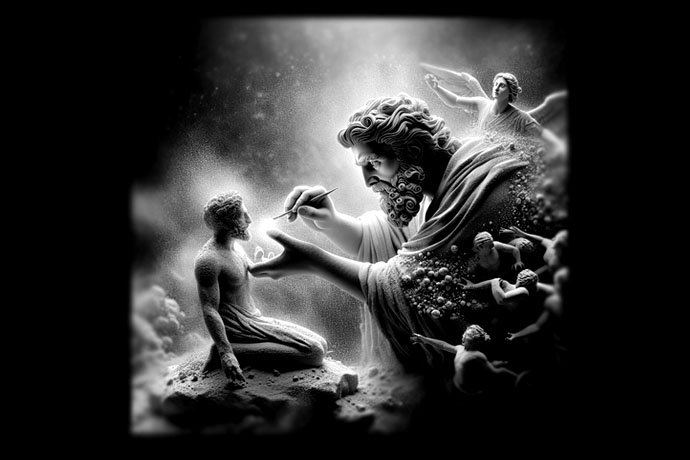
Creation of Man

Genesis 2:7 And Jehovah God formed man of the dust of the ground, and breathed into his nostrils the breath of life; and man became a living soul. 8 And Jehovah God planted a garden eastward, in Eden; and there he put the man whom he had formed
20 And the man gave names to all cattle, and to the birds of the heavens, and to every beast of the field; but for man there was not found a help meet for him. 21 And Jehovah God caused a deep sleep to fall upon the man, and he slept; and he took one of his ribs, and closed up the flesh instead thereof: 22 and the rib, which Jehovah God had taken from the man, made he a woman, and brought her unto the man. 23 And the man said, This is now bone of my bones, and flesh of my flesh: she shall be called Woman, because she was taken out of Man.
There are two creations accounts: Genesis 1 and Genesis 2. There is some sameness, and there is some difference, both speak of creation, both show that human beings are dependent on God.
With respect to God, In chapter 1, God is presented as sovereign ruler over all, The God who acts. He creates out of chaos and formlessness. He provides for the needs of all. He’s a talking God. He deliberates at crucial points, especially in the creation of human beings, and he entrusts the care of his created order to human beings.
In chapter 2, the most striking initial difference is that God is presented as the Lord. God is Yahweh God, the name that came to be associated with God’s covenant with Israel. This chapter shows more clearly than chapter 1 that God is a personal God. There is an emphasis on his presence and relationship with his image-bearers.
We note the immanent presence. He sends the rain. He shapes the man from the dust. He breathes into his nostrils the breath of life. He plants a garden. He puts the man there. He takes a rib, closes the flesh, forms the woman, and brings her to the man. It’s much more hands-on, personal, and interactive.
With respect to creation, in both chapters, transparently, there is creation out of formlessness. In both chapters, God names things and pronounces things good, but God is different from his creation in both chapters as well. Neither chapter will be open to a pantheistic, “green” view in which nature is God and God is nature. Nor even a panentheism, avatar view in which somehow creation is part of or infused by God.
Genesis 1 offers a kind of Google Earth view of creation. The whole Big Bang, the whole thing. Genesis 2 gives you more of a street view with names, locations, rivers. There is a picture of abundance and delight, which also itself says something about God and what he has made for human beings.
With respect to human beings, the creation is introduced by divine speech in both chapters.
First, they were made in the image of God. In one sense, human beings are creatures, and thus, they have in common the attributes of other creatures. Man animals return to the dust when they die. We’re part of this created order.
If you keep stressing the continuity and keep stressing the continuity, then eventually you might come out with a kind of position Peter Singer adopts at Princeton University who wants, in effect, all animal life to have, so far as it’s possible to work out at all, exactly the kind of rights human beings have because, after all, we’re genetically the same stuff. We are physical beings. They’re physical beings. They are born, they live, they die; so also is our course.
Genesis doesn’t see things that way. It insists human beings and human beings alone are made in the image of God. As you can imagine, that expression image of God has over the millennia generated endless discussion of what does it mean to be made in the image of God?
Philosophers and theologians have written long volumes saying, “It has something to do with the facility of language,” or “It has something to do with our self-identity, of our reasoning processes, of love that might be altruistic, of our capacity to know God, and so on and so on and so on.”
The image of God becomes a kind of master concept which is filled in as you go along. That is, we reflect God and the ways in which we reflect God will get filled in as the Bible unfolds.
From this first chapter, God is a talking God. He speaks to human beings, and they speak back to him. There is a commonality of speech, of propositions, of knowledge that is not merely felt but that can be articulated. There is also something of creativity. Of course, our creativity is not like God’s, but God makes things.
He makes things out of nothing. We don’t do that, but there is implanted in human beings as a reflection of God because we are made in his image a certain creativity. We work with our hands.
There is the capacity to work. God is said to work all of this creation week and then come to the end of it. What he gives to the man and the woman are certain responsibilities to work in this world, to tend the garden, which is teased out across all of Scripture as something honorable. Christians should never descend to the place where working at the manufacturing floor or working as a secretary or working driving a bus or doing research chemistry is secular.
“I do that to pay the bills, and then I’m supposed to be spiritual on Sunday, but what I do on Sunday and spirituality is just for Sunday. On Monday I go back to my reagents as I try to develop a new chemical that will fight cancer.” Rather, if it’s God’s universe and we are made in his image, as we work our work, too, reflects him and is offered back up to him with integrity and gratitude. It is significant because we are made in the image of God. It changes our perspective about who we are.
Although we have to recognize there are differences between God and us, there are other things where we are similar where we reflect him. Later on in the Bible God will say things like, “Be holy for I am holy,” so proper image-bearing ought to reflect God’s holiness.
God never says, “Be omnipotent, for I am omnipotent.” That is, “Be all powerful and do anything you choose to do because I am all powerful.” There are some differences between the God who is the Creator and we who are creatures. There are some differences. We’re not God! We’re his image-bearers. We’re made in his image, and we reflect him in certain ways.
God, in the Bible, is not only the Creator; he’s finally the sovereign over all, but the fact that he puts these human beings, this man and this woman, in charge over the rest of the created order, not to rape it, not merely to exploit it, not to become ecologically selfish, but to be God’s own stewards over the good world God has made really makes us (I don’t know what else to call it) vice regents.
We’re made in his image, and as God has made it all and we’re under him and charged with the responsibility of looking after it, we’re reflecting something of God. Even the capacity to know God, to delight in him, is wonderful.
Human beings were made in the image of God, and in this connection they were made to work, to rule, to serve as God’s stewards, to be surpassingly God-centered.
Human beings are the pinnacle of the creation in both chapters. But there are some differences. Genesis 1 emphasizes the similarity of human beings to God, made in his image.
In Genesis 1, God made male and female, but the differences between male and female don’t leap off the page. In Genesis 2 there is a basket of differences. One was made first, was alone, and had the responsibility for ruling and naming, and then the woman was taken from him.