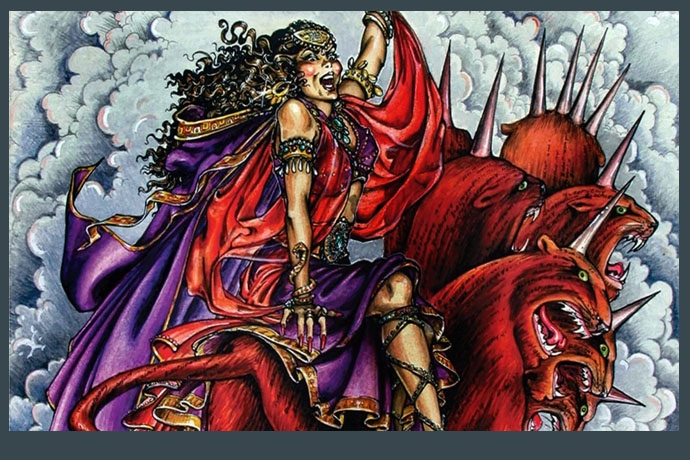
Beauty and the Beast

Revelation 17
17 Then one of the seven angels who had the seven bowls came and spoke with me: “Come, I will show you the judgment of the notorious prostitute who is seated on many waters. 2 The kings of the earth committed sexual immorality with her, and those who live on the earth became drunk on the wine of her sexual immorality.” 3 Then he carried me away in the Spirit to a wilderness. I saw a woman sitting on a scarlet beast that was covered with blasphemous names and had seven heads and ten horns. 4 The woman was dressed in purple and scarlet, adorned with gold, jewels, and pearls. She had a golden cup in her hand filled with everything detestable and with the impurities of her prostitution. 5 On her forehead was written a name, a mystery; Babylon the Great, the Mother of Prostitutes and of the Detestable Things of the Earth. 6 Then I saw that the woman was drunk with the blood of the saints and with the blood of the witnesses to Jesus. When I saw her, I was greatly astonished. 7 Then the angel said to me, “Why are you astonished? I will explain to you the mystery of the woman and of the beast, with the seven heads and the ten horns, that carries her. 8 The beast that you saw was, and is not, and is about to come up from the abyss and go to destruction.t Those who live on the earth whose names have not been written in the book of life from the foundation of the world will be astonished when they see the beast that was, and is not, and is to come. 9 This calls for a mind that has wisdom.
Beauty and the Beast
The final judgment of Babylon and the beast (17:1–19:21)
Rev. 17:1–19:10 is a large interpretative snapshot of the sixth and seventh bowls, which have foretold the judgment of Babylon that was first explicitly prophesied in 14:8. This is followed in 19:11–21 by an expanded description of the last battle, in which Christ triumphs over the forces of evil. Much space is taken up with the beast in ch. 17 because the woman’s significance and power cannot be fully understood except in her relationship to the beast
The Woman and Her Character, a Mystery
The angel announces to John that he is to witness a vision about the judgment of the world’s idolatrous economic-religious system
Chapter 17 begins with an opening vision of the harlot sitting on the scarlet beast, and then the rest of the chapter is given over to the interpretation of those symbols,
The angel speaks to John in words taken from God’s judgment on historical Babylon in Jer. 51:13, “O you who dwell by many waters, abundant in treasures, your end has come.” Babylon’s “sitting” on many waters speaks of her sovereignty over the nations, for “sitting” in Revelation indicates sovereignty, whether used of God, Christ, the angels, or evil beings, the sitting implies the woman’s alliance with the world and the beast.
She’s seated on great waters, the fact that she is called Babylon reminds us how historically sensitive that Babylon was, it was constructed on a whole canal system. In that sense, ancient historical Babylon was seated on many waters. The waters you saw, where the prostitute sits, are peoples, multitudes, nations and languages.”
Her Wicked Influence
“With her the kings of the earth committed adultery and the inhabitants of the earth were intoxicated with the wine of her adulteries.”
The woman stands for false religion. Babylon stands for false religion also. The word Babylon is a code word. Like Wall Street, when somebody says Wall Street, they are talking about a literal street. No, they are talking about the economic system when they say Wall Street.
What about Babylon? if you were to go back to Genesis chapter 10 and 11, you would find out that Babylon was built, first of all, by a man named Nimrod (Genesis 10:8–10). The very name Nimrod means rebel. Nimrod is a symbol, a type, a prophecy, of the Antichrist to come. He wasn’t trying to build a tower into the stratosphere. That is not what it means. It means that the top of this tower was a place for pagan worship. It was unto heaven. It was there that man first began pagan idolatrous worship there.
Babylon is the prevailing economic-religious system in alliance with the state and its related authorities, as it exists in various forms throughout the ages.
In the book of Daniel, 5:7. Daniel was in Babylon, and the king of Babylon had a dream.
Satan is not against religion, Satan is working for a worldwide religion. The first temptation in the Garden of Eden from Satan was not against religion; it was for religion. The devil was trying to tell Eve how to be godly. He said, “If you will do this, you will be as God” (Genesis 3:5). It wasn’t a temptation to fall down; it was a temptation to climb up, to be godly, but the devil’s way.
The world is going to see a worldwide religion. During the Great Tribulation, the entire world is going to be unified by the beast with a false religion. And this false religion will have all of the resources that it will ever need.
The Bible links her with Babylon, the mystery is unlocked, and when we see here that she is a woman deeply involved in apostate, false religion, a worldwide religion.
How do you commit adultery with an empire?
What is meant is that Rome saw herself so much as at the center of everything, fostered pagan worship, demanded god swaps, demanded, finally, that the emperor himself be worshiped as god, almighty, savior, divine, lord of lords, king of kings …
Part of the basis of Babylon’s judgment is the fact that the kings of the earth committed acts of immorality with her and those who dwell on the earth were made drunk with the wine of her immorality. The kings’ and the nations’ acquiescence to immorality refers not to literal immorality, but figuratively to acceptance of the religious and idolatrous demands of the ungodly earthly order
The intoxicating effect of Babylon’s wine removes all desire to resist Babylon’s destructive influence, blinds them to Babylon’s own ultimate insecurity and to God as the source of real security and numbs them against fear of a coming judgment. Harlotry, wine and new wine take away the understanding. My people consult their wooden idol … for a spirit of harlotry has led them. Hosea 4:11
In that sense, every nation that was allied with Rome was, in principle, bound up with idolatry. It couldn’t be any other way. Because the whole ethos of the empire was “Empire first; everybody else second,” then to be committed to the empire was to be committed to that which was holding itself to be number one over against the living God. It was intrinsically a faithless relationship. It was intrinsically an evil thing.
Now it’s understandable that the Christians would see it peculiarly that way when their most serious persecution came from this source, but the essence of the idolatry is not that they persecute Christians.
The essence of the idolatry is that they demand the allegiance that should belong only to God.
So in principle, wherever you find any system of thought or any political structure or any party that demands the kind of allegiance that belongs only to God, you have exactly the same kind of idolatry taking place, and it has taken place many times in world history.
Vision From the Desert
V3“Then the angel carried me away in the Spirit into a desert. There I saw a woman sitting on a scarlet beast that was covered with blasphemous names and had seven heads and ten horns.” One of the seven angels who had the seven bowls is who introduces this particular woman, this particular prostitute.
Later on in chapter 21 and 22, it is also the same angel, one of the seven with the seven bowls, who introduces John to the bride of the Lamb. Chapter 21, verse 9: “One of the seven angels who had the seven bowls full of the seven last plagues. Same person came and said, ‘Come, I will show you the bride, the wife of the Lamb.’ ”
By making it the same angel, it’s a way of drawing attention to the two women, one who is a prostitute and the other who’s the bride; one who is and, in the imagery of the book, all the people who are in spiritual prostitution and all those who are engaged to the Lamb. You have only two people.
Just as you’ve had two cities, Babylon or Jerusalem, so you’ve had people belonging to the mark of the Beast or the mark of the Lamb, now you have two women. You either have the prostitute or you have the bride. You belong to one party or the other.
He’s caught up in a desert, where he sees this woman sitting on a scarlet beast. It may be just the pomposity of the occasion. It may be some suggestion of his murderous intent. We just are not certain. “It was covered with blasphemous names and had seven heads and ten horns.” This, of course, identifies this beast for us as the first beast back in chapter 13.
John’s transport into a wilderness alludes to Isa. 21:1–2, where a vision from God, Isa. 21:10 is revealed to the prophet Isaiah and is described as coming “from the wilderness, from a terrifying land” (21:1). This allusion is confirmed by the fact that Isa. 21:1–10 is a vision of judgment against Babylon and by the fact that the phrase “fallen, fallen is Babylon” of Isa. 21:9 appears in Rev. 18:2 as well as in 14:8, which itself looks ahead to chs. 17–18.
In both Isaiah and Revelation, the desert is central to the vision, in one the source of the vision is in the desert, in the latter the prophet is taken to the desert to see the vision.
These verses present us with a nuanced understanding of the significance of the desert. Revelation consistently presents the desert as the place where, in spite of ever-present danger, God provides security for His people.
It is in this place of attack upon God’s people that God now declares His judgment of the attackers. John needed to be taken into the desert ( if this is understood as the place of God’s security) in order to avoid being mesmerized by the harlot.
Reflections
How easily is it possible for God’s people to be seduced by her attractive appearance and the economic and social advantages she offers to those who cooperate with her?
If this is the most materialistic and wealthy society in human history, are these temptations even greater for us today? What would it involve for us to compromise our faith in order to gain material or social advantage from our own Babylon?
This verse affirms that the whole vision of ch. 17 appears in the spiritual dimension of a wilderness or desert. Part of Babylon’s judgment in ch. 18 for persecuting the saints in the desert is that she herself is made into a desert-like place, where only demonic spirits dwell. Here is the biblical principle of an eye for an eye, the judgment of Babylon is decreed in the very place where she persecuted the saints.
An alternative interpretation of the desert’s significance here is that John is taken there not simply because it is an appropriate setting for Babylon’s sin to be revealed, but also because it is a place of spiritual security and detachment from the world’s dangers. There he can truly see the evils of Babylon and avoid her deception.
The Beauty of the Beast
“The woman was dressed in purple and scarlet, and was glittering with gold, precious stones, and pearls. She held a golden cup in her hand, filled with abominable things and the filth of her adulteries. This title was written on her forehead, Mystery, Babylon the Great, the Mother of Prostitutes and the Abominations of the Earth.
She is identified with this beast. She’s riding a beast, who, is that power controlled by Satan who incarnates himself in successive antichrists in historical opposition and persecution of the people of God.
To say that she rides the beast is not trying to establish her form of locomotion. The point is that under the harlot, supporting the harlot is the beast. It’s not just a political power. You’re seeing that behind the superficial, sociological, phenomenological level is Satan and his prime power incarnated this way. That’s what’s going on.
The heads and horns represent the fullness of power held by evil kingdoms who persecute God’s people, since this is their figurative meaning in Daniel 7 ten kings in Dan. 7:24. The beast’s red color associates him with the red dragon of 12:3. The color indicates royal attire and hence kingship, but more particularly the persecuting nature of the dragon in 12:3 and the beast here, who spill the red blood of the saints.
The blasphemous names, as in 13:1, refer to the beast’s false claims of universal sovereignty. Though closely associated with the beast, the woman is not to be equated with the beast. That the woman rides the beast indicates her alliance with it. She represents the ungodly world as it works with the state socially, culturally, and economically to persecute Christians. They are also mutually involved in deception of ungodly multitudes throughout the earth
The description of the woman confirms that she represents worldly economic forces which are in collusion with the state in persecuting Christians, 14:8; 17:2.
A golden cup, seeming so precious and pure, but, in fact, it’s filled with abominable things and the filth of her adulteries.
The fullness of blasphemies are not so much because this beast and this woman are swearing all the time, are blaspheming. They’re blaspheming in the sense not that they’re throwing curses against God but that they are engaged in such wholesale self-deification. There are all kinds of people who never blaspheme overtly, who never say, “Cursed Jesus” or something like that, but who are blaspheming all the time by trying to make themselves the center of the universe. It’s a form of self-deification.