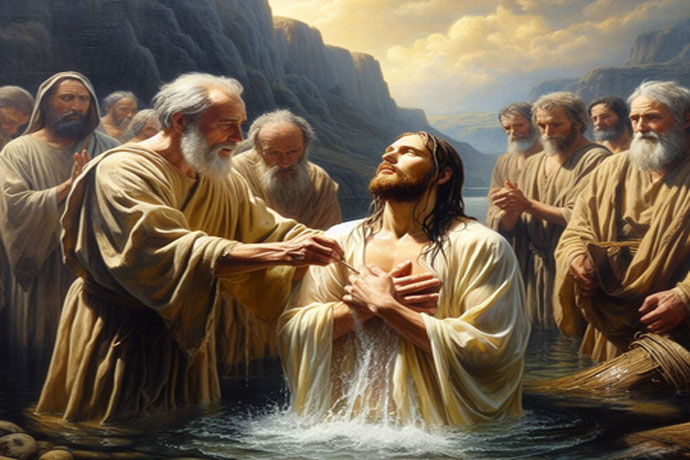
Baptism of Believers

In 1896, Hensley Henson, later Bishop of Hereford and then Durham, said during a sermon in Oxford (June 14, 1896): “The practice that works out to this miserable confusion, the modern practice of unconditioned, indiscriminate baptising is indecent in itself, discreditable to the Church, and highly injurious to religion.”
We are in a paradox of a world that is full of baptized non-Christians and unbaptized Christians. There is a world of people who have been baptized by the mode of infant Baptism by sprinkling, that has been a dominating form of Baptism in the Christian church historically.
At the same time, there is a large group of people who do know the Lord and they’re in the church and have been baptized. This is a strange thing. Non-believers should not be baptized, and believers must be baptized.
All authority hath been given unto me in heaven and on earth. 19Go ye therefore, and make disciples of all the nations, baptizing them into the name of the Father and of the Son and of the Holy Spirit: 20teaching them to observe all things whatsoever I commanded you: and lo, I am with you always, even unto the end of the world. Mt 28:18–20.
He immediately said this, “Baptizing them, Baptizing them.” That’s the church’s commission. When the Holy Spirit said in Acts 2:38, “Repent and be baptized,” that was a command to individuals. And when three thousand believed on the Day of Pentecost, and three thousand were baptized, that set the example.
It’s unmistakably clear that the Lord has called us to this means of public identification with Christ. A person who claims to be a Christian but has not been baptized by believer’s Baptism, falls into one of the following categories .
That believer may be ignorant, perhaps not taught, or perhaps taught wrongly, and there has been much wrong teaching about Baptism. In evangelical churches, people are told that their infant Baptism is sufficient and that it would be wrong, sinful, to be baptized after you have come to faith in Christ because your infant Baptism is sufficient. They have been taught wrongly or they have not been taught at all.
During the middle Ages, severe ecclesiastical laws were created as part of the civil code. In Europe, nations were divided. There were Catholic nations, or countries, and Protestant countries. There was no separation of church and state, the church and the state were one great sort of monolithic power. There were Catholic states and there were Protestant states. And everybody in a Catholic state was a Catholic by virtue of infant baptism. And everybody in a Protestant state was a Protestant by virtue of Protestant infant baptism.
And so, if you were in the country, you were not only under the civil code from a social standpoint but you were under the civil code from a religious standpoint. And rebaptism, rebaptizers were called Anabaptists. That’s what ana means, again, rebaptizers. And if you were a rebaptizer of somebody who was baptized as an infant, that was a capital offense, a capital offense. It was an act against the state, against the state church and you could pay with your life.
It was considered a heresy worthy of death. Anybody who violated baptism as ordained in their country, whether a Catholic or a Protestant country, came under the punishment of this civil code. This was around for a long time. If you go back to the year 391 you read the following order from the emperors. “Whoever forsakes the holy faith and desecrates the holy baptism through heretical superstition shall be excluded from human society.”
A law of the Emperors Honorius and Theodosius II in the year 413 says, “If any person is convicted of having undertaken the rebaptism of a member of the Catholic Church, the one who has committed this shameful crime together with the one provided he is of accountable age who has allowed himself to be baptized shall be punished with death without mercy.”
Consequently, infant baptism reigned supreme because people didn’t want to lose their lives. The Catholic Church hated the Anabaptists even through the Middle Ages, the Reformers, the Reformed Church who got their soteriology right, hated the Anabaptists, the rebaptizers, because they bought into the Roman Catholic view of infant baptism. And one of the sad realities of the Reformation is that Reformers who believed in sola Scriptura, sola gratia, sola fide, sola Christus, all the solas, drowned people who baptized believers. You want to be baptized, we’ll put you down and won’t bring you up until you’re dead.
The Reformation period had little understanding and even in the newly formed Protestant Churches, freedom of conscience remained an unknown thing. Not only was it again laid down exactly what and how one must believe, but all other opinions and convictions in matters of faith were suppressed with iron energy. Luther’s original defense of the freedom of a Christian remained an unfulfilled demand. The right of free Christian individuality was an ideal that remained at that time unrealized.” This writer says, “The Reformation did not bring to an end the zeal for bloody persecution. On the contrary, it began a new era of tribulation, tears and blood and not less indeed in the regions of the churches that it separated from Rome than where the Roman Church continued to assert its way.”
In other words, the animosity and the persecution of these people who wanted to do baptism the way the Scripture says were persecuted both in Catholic and Protestant places. This persecuting zeal was directed very specially against the rebaptizers who rejected infant baptism and demanded a return to the original Christian mode of baptism taught in the New Testament.
So sometimes you hear people say, “Well, we need to agree on a lot of things, but baptism is a minor detail.” It’s not a minor detail if you’re about to be drowned for believing it. The city law for Hanover, Germany, and other German cities with the specific approval of Luther and Melanchthon, called for all rebaptizers to be beheaded. The Zwinglians and Baptists were to be flogged and banished from the city forever. They saw believers baptism as disrupting the national church, posing a threat to national solidarity and being a blasphemous heresy that would corrupt others and break the power of the nationalized church.
IT is sad to read such judgments from the pen of a Catholic historian. But truth must be honored. So the sixteenth century church as we know it, the Reformed Church that we love for its soteriology, knew no tolerance for rebaptizers. Infant baptism was required as the only baptism and defended by fire, water and the sword.
What is Baptism?
Two verbs in the New Testament support this basic idea. They are the verb bapto used four times in the New Testament, it means to immerse, it means to dip into. It would be a word used to dip cloth into dye so that it was totally submerged so as to be fully colored by the die.
And then there is an intensified form of bapto, baptizo. That’s simply used many, many times in the New Testament and it means to dip completely and the noun, baptismo, is always used in the New Testament in the book of Acts, always to refer to a person who is confessing Christ being immersed fully into water.
The translators of English Bibles transliterated the Greek and created a word “baptized,” because it had become a technical term for immersion from its biblical use. It does not mean sprinkle, that’s a completely different Greek word,
The word could be best be translated immerse. It would have helped a whole lot of the translators had just translated it immerse. But every New Testament use of the word requires that its translation and its understanding be immersion. Even John Calvin who was a baby baptizer, who advocated sprinkling babies, said, “The word “baptize” means to immerse, and it is certain that immersion was the practice of the early church,”
Matthew 3;6, John the Baptist in his ministry, “They were being baptized by him, not with the water from the Jordan River, but in the Jordan River. They were being baptized by him in the Jordan River.” Verse 16, “After being baptized, Jesus … who was baptized there by John … came up immediately out from the water.” He came up out of the water. So we have there in just those two references a visual picture of what John the Baptist was doing, placing people into the water, including the Lord Jesus, and then bringing them up out of the water.
In 3 of John’s gospel, we get another insight into the baptizing ministry of John the Baptist. In verse 23, “He was baptizing in a place called Aenon near Salim.” Why was he baptizing there? “Because there was much water there.” You need enough water to get them under.
Again, in Mark 1:5, “All the country of Judea was going out to him and all the people of Jerusalem and they were being baptized by him in the Jordan River.” the picture here is you need a river; you need a lot of water in order to immerse these people.
In the eighth chapter of the book of Acts, this is the story of Philip and the Ethiopian eunuch. “They were going along the road. They came to some water and the Ethiopian said, ‘Look, water. What prevents me from being baptized?’ And Philip ordered the chariot to stop.” Verse 38, “They went down into the water, Philip as well as the eunuch
Any student of Scripture knows that God has always taught spiritual truth using symbols.
Baptism is a symbol, an object lesson, a visual representation of a spiritual reality that describes and defines a complete submersion and immersion into Christ.
The Jews had a proselyte baptism, very, very familiar to the people in Jerusalem and Judea. By the time we come then to the New Testament, they are familiar with immersion. They know what it is to be baptized. They know it is connected to coming to worship the true God. It is a symbol of the death of the old life, and the beginning of a new life.
It was unthinkable to John the Baptist to baptize Jesus. Why? Because this was a baptism of repentance. This was a baptism for sinners. This was a baptism for confessed felons, as it were, who had violated the Law of God. He knew Jesus. He knew His divine identity.
In John 1:29 when he first saw Him, he said, “Behold, the Lamb of God who takes away the sin of the world.”
But Jesus prevailed upon him. Why? Why did Jesus insist upon being baptized? Well
The Apostles knew Jesus was baptized. They followed John the Baptist and baptized more people.
What is the meaning of Christian baptism?
I don’t know what the meaning would be of baby baptism, it has no biblical meaning.
When you come to faith in Jesus Christ, you’re immersed into Christ. Romans 6:3, this gives us the spiritual reality pictured in water baptism, this is not the water baptism, this is the spiritual reality section.
“Do you not know,” Romans 6:3, “that all of us who have been baptized into Christ Jesus have been baptized into His death?” When you come to Christ, you’re literally immersed into His death. You die with Him there so that all your sins are paid for in full … solidarity with Him.
Verse 4, “You have been buried with Him through baptism,” again a spiritual union into death so that as Christ was raised from the dead through the glory of the Father, so we might walk also in newness of life. You were buried with Him. You died with Him. You rose with Him.
verse 5. “We have become united with Him in the likeness of His death and also we shall also be in the likeness of His resurrection. Our old self,” verse 6, “was crucified with Him in order that our body of our sin might be done away with, so that we would no longer be slaves to sin, for he who has died is freed from sin. If we have died with Christ, we believe that we shall also live with Him.” He’s circling back over this massive truth again and again.
In Colossians 2:12, “Having been buried with Him in baptism,” that’s the baptism into His death, in which you were also raised up with Him through faith in the working of God who raised Him from the dead.” When you were dead in your transgressions in the uncircumcision of your flesh, He made you alive together with Him, having forgiven all our transgression.
Salvation is placing a person in union with Jesus Christ and in some amazing, supernatural way, we participate in His death, in His resurrection, spiritually. Now again, there’s no water in Romans 6. There’s no water in Galatians 2. There’s no water in Colossians 2. This is what Peter calls the baptism that saves. This is what Paul calls the washing of regeneration, or in Acts 22:16, “The washing away of your sins.” It is immersion into Christ. And that is what is depicted ceremonially, symbolically in baptism.
What is the relation of immersion to salvation?
It’s important but it doesn’t save you. Paul says in 1 Corinthians 1, “I thank God that I baptized none of you except Crispus and Gaius. If baptism saved, Paul would have been baptizing everybody. He said, “I did baptize the household of Stephanas, beyond that I don’t know whether I baptized anybody else. Christ sent me not to baptize but to preach the gospel.” This is a disclaimer on Paul’s part for any saving virtue in H20
You say, it says in Acts 2:38, “Repent and be baptized for the remission of sins.” I take it that the construction indicates there when paralleled with Matthew 12:41, “Repent and be baptized because of the remission of sins.” Baptism was an immediate, inseparable, public testimony of a true conversion.
Matthew 10:32, “Whoever confesses Me before men, I’ll confess Him before My Father who is in heaven. Whoever denies Me before men, I’ll deny before My Father who is heaven.” An open, public confession of faith in Christ is the evidence, the initial evidence of one’s true conversion.