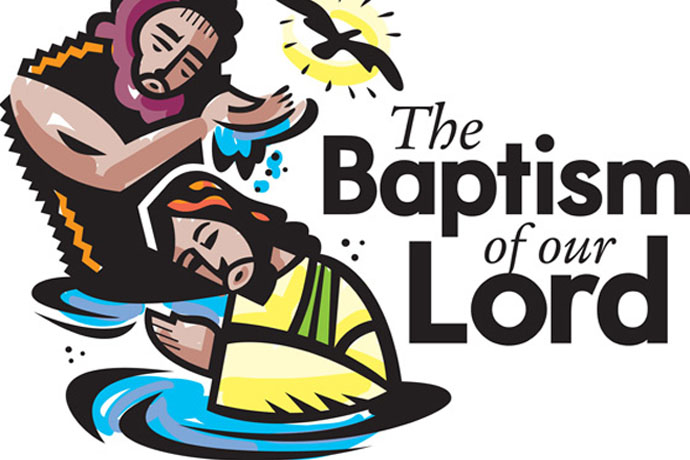
Baptism

“Go ye therefore, and teach all nations, baptizing them in the name of the Father, and of the Son, and of the Holy Ghost.” Mt 28:19
Jesus began His ministry by being baptized by John in the river Jordan. Jesus concluded His ministry by commanding baptism.
Let’s talk about baptism, not Baptists baptism.
If we have any Baptist doctrine, we need to get rid of it. And Presbyterians need to get rid of Presbyterian doctrine. And Methodists need to get rid of Methodist doctrine. And Episcopalians need to get rid of Episcopalian doctrine. And Assemblies of God need to get rid of Assembly of God doctrine. And Catholics need to get rid of Catholic doctrine. All of us need to come back to Bible doctrine, we need to understand what does the Bible say. This is a church, not a club, and we don’t make up our rules as we go along. Jesus has all authority.
What is the biblical method of baptism?
Mark 1:9-10, “And it came to pass in those days, that Jesus came from Nazareth of Galilee, and was baptized of John in Jordan.” “And straightway coming up out of the water, ”if he came up out of the water, where was He? Down in the water he saw the heavens opened, and the Spirit like a dove descending upon him.
The Origin of Christian Baptism
Christian baptism began with John the Baptist, was accepted by Jesus at the beginning of his ministry, was practiced by his disciples, was commanded by the Lord after his resurrection, and was offered in the early church to all who would repent and believe in Jesus Christ. And we can see the meaning it attained. It was a sign of repentance and faith in Christ as the Savior and Lord of a new people. Baptism symbolizes conversion to Jesus. It represents a turning from the old life and an alignment of ourselves with Christ.
It meant that the Messiah has arrived; he will be gathering a new people for himself; the mark of this new people is not Jewishness but repentance and faith. Therefore Jews should not say to John’s demand for repentance: “But we have Abraham as our father, and we bear the marks of circumcision, the sign of the covenant.”
What counts in the new people is not who your parents are but whom you live for; and therefore a new symbol for the new covenant people is given, baptism; and it is given in John’s ministry only to those who repent and believe.
By calling all Jews to be baptized, John declared powerfully that physical descent does not make one part of God’s family, and therefore circumcision which signified a physical relationship will now be replaced by baptism which signifies spiritual relationship. And so John the Baptist lays the foundation for the New Testament understanding of baptism, which we try to preserve.
Jesus himself accepted baptism from John in order to identify himself with John’s teaching and with this new people of faith. Jesus’ disciples picked up John’s practice and baptized as a part of Jesus’ ministry (John 3:26; 4:2). Then at the end of his earthly ministry Jesus commissioned the church to “make disciples of all nations, baptizing them in the name of the Father, the Son, and the Holy Spirit” (Matthew 28:19).
Several weeks later the apostles preached their first sermon to the Jewish people gathered for Pentecost in Jerusalem. Peter closed with these words: “Repent and be baptized, every one of you, in the name of Jesus Christ for the forgiveness of your sins; and you shall receive the gift of the Holy Spirit. For the promise is to you and to your children and to all that are far off, everyone whom the Lord our God calls to him.” Following in the footsteps of John the Baptist
Who should be baptized
Our view of baptism is distinct in that we do not think infants should be baptized. The reason is, infants are not capable of repentance or faith; and, the notion that a person should inherit the blessings of a Christian or be considered a Christian by virtue of his parents’ faith is contrary to New Testament teaching.
The most credible and respectable defense of infant baptism says that just as in Israel circumcision was given to eight-day-old infants, so in the church baptism should be given to infants of Christian parents. We argue that there is a correspondence between circumcision as a sign of the covenant with Israel and baptism as a sign of the new covenant.
Baptism is an expression of faith and therefore only for believers.
We believe that baptism is an ordinance of the Lord by which those who have repented and come to faith express their union with Christ in His death and resurrection. So our understanding of the New Testament is that the meaning of baptism includes the fact that it is an expression of the faith of the one being baptized. It is not something that an unbeliever can do. It is not something than an infant can do. That is why we don’t baptize infants.
Colossians
2:11–12. 11 in whom ye were also circumcised with a circumcision not made with hands, in the putting off of the body of the flesh, in the circumcision of Christ; 12 having been buried with him in baptism, wherein ye were also raised with him through faith in the working of God, who raised him from the dead.
We believe, namely, that just as circumcision was administered to all the physical sons of Abraham who made up the physical Israel, so baptism should be administered to all the spiritual sons of Abraham who make up the spiritual Israel, the Church.
And who are these spiritual sons of Abraham? Galatians 3:7 says: “So you see it is the people of faith who are the sons of Abraham.” Since the only way to enter the true Israel of God, the Church, is by repentance and faith in Jesus Christ, therefore the symbol of that entry should only be administered to those who believe.
Believer baptism bears witness to the teaching of John the Baptist (Matthew 3:9), Jesus (Matthew 21:43), and the apostles that “not all are children of Abraham just because they are his descendants … and it is not the children of the flesh who are children of God”
(Romans 9:7, 8).
A very important change has occurred in the way God forms his people. In the Israel of old God formed his people through natural offspring. But in the Church, the true Israel, God is forming his people not by natural kinship but through supernatural conversion to faith in Christ. There is a correspondence between circumcision for the Israel of old and baptism for the Church. Both symbolize membership in the covenant community. But there is also a crucial difference.
With the coming of John the Baptist and Jesus and the apostles, the emphasis now is that the spiritual status of your parents does not determine your membership in the covenant community.
The beneficiaries of the blessings of Abraham are those who have the faith of Abraham. These are the ones who belong to the covenant community, and these are the ones (in line with Old Testament practice) who should receive the sign of the covenant.
It’s probably right to say that baptism has replaced circumcision as the mark of being part of the people of God. In the Old Testament men were circumcised to signify membership in the old-covenant people of God, and in the New Testament men and women are baptized to signify membership in the new-covenant people of God.
That has led many Christians to assume that, since circumcision was given to the male children of the people of the old covenant, therefore baptism should be given to the male and female children of the people of the new covenant. That’s the gist of the argument for infant baptism.
That Does Not Work
Textually and covenantally, it doesn’t work. Look at Colossians 2:12: “… having been buried with him in baptism, in which you were also raised with him through faith …” The words through faith are all important on this issue. Paul says that when you come up out of the water signifying being raised with Christ this is happening through faith. Verse 12: “… in which [baptism] you were also raised with him through faith.”
Baptism as a drama of death and resurrection with Christ gets its meaning from the faith that it expresses. In baptism you are “raised with him through faith.”
What we celebrate in baptism today is the mighty work of God in the hearts of children and adults to bring them to repentance and faith in Christ.
When we baptize them in the name of the Father, the Son, and the Holy Spirit, we celebrate the involvement of the whole Godhead in their conversion and their new relation to each Person in the Trinity. When we immerse them in the water, we celebrate the death and burial of Jesus Christ for our sins. When we raise them up out of the water, we celebrate the resurrection of Jesus and their participation in it. We celebrate the newness of life in love and joy that Jesus gives.
The Method of Baptism
It is obvious that Jesus was baptized by immersion. Why did Jesus come all the way out to Jordan? Why was John baptizing in Jordan? “And John also was baptized in Aenon, near to Salim, because there was much water there: and they came, and were baptized.” (John 3:23)
Now some people want to make it easy. You know, churches are getting so lax today I expect to see some churches start taking members in on the telephone and baptizing their photographs.
The Meaning of Baptism
Baptism pictures the saving work of the Lord Jesus Christ.
Romans 6: 4: “Therefore we are”—what’s that next word?—“buried with him by baptism into death:” baptism is a burial—“that like as Christ was raised up from the dead by the glory of the Father, even so we also should walk in newness of life. For if we have been planted together in the likeness of his death, we shall be also in the likeness of his resurrection:”—so the Bible says—“knowing this,”—verse 6—“that our old man”—now, watch it. Our old man, old Adrian, that rascal—“is crucified with him,”—that is, with Jesus—“that the body of sin might be destroyed,”—that’s the old man I used to be—“that henceforth we should not serve sin. For he that is dead is freed from sin.” (Romans 6:4–7)
Baptism pictures the gospel.
What is the gospel?
First Corinthians 15 tells us the gospel is this: that Christ died for our sins; He was buried; He was raised again the third day.”
That is the gospel: the death, burial, and resurrection of Jesus. Do we understand that? “We are buried with him by baptism into death: that like as Christ was raised from the dead … even so we also should walk in newness of life.” (Romans 6:4)
Sometimes we refer to baptism as a symbol. That is alright as long as we remember that the symbol represents a faithful commitment.
Can you understand why the devil would like to destroy that symbolism? It is the gospel: the death, burial, and resurrection of Jesus Christ.
Baptism is a picture of a death, a burial, and a resurrection.
God wants it to be clear; God wants it to be plain; and that’s the reason that we picture what Jesus did to save us.
Romans 6:5 “For if we have been planted together in the likeness of his death …” When I go under the water, when I’m baptized, that says I am in the likeness of death. I die, the old person dies, because when Jesus died, He died for me. When I trust Him, His death has my name on it. He died my death. He took my place upon that cross. So my death with the Lord Jesus Christ is pictured in baptism. That’s the reason, if you were baptized before you got saved, hey, folks, you weren’t really baptized. To be baptized before you’re saved is like having your funeral before you die. Baptism is a picture of your death.
Baptism follows belief. The Bible never says, “Be baptized and believe,” but vice versa, “Believe and be baptized,” because real baptism follows real salvation. It pictures what? Our death—.
The old person died with Jesus.
But it also pictures the fact that one of these days, I’m going to die physically. Baptism pictures Calvary, because we died with Him. It pictures Easter, because we rose with Him. It pictures the Second Coming, because one of these days we’re going to be raised up out of that grave to live with the Lord Jesus Christ in a resurrected body. Don’t you think the devil would like to take that picture out of the church?
The Motive of Baptism
Why be baptized?
There is a Master to confess: the Lord Jesus. We are baptized in the name of the Father, the Son, and the Holy Ghost. We take the name of Jesus. He is now our Master.
Knowing this, that our old man is crucified with him, that the body of sin might be destroyed, that henceforth we should not serve sin.” (Romans 6:6) we have a new Master, a new life. I’m a new man with a new Master. I’m identifying myself with Christ
What does baptism mean? It means I belong to Jesus. It doesn’t make me a Christian. It shows I’m a Christian.
There is a message to convey.
Every time one is baptized they are preaching the gospel
There Is a Mandate to Complete
Jesus said, “Go ye therefore, and teach all nations, baptizing them in the name of the Father, and of the Son, and of the Holy Ghost:”—now, watch this—“teaching them to observe all things whatsoever I have commanded you.” (Matthew 28:19–20)