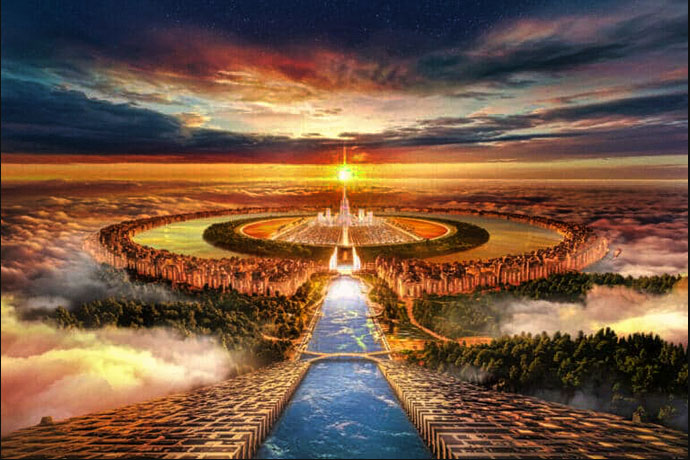
A New Heaven and Earth

How will we as mortals, constrained as we are by both limited knowledge, and sin in a universe still under the curse, find words to describe the glories yet to come?
How would we describe electricity to someone who had lived in jungle all their life and had never heard of electricity?
Some might say they are just stupid. No, of course not, they’re no more stupid than we are, or just as stupid as we are, depending on your point of view. The problem is they have no categories for latching onto these things. They haven’t seen these things. Our children grow up with computers and switches and wires and power generation. They learn it at school. It’s part of their whole social environment.
So how will we talk about the throne room of God? One of the reasons why God uses so much symbolism is because we are so dead to God, so blind, so unable to understand, so without categories, without vocabulary, that when someone like Paul is caught up into the third heaven, the things may be forbidden to Paul to explain, but they are also inexpressible because we haven’t been there. You are finally forced to resort to symbolism, apocalyptic, and the institutions God has placed … temple, holy city.
Strange institutions like kings and priests. We’re a republic here. We don’t hold kings in very good favor. And priests? We’re not really enamored in our culture by a whole lot of reflection about priests. The Bible is full of kings and priests. These are the categories God has chosen to begin to open our eyes, our categories, to begin to understand the glory of what is yet to come. Now just to bring it together, the pieces are there.
Revelation 21:1–22:6
21 And I saw a new heaven and a new earth: for the first heaven and the first earth are passed away; and the sea is no more. 2And I saw the holy city, new Jerusalem, coming down out of heaven from God, made ready as a bride adorned for her husband. 3And I heard a great voice out of the throne saying, Behold, the tabernacle of God is with men, and he shall dwell with them, and they shall be his peoples, and God himself shall be with them, and be their God: 4and he shall wipe away every tear from their eyes; and death shall be no more; neither shall there be mourning, nor crying, nor pain, any more: the first things are passed away. 5And he that sitteth on the throne said, Behold, I make all things new. And he saith, Write: for these words are faithful and true. 6And he said unto me, They are come to pass. I am the Alpha and the Omega, the beginning and the end. I will give unto him that is athirst of the fountain of the water of life freely. 7He that overcometh shall inherit these things; and I will be his God, and he shall be my son. 8But for the fearful, and unbelieving, and abominable, and murderers, and fornicators, and sorcerers, and idolaters, and all liars, their part shall be in the lake that burneth with fire and brimstone; which is the second death.
So what we find in this section of Scripture is several different categories. We find what is new; what is symbol-laden about the New Jerusalem; what is missing; and what is central.
What is new.
It is nothing less than a new heaven and a new earth. “Then I saw a new heaven and a new earth, for the first heaven and the first earth had passed away …” The language is drawn from the Old Testament, as is so often the case in the book of Revelation. It is hard in the book of Revelation to read more than a verse or two without coming across allusions to the Old Testament. So also throughout this chapter.
Here the language is drawn from Isaiah 65:17 and 19 and Isaiah 66:22. This sort of language is picked up in 2 Peter. In other terms, the thing is described in many different ways. in Romans 8, Paul reminds us that the whole universe groans in travail waiting for the final adoption of sons.
When Paul writes to the Romans in his eighth chapter, he anticipates the end of the groaning of the entire creation. He says, “This creation groans in travail, awaiting the adoption of sons, the final transformation of all things.”. The current order of things is disheveled. It’s not the way it’s supposed to be.
2 Peter 3:10 “But the day of the Lord will come like a thief. The heavens will disappear with a roar; the elements will be destroyed by fire, and the earth and everything done in it will be laid bare. Since everything will be destroyed in this way, what kind of people ought you to be?
Some in here are old enough to remember the apocalyptic horror of nuclear exchange and its threat. Some of you who are older will remember that in the 1950s in schoolhouses all across the United States and in Canada, children were told what to do if there was a nuclear exchange: hide under the desks.
This is not mere ratcheting up to some new level of improvement. This is massive renovation, massive transformation. Exactly what this entails is beyond our capacity to imagine. Exactly what the relationship is between the new heaven and the new earth and the old heaven and the old earth we can scarcely articulate. Yet there are hints, and they are all spectacular.
There is no more Sea
There’s no more sea, that is symbol-laden language. This is not talking about the hydrology of the new heaven and the new earth. This is not about the hydrological principles that will prevail in the new universe. The language is symbol-laden. The sea so often functions in Jewish literature as a symbol for chaos, destruction, danger, even evil.
The ancient Israelites, like Isaiah, chapter 57, write, “But the wicked are like the tossing sea, which cannot rest, whose waves cast up muck and mire.” The sea does not have a lot of positive overtones in Old Testament poetry and symbolism.
It’s connected with chaos and death and danger and destruction. we discover that here in the new heaven and the new earth there is no more sea. No more death, no more chaos, no more destruction.
The sea is part of the fallen created order that stands between John, who’s trying to see God, and God himself. But now there’s no more sea. In chapters 12–14, the Devil is introduced in chapter 12, and a beast comes out of the sea in chapter 13 and then out of the land. But now there’s no more sea. There’s no more chaos. There’s no more destruction. There’s no more death.
This is not talking about the ultimate structure of the place of the water molecule in the new heaven and the new earth. John couldn’t care less. He is saying in symbol-laden language, “Chaos is gone.”
Then the symbolism changes. “I saw the Holy City, the new Jerusalem, coming down out of heaven from God, Then it changes again, prepared as a bride beautifully dressed for her husband.”
One very strong features of apocalyptic symbolism is that it’s prepared to mix its metaphors.. Just when you think you’ve got a handle on something, the metaphor changes. It can just about blows our minds.
The New Jerusalem
“I saw the Holy City, the new Jerusalem, coming down out of heaven from God, prepared as a bride, there’s a double switch here. This does not mean there’s a new heaven and a new earth and then Jerusalem is some small part of it. The whole thing is cast as the new heaven and the new earth.
The point is that this side of the fall, this side of the curse, we learn in the Bible that it’s not just human beings who are under sentence of death, but the entire created order is under sentence of death. The universe itself is a dying place.
The whole thing is cast as New Jerusalem, or the people of God somehow being the very essence of the thing. It’s not geography now. It is symbolism. Then it changes again, prepared as a bride beautifully dressed for her husband.
You see, this is the new heaven and the new earth, and the old order (the order that has been cursed by sin, that has attracted the wrath of God, that is stamped by death), it is characterized by decay, despite all the mediating grace of God, the grace that we sometimes call common grace so that all kinds of good and lovely and beautiful things are still here, yet it is a creation that is under the curse. Now the old order is gone.
Here we’re not to think the New Jerusalem comes down out of the new heaven onto the new earth. The New Jerusalem is the new heaven and the new earth. It’s another way of describing the same thing. If you want another way of talking about the same thing, this city is like a bride prepared for her husband because, after all, the Bible speaks again and again and again of the church being the bride waiting for the groom, Christ Jesus, and one day they will be united. It’s another way of talking about the same reality.
It’s Jerusalem, a new Jerusalem. The old Jerusalem was the place of the great king.
It’s the city of the Great King! It’s the city of the Davidic dynasty. It’s the city of the tabernacle, then the temple. This is the city where God rules and where God has provided a sacrificial system that addresses all of human sin and enmity.
The old Jerusalem was the place where God met with his people in the sacrificial system of the temple.
The vision of a city is important. In this book, there are two cities and two women. There’s Babylon, symbol-laden for all that is wicked and cursed, and there’s the New Jerusalem, the very abode of the people of God.
A city symbolizes, from the Old Testament, not only the center of God’s reign, the place where God meets with his people. This vision of a New Jerusalem coming down out of heaven embraces several intrinsic elements.
First, it is transparently the anti-type, the fulfillment of old Jerusalem.
What was old Jerusalem? Old Jerusalem was the city of the king. It was the place where men and women of the covenant met with God. It was the place of the temple. It was the place of worship and rejoicing. We gather together in this New Jerusalem, and it will be the place where, as we shall see in this chapter, we meet with God, where there is great rejoicing, where there is corporate worship.
God will manifest himself as the God of the Israelites by appearing in glory in the tabernacle and then later in the temple. That’s how God will be their God and manifest himself to them. Then a little farther on, by the time you get to Jeremiah, the same language is used in the prospect of the intimacy bound up with the new covenant. Jeremiah 31: “I will put my law in their minds and write it on their hearts. I will be their God; they will be my people.”
The vision of a new Jerusalem coming down out of heaven embraces several intrinsic elements. It’s clearly the antitype to the Old Testament Jerusalem. Jerusalem was the great meeting place between God and his people. It was the place of the temple. It was the city of the king. This was the place that all the tribes were to gather toward at all of the high feasts.
This was as close as you got on this earth to the glories of heaven. If, in fact, that historical city was corrupted by all kinds of gross sin and was destroyed, that was merely a reflection of what should not have been. That was, nevertheless, the historical city. Now the New Jerusalem is the antitype, the fulfillment of that old Jerusalem. It comes down now out of heaven.
This is an act of God. It is not something that we gradually bring in by a superior brand of utopian politics. This is something that God himself finally brings about at the end. The city is also necessarily, intrinsically, a social vision. This is not a picture of isolated blessings for isolated Christians. A city is a place where people live together.
Galatians 4:26. We don’t belong to the old Jerusalem; we belong to the Jerusalem above.
God Among His People
V3 “And I heard a loud voice from the throne saying, ‘Now the dwelling of God is with men, and he will live with them. They will be his people, and God himself will be with them and be their God.
v 4: “He will wipe every tear from their eyes. There will be no more death or mourning or crying or pain, for the old order of things has passed away.”
The eternal blessedness is still couched in negative language. It’s not characterized by death. It’s not characterized by tears. It’s not characterized by pain. It’s not characterized by crying. The old order of things has passed away. We’ve come to a new heaven and a new earth, the home of righteousness.
The old order of things has passed away.
We are given a glimpse into what will no longer be there: death, sorrow, and decay. We still have not yet seen what will be there. There are hints, in that transparently we’re going to see the opposite of this negation. This language too derives from the Old Testament. Isaiah 35: “And the ransomed of the Lord will return. They will enter Zion with singing; everlasting joy will crown their heads. Gladness and joy will overtake them, and sorrow and sighing will flee away.”
earlier in the book of Revelation, in Revelation, chapter 7: “ ‘Never again will they hunger; never again will they thirst. The sun will not beat down on them,’ nor any scorching heat. For the Lamb at the center of the throne will be their shepherd; ‘he will lead them to springs of living water.’ ‘And God will wipe away every tear from their eyes.’ ”
We know about crying and death. We know about pain and mourning, so you can explain what that doesn’t look like by saying there won’t be any more of it, but positively what will there be?
Consummation, life, the fullness of joy in the presence of God, utter holiness without tarnishing, love for one another without any self-justification or one-upmanship, happy service, industry and creativity, jobs to do, and the energy and strength to do them, with a God-centeredness that is full of vitality and resurrection existence.
Especially important is the abolition of death. There will be no more death. Isaiah 25 had already predicted, “God will swallow up death forevermore.”
All Things New
In verse 5, God speaks. The language is weighty. It’s as if every significant clause has to be separately introduced to give you time to stop and think about it. “He who was seated on the throne said, ‘I am making everything new!’ ” Pause. “Then he said, ‘Write this down …’ ”
Write this down, for these words are trustworthy and true. Pause. Weigh. “He said to me: ‘It is done.’ ” The Savior on the cross cried, “It is finished.” Here the voice from the throne calls, “It is done.” When Christ called, “It is finished,” he was saying that all the needed sacrifice had been accomplished. There was no more payment for sin needed, for all the sins of the past, all the sins that would take place in the future. Christ’s holiness was utterly and completely satisfied. “It is finished.”
The New Jerusalem has descended. Now the Alpha and the Omega, the Beginning and the End, the only one who can bring about the promised end, precisely because he is the absolute beginning and not only the one who brings about the end, but the goal itself. The Alpha and the Omega speaks, the Beginning and the End.
He pronounces, “It is done,” for he is the only whose pronouncement can make that stick, bring it to pass.
That’s why the lion-lamb described so eloquently in chapter 5, this lion-lamb actually emerges from the center of the throne. He doesn’t have to approach God from the outside. He emerges from the center of the throne, yet he is himself the lion-lamb who alone is qualified to take all of God’s purposes, held in this scroll in the right hand of the Almighty, and bring them to pass. The Beginning and the End, the Alpha and the Omega, has brought it to be and, “It is done.”
This is addressed to people who hear these words of announcement (the consummation is not here yet) and hear the gracious God saying, “To the thirsty I will give water without cost from the spring of the water of life.”
Who does this pertain to?
For the overcomer. In the book of Revelation the overcomer is simply the one who perseveres in faith and obedience. “He who overcomes will inherit all this, and I will be his God and he will be my son.”
It’s without cost to those who receive it; it was not without cost to him who provided it.
The one who is victorious, who is a conqueror, will inherit all this, and I will be his God and he will be my son.” It is worth thinking about this son language again.
At the level of whether men and women are included, there’s no dispute, it is both. In some instances, it’s helpful to point that out, even in the translation, but in this instance, son is so much bound up with a symbolism that runs right through Scripture that you’ve just got to preserve the word.
In our culture, the overwhelming majority of sons do not end up doing what their fathers did vocationally. The overwhelming majority of daughters do not end up doing what their mothers did vocationally. Most of us, find jobs in vocations away from our parents. We are not trapped into the heritage of our family. In the ancient world, sonship was more than genetics. It was bound up with self-identity.
In the ancient world, it wasn’t like that. If you were a boy in the ancient world and your father was a farmer, you became a farmer.
For God here to say, “He will be my son.” In the Old Testament, Israel, as early as Exodus 4, is considered God’s son. That’s why Moses quotes God to Pharaoh as saying, “Israel is my firstborn son, and I say, ‘Let my son go that he may worship me.’ Because in certain respects, Israel was supposed to reflect something of the character of God to the nations.
Eventually the king was supposed to be God’s son par excellence, exercising God’s rule, God’s authority, God’s justice to the son who is his people. Hence, the enthronement of the king in Psalm 2 can be pictured as the elevation of the son or the engendering of the son. But the son par excellence is Jesus. He’s the Son of God in a unique sense. Why a unique sense?
The most powerful description of this in the New Testament is in another Johannine writing, John 5:16–30. There we’re told of this Son, the Lord Jesus, everything the Father does, the Son also does.
Insofar as God is the supreme peacemaker, if we make peace then we’re acting like God and so far also are we sons of God, but no one would say of Don Carson, “He’s the son of God because he does all that God does.” You or I might make peace but as far as I know, none of us has made a universe recently. Of this Son it is said, “Everything the Father does, the Son also does.”
Whatever the Father does, the Son also does. To us he says, “Be holy, for I am holy.”
He does not say, “Be omniscient, for I am omniscient,” for there are incommunicable attributes of God.
We are not God, but now insofar as finite beings can ever reflect God, now without footnote, without excuses, without exceptions, we reflect God. We are the son. That is what’s going on here. This is not merely an expression of relationship. It’s an expression of identity and, thus, of character and of morals and of integrity and of orientation and of value.
That is why there is such a strong contrast between verse 7 and verse 8. “He who overcomes will inherit all this, and I will be his God and he will be my son.” There’s a sense in which we’re already son, but then we will be the son without the footnotes, without the residue of sin, without the corruption that still traps us now. No, there we will reflect God.
What that means now is we who are Christians (whether we’re men or women) will so perfectly reflect God. After all, we were originally made in his image, and if the image has been horribly distorted and soiled, now we’re coming into a fullness that is even greater.
We will reflect God. We will be like him in every way that human beings can be like him.
The contrast is painfully, desperately sharp: “But the cowardly, the unbelieving, the vile, the murderers, the sexually immoral, those who practice magic arts, the idolaters and all liars, they will be consigned to the fiery lake of burning sulfur. This is the second death.”
All that does not reflect God, all that is still corroded with sin cannot be there. So we read, “But the cowardly, the unbelieving, the vile, the murderers, the sexually immoral, those who practice magic arts, the idolaters and all liars—their place will be in the fiery lake of burning sulfur. This is the second death.” They have become as detestable as the things they loved, to use the language of Hosea. Here then is what is new. A new heaven and a new earth, with death and sorrow and all the effects of the curse gone.
As far as I can see in Scripture, there is no hint anywhere that people in hell genuinely repent. Even in the parable of the rich man and Lazarus, the rich man lifts his eyes in torment and somehow he is enabled to see, in the story, Abraham and Lazarus afar off. Considering how he had treated Lazarus during the days of his flesh, what do you think the rich man in hell should say? What do you think he would say?
Wouldn’t you expect him so say, “Oh Lazarus, did I get that one wrong! I am so sorry. Will you please forgive me?” Wouldn’t you expect that? He doesn’t even address him; he was a nobody in the days of his flesh. The rich man doesn’t deal with nobodies. He goes right to the top. “Father Abraham,” he says, “tell Lazarus to go and dip his finger in water and bring me something to cool my tongue. It’s pretty hot here.” Where’s the repentance in that?
He still thinks he’s at the center of the universe. He’s still going to order Lazarus around. There’s no brokenness, there’s no contrition, there’s no shame. Before the story is over, he’s actually arguing theologically with Abraham: “No, Father Abraham, you got that one wrong. If someone rose from the dead that would really make a difference. Don’t you see?”